A listening lounge is the room where the phone isn’t welcome and the record is. Nobody needs a grand space for it. Most people who start planning one already have a spare bedroom, a loft that’s turned into a dumping ground, or a corner of the living room they keep meaning to do something about. What they’re after is one place in the house where nothing pings, buzzes or lights up. Below I’ll go through choosing the room, dividing it, sorting the sound and furnishing it, so the screen-free part still holds on a tired Tuesday and not only in the first week.
(Insert your image here with the alt text above.)
What a Listening Lounge Is, and Where the Analogue Escape Room Fits
A listening lounge is a room, or a properly separate corner, built around slow things you do with your hands and ears: records, books, letters, a jigsaw, knitting, a sketchbook. “Analogue escape room” is the same idea from the other side. You’re not running away from the house. You’re stepping into the one part of it where the usual pull doesn’t reach.
It isn’t a media room with a smaller telly. The second a laptop turns up, the room starts arguing with itself. One job, done well, beats three done halfway. Size matters less than you’d think, too. A box room barely bigger than a double bed can make a lovely listening lounge, and a huge loft can feel dreadful if nobody planned where anything goes.
Most requests fall into one of four shapes, and it helps to pick the nearest one before buying a single cushion.
| Room type | What happens there | What it needs | Easy mistake |
|---|---|---|---|
| Vinyl lounge | Sitting down to listen properly | Controlled sound, a solid turntable base, record storage | Speakers shoved into corners |
| Snug | Curling up, chatting, dozing | Warmth, soft furnishings, low light | A chair that’s too upright to relax in |
| Reading room | Long, quiet reading | Good task light, a really comfortable chair | Light that’s either gloomy or harsh |
| Screen-free corner | Shared homes with no spare room | A clear edge, one chair, one lamp | Not marking the boundary, so it drifts back into the lounge |
Plenty of homes end up combining the first and third. Records and books want the same things anyway: warmth, quiet, shelves, a decent seat.
Where to Put a Listening Lounge
The room you choose matters more than anything you put in it, so look hard before you commit.
Start with noise. If the wall is shared with a bedroom or a neighbour, you’ll care about sound leaving as much as sound arriving, and a back bedroom or loft usually beats a bigger room in the middle of the house. Look at the floor next. A suspended timber floor flexes, and a turntable on a bouncy floor will jump every time someone walks past. Concrete is much kinder. If boards are all you have, you’ll need a very solid wall shelf or a heavy stand for the deck.
Keep it away from the kitchen, the front door and the television if you can. A short walk to the room is fine, a long one is better, because it starts to feel like going somewhere. And check the sun. Records dislike direct light and radiators, and a room that turns into a greenhouse by three in the afternoon isn’t one you’ll want to sit in.
If you’re unsure a room will work, Archtra’s interior architecture team can look at the layout with you, and the full list of services shows where else we can help.
Zoning a Small Room Without Chopping It Up
You don’t need walls. A few decisions will do.
Place the listening chair first, because everything else hangs off it. Then the speakers and the turntable. Then the second activity, whether that’s a reading chair by the window, a small writing table or a shelf of board games. Keep records within arm’s reach of the chair. If you have to get up and cross the room to flip a side, you’ll stop flipping sides, and the record will play out into silence.
Then mark the edge of the room. A rug, a different paint colour, a curtain across the doorway, a little shelf outside where the phone goes. Anything that quietly says the rules change here. It sounds minor, and it’s the thing that stops the space from turning into just another room.
Acoustics for a Listening Lounge: Sort the Room Before the Kit
People will happily spend serious money on a stylus and nothing at all on the walls. It’s the wrong way round. Specialists keep saying the same thing: the room is one of the biggest factors in how a system sounds, and simply moving the speakers can do more than a pricey upgrade.
Start with what you’re aiming for. For a home listening space, a reverberation time of roughly 0.3 to 0.5 seconds is the figure most often quoted. Bare plaster, wooden floors and big windows push it up, and music turns splashy and tiring. Go the other way, with soft absorption everywhere, and the room sounds dead. You want calm, not silence.
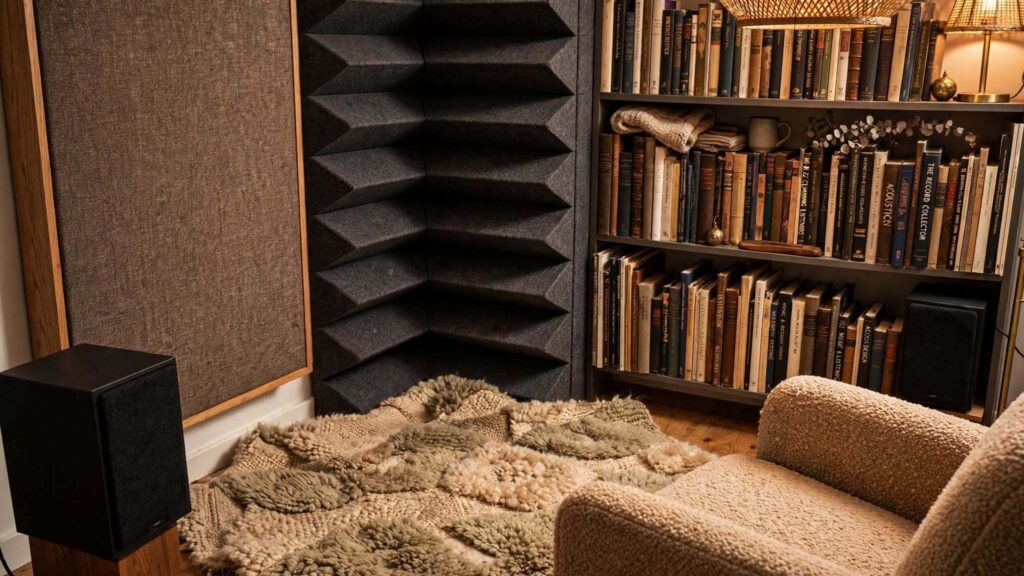
Then find the first reflections. These are the spots on the side walls and ceiling where sound from a speaker bounces once and arrives at your ears just behind the direct sound, which smudges the image. There’s a cheap way to find them. Sit in your chair while a friend slides a mirror along the side wall. Wherever you can see a speaker in the mirror, that’s a reflection point. A panel, a thick curtain, a hanging rug or a packed bookcase there makes a clear difference.
Bass is the next problem. Low notes pile up in corners, which is why a small room can sound boomy in one spot and thin in another. Floor-to-ceiling bass traps in a couple of corners are usually the most effective single treatment, and thin acoustic foam won’t do the same job, whatever the packaging says.
A good deal of the work can come from furniture. A rug between you and the speakers, full bookshelves on one wall (the uneven spines scatter sound nicely), a deep sofa and lined curtains all count. For the ceiling, our ceiling design guide covers timber slats, panels and fabric that soak up sound and still look good.
If neighbours are a worry, be realistic. Sound escapes through gaps around doors, vents and sockets, and a solid door with proper seals beats a handsome panel. Real soundproofing needs weight and airtightness, and decoration can’t stand in for either. Treat all the figures here as a starting point, and if the room matters to you, pay an acoustician to measure it.
Speaker and Turntable Placement
Placement costs nothing, and it’s where most people leave sound on the table.
Put the speakers and your seat at the corners of a rough equilateral triangle, so the gap between the speakers matches the distance from each one to your ears. Pull them away from the walls. Pushing a speaker into a corner boosts the bass, but the extra is muddy and can run to several decibels. A common starting point for the seat is about a third to 40 percent of the way into the room from the front wall, then adjust by ear. A hand’s width can change a lot.
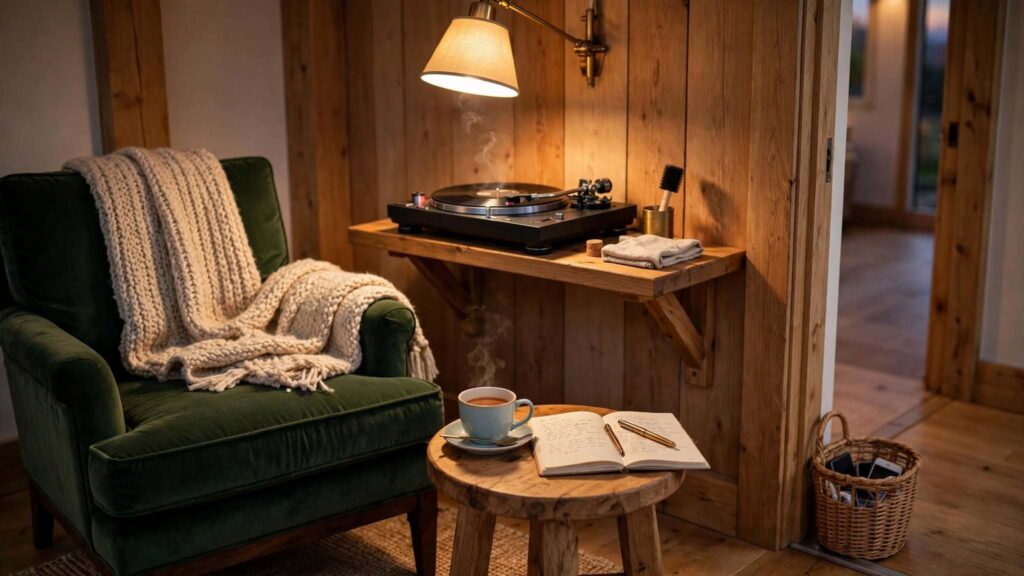
The turntable needs its own quiet spot. Use something solid and level, and don’t share a unit with the speakers, because bass vibration travels through furniture and back into the stylus as rumble or feedback. A shelf fixed to a masonry wall or a heavy, dedicated stand works well. Keep it out of dust and sun, and leave a surface nearby for the sleeve.
Store records upright, somewhere cool and dry, away from windows and radiators. Leaning stacks warp, and crammed shelves squeeze the sleeves.
Seating, Light and Materials That Make You Stay
You’ll decide whether you like the room in about ten minutes, and it mostly comes down to the chair, the light and what everything’s made of.
The chair first. A listening lounge lives or dies by it. Not a dining chair with a cushion, but a proper lounge chair or deep armchair, with a supportive back, somewhere to put your feet and a side table close enough to reach. If two people share the room, they each get a good seat, not one good seat and a stool.
Lighting second. Overhead lights flatten everything, so use lamps at different heights, put them on dimmers, and go warm in the evening, around 2200 to 2700K. For reading, add a directional lamp that’s a touch crisper, around 3000K, with good colour rendering so the page is sharp without glare. Candles are lovely and a bad idea near records, curtains and cables.
Materials last. Wool, timber, cork, linen, books and plaster soften sound and feel good to touch, while glass and hard glossy surfaces do the reverse. Deep matt colours like moss, clay or ink make a room feel enclosed, which suits a snug. If you can’t decide on a colour, our piece on choosing calming colours explains how to test a shade before you paint the whole room.
Keeping Your Listening Lounge Properly Screen-Free
This is the part that fails quietly. People build a beautiful room, walk in with their phone and by week two it’s an ordinary room again.
Habits help more than rules. Put a basket, drawer or shelf outside the door and make it the first thing you pass. Don’t put a television in there. Think twice about a smart speaker, and if you stream, use a dedicated player with a physical remote so the phone stays out. Keep an analogue clock and a notebook on the table, so there’s no reason to look anything up. If the Wi-Fi is strong in the room, nothing says it has to be.
Agree the rules with whoever lives with you. A room that works only when you’re alone isn’t really working. Say the rules out loud, keep them dull and consistent, and give children a basket of their own.
What a Listening Lounge Costs
I can’t give you one figure, because rooms, countries and equipment vary too much. I can give you the shape of it.
A starter listening lounge costs very little: a rug, a couple of lamps, a good chair, some shelving and a solid place for the deck. The middle tier adds proper treatment (bass traps, panels at the reflection points), a purpose-built record shelf, heavier curtains and a better door. The full build, with new walls, insulation, flooring and electrics, costs most, and most of that money disappears into things you won’t see.
Set aside 10 to 15 percent for surprises, especially in older houses where floors and walls turn out to be wonky. To see how finished rooms get specified, browse the project pages, and if you’re considering structural work, our guide to architectural designs and what they cost explains how a job moves from sketch to budget.
You can see plenty of finished interiors for ideas at https://archtra.com/our-portfolio/ before you decide anything.
Listening Lounge Mistakes Worth Dodging
Buying the kit before sorting the room is the classic. Close behind it: speakers pushed into corners, the turntable sharing a wobbly unit with the speakers, and thin foam used to fix a boomy room. Then flat, bright lighting that makes the place feel like an office, one uncomfortable chair, and no storage, so the records end up in piles on the floor.
The quiet one is making the room do too much. Once it has a desk, a laptop and a TV, it’s another living room, and you’re back to having nowhere to go.
If you’re planning from a distance, say for a house you haven’t moved into yet, our 3D visualization and walkthroughs let you test seating, speaker positions and sightlines before anyone touches a wall. The relocation guide is handy if the room is part of a bigger move.
When to Get a Professional
A snug, a reading corner or a basic vinyl setup is well within reach of a keen DIYer. Bring in a designer or acoustician if you’re building walls, insulating for neighbours, changing the floor, running new electrics or planning around a high-end system. Those are the jobs where a small error costs real money. You can contact the Archtra team, read about the studio, check the FAQ page or browse the blog. If you’re thinking about a café, bar or small venue built around listening, have a look at our hospitality architecture work.
Final Thoughts on the Listening Lounge
Room first, then sound, then chair, then gear. Give it one job. Mark the doorway, leave the phone outside, and make the seat so good that you’d rather be in it than anywhere else. A listening lounge doesn’t have to be big or expensive. It has to be quiet enough, warm enough and obviously yours.
Frequently Asked Questions About the Listening Lounge
1. What is a listening lounge?
It’s a dedicated room or corner for slow, screen-free activities, most often listening to records but also reading, writing or quiet games. It’s designed around sound, comfort and low light, and it leaves out televisions and work gear so the space has one calm purpose.
2. How big does a listening lounge need to be?
Smaller than you’d expect. A box room or a corner can work if the seat, speakers and record storage are planned together. Very small rooms need extra bass control, so put corner traps and careful speaker placement first. If you can only afford one thing, make it a great chair.
3. What acoustic treatment does a listening room really need?
Begin with the first reflection points on the side walls and ceiling, then add bass traps in the corners and soft furnishings like rugs and curtains. A reverberation time of roughly 0.3 to 0.5 seconds is the usual target for a home. An acoustician can measure your own room.
4. Can I turn a spare bedroom into a listening lounge?
Yes, and it’s one of the easiest conversions. Take out the bed, add a proper chair, treat the reflection points and corners, and put the turntable on a solid surface. Check the floor as well, because bouncy boards can make records skip.
5. Where should the turntable go?
On a solid, level surface that’s separate from the speakers, ideally a shelf fixed to masonry or a heavy stand. Bass vibration travels through furniture and back into the stylus, so don’t put both on one unit. Keep it away from sun, heat and dust.
6. How should I store vinyl records at home?
Upright, in a cool, dry place, away from sunlight and radiators. Don’t lean them in stacks or pack them so tightly that the sleeves are squeezed. Use proper inner sleeves, and make sure the shelves can carry the weight, because records are heavy.
7. What lighting works best for a listening or reading room?
Warm, dimmable, layered light. Around 2200 to 2700K suits the evening, with a directional reading lamp at about 3000K and good colour rendering for books. Avoid a single bright overhead light, and keep candles away from records, curtains and cables.
8. How much does a listening lounge cost?
It varies a lot. A starter version with a rug, lamps, a chair and a shelf costs little, adding acoustic treatment, a better door and custom shelving costs more, and a full build with insulation and new electrics costs most. Get local quotes and add 10 to 15 percent for surprises.
9. How do I keep a listening lounge screen-free?
Use habits: a phone drop outside the door, no TV, a dedicated player with a remote for streaming, and an analogue clock and notebook inside. Agree the rules with everyone in the house, and keep the room to one job so it doesn’t drift back into the living room.
10. Do I need a designer or an acoustician?
Not for a simple snug or reading corner. For soundproofing against neighbours, adding walls, changing floors, new wiring or a high-end system, a professional saves money by getting it right the first time. A designer plans the room, and an acoustician measures and tunes it.