Last Updated: August 2026
Quick Answer
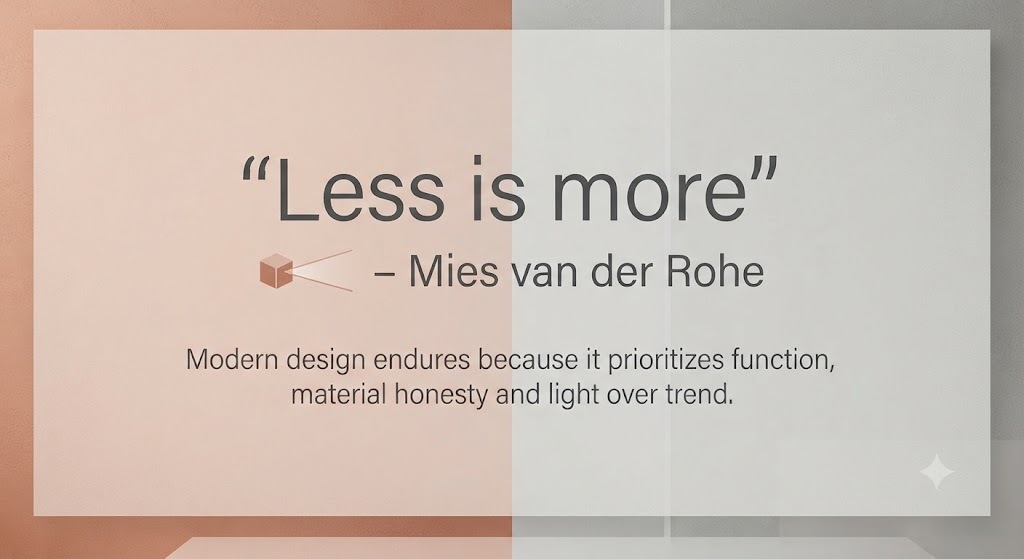
Modern house design centers on a handful of enduring principles — clean lines, open floor plans, abundant natural light, honest use of materials, and a rejection of unnecessary ornamentation in favor of genuine function. As German-American architect Ludwig Mies van der Rohe famously put it, “less is more” — a philosophy that still defines modern house design today, decades after he first articulated it. Done well, modern house design isn’t about following a trend; it’s about designing spaces where every element earns its place.
Why Modern House Design Keeps Getting Misunderstood
I’ve noticed a persistent confusion in client conversations: people often equate “modern house design” with a specific aesthetic — white walls, flat roofs, glass everywhere — rather than understanding it as a design philosophy. That distinction matters enormously. A home can borrow modern aesthetic cues without actually embodying modern design principles, and the result usually feels hollow rather than genuinely well-designed. I want to walk through what actually makes modern house design work, not just what it looks like.
The Core Principles of Modern House Design
1. Function Drives Form, Not the Other Way Around
American architect Louis Sullivan’s famous maxim, “form follows function,” remains one of the clearest summaries of modern design thinking. In practice, this means every element of a modern house design — a room’s shape, a window’s placement, a material’s use — should serve a genuine purpose rather than existing purely for decoration. This is the principle most often lost when people chase a modern “look” without understanding the reasoning behind it.
2. Open Floor Plans Over Compartmentalized Rooms
Modern house design consistently favors open, connected living spaces over the rigidly separated rooms of traditional architecture. Removing unnecessary walls between kitchen, dining, and living areas creates a sense of flow and volume that’s become one of the defining characteristics of contemporary residential design worldwide.
3. Honest, Restrained Material Use
Modern design tends to celebrate materials for what they actually are — exposed concrete, natural wood grain, raw steel — rather than disguising them behind decorative finishes. This “honesty” in materiality is a genuinely core principle, not just an aesthetic preference, and it’s part of why modern house design tends to age well rather than looking dated within a few years.
4. Natural Light as a Structural Priority
Large windows, strategic skylights, and glass walls aren’t just visual features in modern house design — they’re functional decisions that shape how a space feels and performs throughout the day. Copenhagen-based architect Jonas Bjerre-Poulsen, founder of Norm Architects, has described minimalism as fundamentally about finding the core of a space — stripping back to what actually matters, which in residential design consistently comes back to light, proportion, and material honesty rather than decorative additions.
5. Restraint as a Design Discipline, Not a Limitation
This is the principle most people misunderstand. Restraint in modern house design isn’t about having less for the sake of it — it’s a deliberate editing process where every element is evaluated for whether it genuinely contributes to the space. Done well, this restraint creates calm, clarity, and a sense of intentionality that’s hard to achieve through decoration alone.
How Modern House Design Has Evolved Recently
Modern house design in 2026 looks noticeably different from the stark, cool minimalism of a decade ago. The core principles remain, but the execution has warmed considerably — natural materials like wood and stone are being layered into minimalist frameworks more heavily, softening what used to be a colder aesthetic. Sustainability has also moved from an optional add-on to a genuine design priority, with passive orientation, energy-efficient glazing, and responsibly sourced materials increasingly treated as baseline expectations rather than premium upgrades. If you want to see how these updated principles play out in practice, our guide to house front elevation design breaks down current material and lighting trends in more depth.
Common Mistakes That Undermine Modern House Design
- Copying the aesthetic without the discipline. Flat roofs and large windows alone don’t make a home “modern” if the underlying planning doesn’t actually prioritize function and flow.
- Over-simplifying to the point of impracticality. Restraint shouldn’t come at the cost of genuine livability — a home that’s too sparse to actually live in comfortably has missed the point of the philosophy.
- Ignoring climate and context. Modern house design principles need to be adapted to local climate, orientation, and site conditions — a design that ignores this ends up performing poorly regardless of how it looks.
- Ornamentation disguised as “modern” detailing. Adding decorative elements purely for visual interest, without functional purpose, contradicts the core philosophy even if it photographs well.
Modern House Design for Different Project Types
The same underlying principles apply whether you’re planning a compact urban home or a larger residence, though the execution shifts:
- Compact and small-footprint homes lean heavily on open planning and vertical space to maximize how spacious a limited area feels, since restraint and efficiency naturally reinforce each other here.
- Larger residential and villa projects have more room to explore double-height spaces, expansive glazing, and a stronger connection to landscaping, while still holding to the same material honesty and functional-first thinking.
- Urban and multi-floor buildings apply modern principles at scale, using varied facade treatment and material honesty to avoid the flat, repetitive look that can come with larger structures.
Working With an Architect Who Understands the Philosophy, Not Just the Look
This is where I’d encourage some caution when hiring for a modern house design project. Plenty of designers can replicate the visual language of modern architecture without genuinely applying its underlying principles — the difference shows up in how the home actually performs and feels to live in, not just how it photographs. Our Interior Architecture and residential design process is built around exactly this distinction, starting with function and context before ever getting to material and finish decisions.
Final Thoughts
Modern house design endures, decades after its founding principles were first articulated, because it was never really about a specific look — it’s about a disciplined way of thinking through function, material, and light. Mies van der Rohe’s “less is more” and Sullivan’s “form follows function” remain genuinely useful design tests, not just historical quotes: if an element doesn’t serve a real purpose, modern design asks you to question whether it belongs at all.
If you’re planning a home and want a design grounded in these principles rather than just their surface aesthetic, our team can walk through your specific project starting from function and context, the way modern design philosophy actually intends.
Frequently Asked Questions
What are the key principles of modern house design? Function-driven form, open floor plans, honest use of materials, abundant natural light, and deliberate restraint are the core principles that define modern house design, more than any single visual style.
Is modern house design the same as minimalist design? They’re closely related but not identical. Minimalism is often considered a more extreme expression of modern design’s emphasis on restraint, while modern design more broadly focuses on function, materials, and light as its foundation.
Does modern house design work in any climate? The core principles can be adapted to any climate, but successful modern house design always accounts for local orientation, sunlight, and weather patterns rather than applying a fixed aesthetic regardless of context.
Why does modern house design tend to age well compared to other styles? Its focus on honest materials and functional decision-making, rather than decorative trends, means modern house design tends to avoid the dated look that heavily ornamented or trend-driven styles often develop over time.
Do I need an architect to achieve genuine modern house design, or can I just copy the aesthetic? Working with an experienced architect matters, since genuine modern house design is a disciplined process of prioritizing function and context, not just replicating a visual style — a home that only copies the look often falls short on comfort and performance.