If you’re planning a home, an office, or a full-scale commercial development in 2026, green building materials are no longer a “nice extra” — they’re the baseline clients, city planners, and lenders now expect. Whether you’re an architect specifying products for a client, a homeowner renovating on a budget, or a developer chasing LEED v5 points, choosing the right sustainable building materials directly affects your project’s carbon footprint, long-term running costs, and resale value. In this guide, we’ve pulled together the top 10 green building materials for 2026, backed by current market data, real-world use cases, and practical buying advice — the same way our design team at Archtra evaluates materials before recommending them to clients.
The construction and building sector is responsible for close to 37% of global carbon emissions, according to the United Nations Environment Programme — which is why green building materials have shifted from a “nice-to-have” into a genuine market driver. Analysts expect the global green building materials market to cross $700 billion by 2030, growing at roughly 12% a year. If you’re serious about sustainable architecture, this is the year to get your material choices right.
Table of Contents
- Why Green Building Materials Matter More in 2026
- Top 10 Sustainable Building Materials for 2026
- How to Choose the Right Eco-Friendly Building Materials
- Green Building Certifications to Know
- Cost vs. Long-Term ROI
- 2026 Sustainable Construction Trends
- Frequently Asked Questions
- About the Author & Company Details
Why Green Building Materials Matter More in 2026
Governments across North America, Europe, and Asia have tightened energy codes for 2026, and the U.S. Green Building Council’s launch of LEED v5 has pushed embodied carbon — the emissions locked into a material during manufacturing, transport, and installation — to the center of every serious design conversation. Embodied carbon can account for 20–50% of a high-performance building’s total lifetime emissions, which means the materials you specify at the drawing-board stage matter just as much as how efficiently the finished building runs.
That’s why sustainable building materials are increasingly judged on three things: their embodied carbon footprint, their durability (a material you never have to replace is inherently greener), and whether an Environmental Product Declaration (EPD) backs up the manufacturer’s claims. If you’re weighing eco-friendly construction materials for an upcoming project, our team can walk you through a full construction consultation to match materials to your climate, budget, and design goals.
Top 10 Sustainable Building Materials for 2026
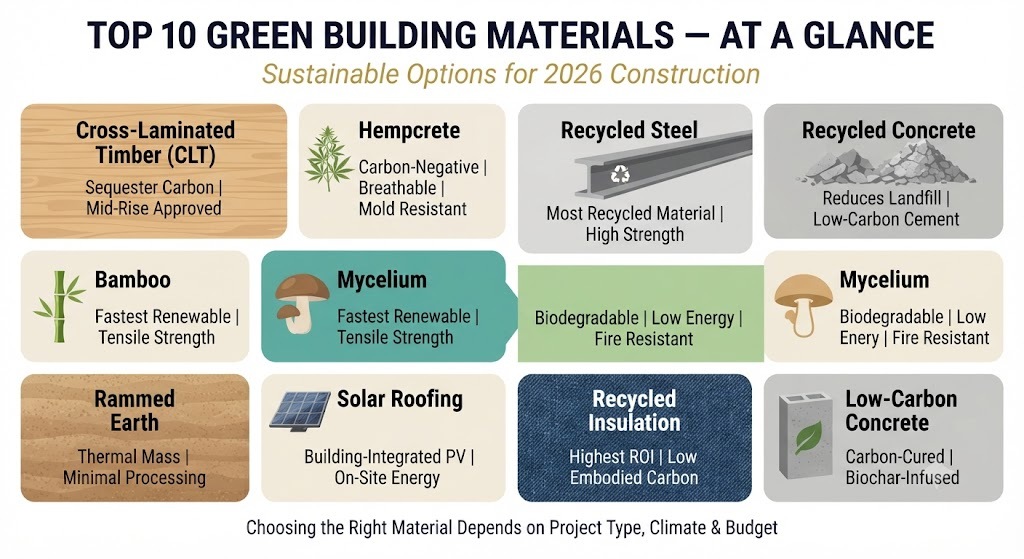
1. Cross-Laminated Timber (CLT)
Cross-laminated timber remains one of the most talked-about green building materials heading into 2026. Made by gluing layers of solid-sawn lumber at right angles, CLT sequesters carbon rather than releasing it, cuts construction time significantly compared to concrete or steel framing, and is now approved for mid-rise and even some high-rise structures in most major building codes. It’s an excellent long-term keyword pairing with “low-carbon building materials” because timber literally stores CO₂ for the life of the structure. CLT works particularly well in residential architecture projects where warmth of finish and speed of build both matter.
2. Hempcrete
Hempcrete — a mix of hemp hurds, lime, and water — is gaining serious traction as a bio-based, carbon-negative insulating material. It’s not structural on its own (it’s usually paired with a timber or steel frame), but its breathability, mold resistance, and excellent thermal mass make it a favorite for eco-conscious residential and boutique commercial builds. Demand for hempcrete is rising fastest in regions with strict indoor air quality requirements, since it naturally regulates humidity without off-gassing volatile organic compounds (VOCs).
3. Recycled Steel
Steel is already the most recycled material on the planet, and in 2026, recycled steel content requirements are becoming standard in commercial specifications. Choosing recycled steel over virgin steel can cut embodied energy dramatically while delivering the same structural strength, fire resistance, and long design life builders already trust. It’s a go-to option for commercial architecture projects that need both strength and a lower carbon footprint without changing structural engineering assumptions.
4. Recycled and Reclaimed Concrete
Recycled concrete — made by crushing and reprocessing demolished concrete into new aggregate — reduces landfill waste and cuts the need for freshly mined raw materials. Combined with low-carbon cement alternatives (like fly ash or slag-based blends), recycled concrete is becoming a default spec for foundations, pavements, and structural elements where traditional concrete would otherwise dominate. Builders working on renovation projects can read more about how we integrate reclaimed materials during renovation & remodeling work.
5. Bamboo
Bamboo continues to be one of the fastest-renewing, highest-strength-to-weight sustainable building materials available. Some species can be harvested in three to five years compared to decades for hardwood, and bamboo’s tensile strength rivals steel in specific structural applications. It’s increasingly specified for flooring, cladding, scaffolding, and even engineered structural bamboo panels in hospitality and residential design.
6. Mycelium-Based Materials
Mycelium — the root structure of fungi — can be grown into rigid, lightweight insulation panels, acoustic tiles, and even packaging in a matter of days. It’s fully biodegradable, requires very little energy to produce, and offers natural fire resistance. While still an emerging material for structural use, mycelium composites are already being used commercially for interior insulation and decorative panels, making them one of the most exciting long-term entries on any 2026 sustainable materials list.
7. Rammed Earth
Rammed earth construction — compacting natural subsoil into dense, load-bearing walls — is having a genuine resurgence, particularly in hot and arid climates where its thermal mass keeps interiors cool without heavy mechanical cooling loads. It uses minimal processed material, produces almost no manufacturing emissions, and gives buildings a distinctive, textured aesthetic that architects increasingly favor for sustainable residential and hospitality projects.
8. Solar (Photovoltaic) Roofing and Glazing
Building-integrated photovoltaics (BIPV) — where solar cells are built directly into roof tiles, shingles, or glazing — are one of the biggest crossover categories between green building materials and renewable energy systems. Instead of bolting panels onto a finished roof, BIPV products double as the building envelope itself, reducing both material use and installation cost while generating on-site renewable power, a key requirement for any net-zero target.
9. Recycled Insulation (Denim, Cellulose & Sheep’s Wool)
Insulation is projected to be the single largest application segment in the green building materials market in 2026, and for good reason: it’s one of the highest-ROI upgrades available. Recycled denim insulation, cellulose made from post-consumer paper, and sheep’s wool batts all outperform traditional fiberglass on embodied carbon while matching or beating it on thermal performance (R-value) and indoor air quality.
10. Low-Carbon and Carbon-Negative Concrete
Traditional Portland cement production is one of the largest single sources of industrial CO₂ emissions worldwide, which is why low-carbon and carbon-negative concrete alternatives — including biochar-infused mixes and carbon-cured concrete that permanently locks in captured CO₂ — are quickly becoming a mainstream specification in 2026 commercial and infrastructure projects. These products are engineered to match conventional concrete’s compressive strength while actively reducing a project’s total carbon ledger.
How to Choose the Right Eco-Friendly Building Materials
Not every sustainable material fits every project, and picking the wrong one can cost you more in the long run than it saves. Before finalizing a materials list, weigh these factors:
- Project type — structural, interior, or decorative applications each favor different green building materials.
- Climate and environmental exposure — humidity, temperature swings, and UV exposure all affect long-term durability.
- Cost vs. lifecycle value — the cheapest material upfront is rarely the most cost-effective material over a 20–30 year building life.
- Certification requirements — LEED v5, BREEAM, or WELL targets may dictate which materials qualify for points.
- Local sourcing — sourcing materials regionally cuts transportation emissions and often speeds up procurement.
If you’re unsure where to start, our architectural planning team can help translate sustainability goals into a practical materials schedule before you break ground.
Green Building Certifications to Know
Green building materials are only as credible as the certifications behind them. The three frameworks worth knowing in 2026:
- LEED (Leadership in Energy and Environmental Design) — now on version 5, with a much stronger emphasis on whole-life carbon accounting.
- BREEAM (Building Research Establishment Environmental Assessment Method) — widely used across the UK and Europe, scoring materials on sourcing, waste, and energy performance.
- WELL Building Standard — focused on occupant health, indoor air quality, and material toxicity.
Environmental Product Declarations (EPDs) are increasingly required as supporting documentation for all three, so ask suppliers for EPDs before specifying any “green” building material at scale. For projects that need to meet one of these frameworks from day one, our sustainable & green design service builds certification requirements directly into the concept stage.
Cost vs. Long-Term ROI
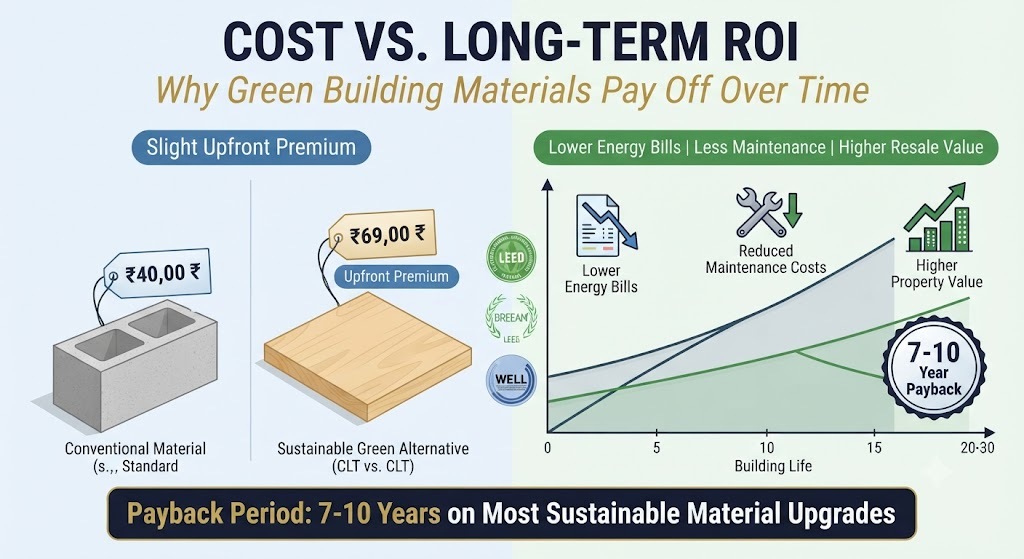
A common myth is that sustainable building materials always cost more. Some do carry a modest upfront premium — recycled steel and BIPV roofing, for example — but the lifecycle math usually favors green materials once you factor in:
- Lower energy bills from better insulation and thermal mass.
- Reduced maintenance and replacement costs from more durable materials.
- Faster lease-up or resale thanks to growing buyer and tenant demand for certified green buildings.
- Access to tax incentives and rebates tied to energy-efficient construction in many regions.
For most residential and commercial clients, the payback period on premium green building materials now falls well within a normal 7–10 year ownership or lease cycle.
2026 Sustainable Construction Trends Shaping Material Choices
A few forces are actively reshaping which green building materials get specified this year:
- Whole-life carbon accounting is replacing simple energy-efficiency checklists, forcing designers to look at a material’s full manufacturing-to-demolition footprint.
- Electrification of buildings is accelerating, which is pushing demand for materials compatible with heat pumps, induction systems, and all-electric mechanical design.
- AI-driven material optimization now lets architects and engineers model carbon impact and cost trade-offs across dozens of material combinations before a single order is placed.
- Climate-adaptive materials, including facades that respond to temperature and humidity, are moving from pilot projects into mainstream specification.
These trends are exactly why we run every new brief through a dedicated urban & site planning review — material choices work best when they’re tied to climate, orientation, and long-term site strategy from the start.
Frequently Asked Questions
1. What are green building materials? Green building materials are products manufactured, sourced, or processed in ways that reduce environmental impact — through lower embodied carbon, recycled content, renewability, or improved energy efficiency — compared to conventional construction materials.
2. What is the most sustainable building material in 2026? There’s no single “most sustainable” material; cross-laminated timber, hempcrete, and recycled steel are consistently ranked among the top green building materials for 2026 depending on the structural and climate requirements of the project.
3. Are green building materials more expensive than traditional materials? Some carry a modest upfront premium, but most sustainable building materials pay for themselves within 7–10 years through lower energy costs, reduced maintenance, and stronger resale value.
4. Do green building materials qualify for LEED points? Yes. Materials with a documented Environmental Product Declaration (EPD), recycled content, or regional sourcing can contribute directly to LEED v5, BREEAM, and WELL certification scoring.
5. What is embodied carbon and why does it matter for building materials? Embodied carbon is the total greenhouse gas emissions generated while manufacturing, transporting, and installing a material — before the building is even occupied. It can represent 20–50% of a building’s total lifetime carbon footprint.
6. Is bamboo really as strong as steel for construction? In specific tensile-strength applications, engineered bamboo can match or exceed steel’s strength-to-weight ratio, though it’s typically used for flooring, cladding, and select structural elements rather than as a full steel replacement.
7. Can I use green building materials in a renovation, not just new construction? Absolutely. Recycled insulation, reclaimed concrete, low-VOC finishes, and salvaged structural elements are commonly integrated into renovation and remodeling projects to lower a building’s overall carbon footprint.
8. What certifications should I look for when buying sustainable building materials? Look for an Environmental Product Declaration (EPD), third-party recycled-content verification, and alignment with LEED, BREEAM, or WELL criteria relevant to your project’s certification goals.
9. How do I choose between competing green building materials for my project? Base the decision on project type, local climate exposure, lifecycle cost, and certification requirements — not just the sticker price of the material.
10. Who can help me select and specify green building materials for my project? An experienced architecture and design studio can assess your site, climate, and budget, then recommend a materials package that balances sustainability, cost, and aesthetics — which is exactly the kind of consultation our team offers.
About the Author & Company Details
This guide was researched and written by the editorial and design team at Archtra, an architecture and interior design studio working across residential, commercial, hospitality, and institutional projects.
Company: Archtra Architecture & Interior Design Studio Registered Address: Old Kalsiya Road, Near Shesha Factory Wali Gali, Saharanpur, 247001, Uttar Pradesh, India Phone: +91 82794 62739 WhatsApp: +91 97613 00725 Website: https://archtra.com About Us: https://archtra.com/about/ Contact: https://archtra.com/contact/
Note: We’ve listed the publicly available business address and contact details from Archtra’s official website above. We don’t have access to Archtra’s formal company registration or CIN/business registrar number — if you’d like that included, please share it and I’ll add it to this section.
Ready to bring green building materials into your next project? Book a free consultation with Archtra’s architecture team, or explore our full sustainable & green design services to see how material choices, orientation, and energy strategy come together in one plan.