If you’re seriously considering moving to Charleston, you’re joining a long line of remote workers, young families, and retirees who’ve made the same decision over the past few years — and for good reason. Between the cobblestone streets, the marsh-front sunsets, and a job market that’s grown well beyond tourism, Charleston has become one of the most in-demand relocation destinations in the Southeast. But it’s also gotten more expensive and more competitive, which means moving to Charleston in 2026 takes a bit more planning than it did a decade ago.
This guide walks through everything you actually need to know before you book the moving truck: what things really cost, which neighborhoods fit which lifestyle, what the job market and climate look like, and a month-by-month timeline to keep the whole process from feeling overwhelming. And since a huge part of settling into a new city is turning a house into an actual home — especially in a place known for historic architecture and coastal design — we’ll also touch on what to expect if you plan to renovate or design your new Charleston property, an area our team at Archtra works in directly.
Table of Contents
- Why People Are Moving to Charleston
- Cost of Living: What to Expect
- Best Neighborhoods for Different Lifestyles
- Job Market and Local Economy
- Climate, Hurricane Season, and Flood Risk
- Schools and Education
- Renovating or Designing a Home After Moving to Charleston
- Your Charleston Moving Timeline
- Frequently Asked Questions
Why People Are Moving to Charleston
Charleston consistently lands on national “best places to live” lists, and it’s not hard to see why. It combines a walkable, historic downtown with beaches, a genuinely strong food scene, and a mild climate for most of the year. Add in a growing base of aerospace, healthcare, tech, and port-related employers, and it’s easy to understand why so many people are moving to Charleston instead of just visiting it.
That said, popularity has a cost — literally. Home prices and rents have climbed steadily, and anyone moving to Charleston today needs a realistic budget rather than assumptions based on what the city used to cost five or ten years ago.
Cost of Living: What to Expect
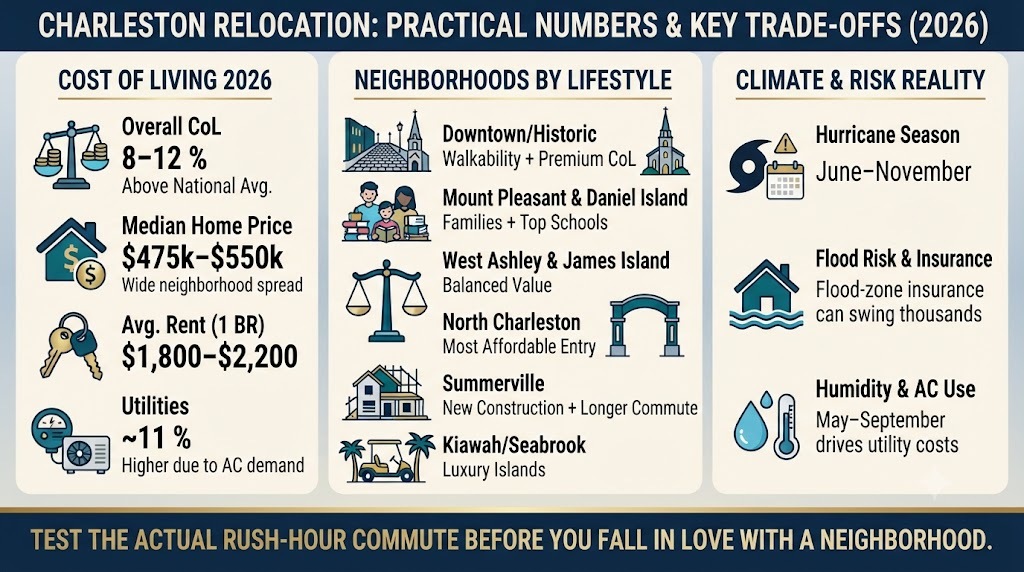
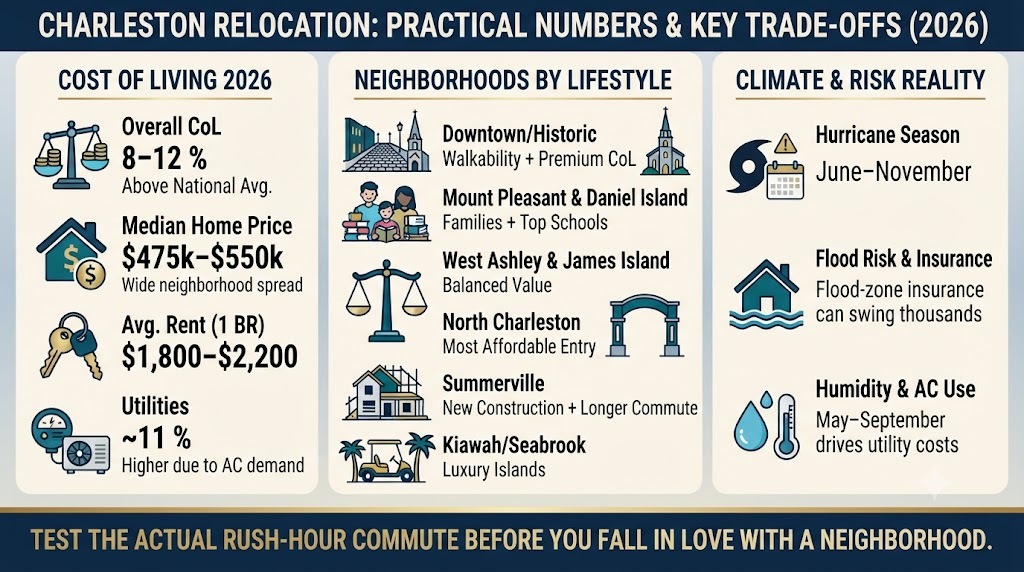
This is usually the first (and most important) question for anyone moving to Charleston. As of 2026, the overall cost of living in the Charleston metro runs roughly 8–12% above the national average, driven mostly by housing rather than everyday expenses like groceries or transportation, which stay closer to average.
Housing:
- Median home sale price across the Charleston metro currently sits somewhere in the $475,000–$550,000 range, though it varies enormously by neighborhood — a downtown historic property or an island home can run into the millions, while inland suburbs offer more accessible entry points.
- Average apartment rent across the metro typically falls between $1,800 and $2,200 a month, with North Charleston generally offering the most budget-friendly one-bedroom options and areas like James Island sitting in the middle of the range.
Utilities and everyday costs:
- Utilities run about 11% above the national average, largely due to air conditioning demand during Charleston’s long, humid summers.
- Groceries and transportation costs tend to stay close to the national average, which helps offset some of the housing premium.
Rent vs. buy: For most people moving to Charleston with plans to stay two or more years, buying tends to make more financial sense given how strongly the market has appreciated — though with mortgage rates still meaningfully higher than the 2020–2021 lows, it’s worth running the numbers carefully with a local lender before deciding.
If part of your move includes buying an older property that needs work, our interior design and renovation services are worth a look before you finalize a purchase — older Charleston homes often come with character but also with layout and structural quirks that are easier to plan for before closing than after.
Best Neighborhoods for Different Lifestyles
Not every neighborhood suits every reason for moving to Charleston, so it helps to think in terms of lifestyle first, budget second:
- Downtown/Historic Charleston — best for walkability, restaurants, and architecture lovers; expect a premium price tag and limited parking.
- Mount Pleasant — a top pick for families, with strong school zones and easy access to both downtown and the beach.
- Daniel Island — a master-planned, town-within-a-city feel, popular with families who want walkability plus amenities.
- West Ashley — more budget-friendly than downtown or Mount Pleasant while still staying close to the city center.
- James Island — a balanced option between downtown proximity and the beach, at moderate price points.
- North Charleston — generally the most affordable entry point into the metro, popular with first-time buyers and renters.
- Summerville — the fastest-growing city in the metro, offering new construction and more house for the money, with a longer commute into downtown.
- Kiawah and Seabrook Islands — luxury, low-density island living, with home prices reflecting the exclusivity.
A good rule of thumb for anyone moving to Charleston: take a scouting trip and test your actual commute at real rush-hour times (7:45 a.m. and again in the afternoon), since the Ravenel Bridge, I-526, and Highway 17 behave very differently depending on the hour. This single factor eliminates more neighborhoods, faster, than almost anything else.
Job Market and Local Economy
Charleston’s economy has diversified well beyond tourism and shipping, which is a big part of why so many working professionals are moving to Charleston rather than just retiring there. Major employment drivers include:
- Aerospace and manufacturing — Boeing’s South Carolina operations are one of the region’s largest employers.
- The Port of Charleston — one of the busiest container ports on the East Coast, supporting logistics, trade, and manufacturing jobs throughout the region.
- Healthcare — large hospital systems and a growing medical research presence.
- Technology — a steadily expanding tech and startup scene, helped along by a strong remote-work population relocating from the Northeast and Mid-Atlantic.
For context on affordability relative to income, most local relocation specialists suggest households aim for a combined income of $100,000 or more to live comfortably in Charleston without major lifestyle compromises, though this obviously varies based on housing choices and family size.
Climate, Hurricane Season, and Flood Risk
Charleston’s climate is a major draw — mild winters, long springs, and warm coastal breezes — but it comes with real trade-offs that anyone moving to Charleston should plan around:
- Hurricane season runs June through November, with peak activity typically in late summer and early fall. Flood insurance and evacuation planning aren’t optional extras here; they’re part of normal homeownership.
- Flood zones matter enormously. The difference between FEMA Zone AE and Zone X can swing your annual insurance cost by several thousand dollars, so it’s worth checking flood maps before falling in love with a specific property.
- Humidity is intense from roughly May through September, which is part of why utility costs run above the national average — air conditioning isn’t optional for most of the year.
If you’re planning renovations on a property in a flood-prone or historic zone, working with a design team that understands local building codes and climate-resilient materials — something we handle regularly through our architecture and design services — can save significant headaches later.
Schools and Education
Families moving to Charleston should know that public school quality varies significantly by exact address, not just by neighborhood or subdivision — two homes on the same street can sometimes feed into different schools. Mount Pleasant, Daniel Island, and parts of West Ashley consistently rank among the strongest areas for public school zones, while the metro also has a number of well-regarded private schools for families prioritizing that route. It’s worth verifying school assignments directly through the county school district’s official tools rather than relying on a real estate listing description, since zone lines shift and listings aren’t always current.
Renovating or Designing a Home After Moving to Charleston
One thing that catches a lot of newcomers off guard: Charleston’s older housing stock — especially downtown and on the surrounding islands — often needs updates that go beyond cosmetic paint and furniture. Historic preservation rules, flood-zone building requirements, and the region’s humidity all affect what materials and layouts actually work long-term.
If your move involves a fixer-upper, a historic property, or simply a home that needs its interior reimagined for how you actually live, this is exactly the kind of project our team supports from concept through completion. A few areas where professional input tends to pay off fastest for new Charleston homeowners:
- Climate-appropriate materials that hold up to humidity and salt air without warping or mildewing.
- Flood-resilient design choices for homes in or near flood zones, without sacrificing style.
- Space planning for historic layouts, which often have smaller, more compartmentalized rooms than modern floor plans.
You can browse examples of this kind of work in our project portfolio, see recent builds in our project gallery, or read more about our approach on our about page before reaching out.
Your Charleston Moving Timeline
A well-paced timeline is the difference between a smooth move and a stressful scramble. Here’s a realistic month-by-month plan for anyone moving to Charleston:
- 6–9 months out: Define your budget, target neighborhoods, and job or school constraints. Get pre-approved with a lender familiar with the South Carolina market.
- 3–6 months out: Take a two- to three-day scouting trip focused on evaluating neighborhoods, not individual houses.
- 3 months out: Collect moving quotes from at least three licensed movers — book early if you’re moving during peak summer months.
- 2 months out: Finalize housing, whether that’s signing a lease or going under contract on a purchase. Notify your current landlord or employer as needed.
- 1 month out: Confirm your mover, arrange utility transfers, start packing non-essentials, and file a change of address with USPS.
- Move week: Confirm any downtown parking permits needed for the moving truck, pack an essentials box, and back up important documents.
- First 45 days: Complete DMV registration, voter registration, and (if you purchased a home) any homestead exemption filings.
Frequently Asked Questions
1. Is moving to Charleston worth it in 2026? For most people, yes — Charleston continues to offer a strong combination of lifestyle, job growth, and long-term property value, even though the cost of living runs above the national average. The right fit really depends on your budget, commute tolerance, and whether the climate and hurricane season are dealbreakers for you.
2. How much money do I need to move to Charleston comfortably? Most relocation specialists suggest a household income of $100,000 or more for a comfortable lifestyle, though this varies widely based on whether you’re renting or buying, and which neighborhood you choose.
3. What is the best neighborhood for families moving to Charleston? Mount Pleasant, Daniel Island, and parts of West Ashley are consistently ranked as the top family-friendly areas, largely due to school zone quality and a strong balance of safety, amenities, and commute times.
4. Is it better to rent or buy when moving to Charleston? If you plan to stay two or more years, buying often makes more financial sense given how strongly Charleston real estate has appreciated — though current mortgage rates make it worth running the full numbers with a local lender before committing either way.
5. How bad is hurricane season for people moving to Charleston? Hurricane season runs June through November, with the highest activity typically in late summer. It’s a serious, real consideration — not just a formality — and includes checking flood zones, carrying appropriate insurance, and having an evacuation plan in place.
6. What is the job market like for someone moving to Charleston without a job lined up? Charleston’s economy has diversified significantly beyond tourism, with aerospace, healthcare, technology, and port-related logistics all providing steady employment. That said, securing a role — or confirming remote-work flexibility — before finalizing your move is still the safer approach.
7. How far in advance should I start planning a move to Charleston? Six to nine months is the ideal runway for most people moving to Charleston, giving enough time for a scouting trip, mortgage pre-approval, and a well-paced moving timeline rather than a last-minute scramble.
8. Are older Charleston homes a good idea for someone unfamiliar with historic properties? They can be a great choice, but they often require updates related to flood-zone compliance, humidity-resistant materials, and layout modernization. Working with a design and renovation team familiar with the local building environment — like our team at Archtra — helps avoid costly surprises after closing.
9. What’s the biggest budgeting mistake people make when moving to Charleston? Underestimating utility costs and flood insurance. Both can run meaningfully higher than in other parts of the country, and skipping this line-item research is one of the most common reasons newcomers feel financially blindsided in their first year.
10. Do I need a car after moving to Charleston, or is it walkable? Downtown Charleston and parts of Mount Pleasant are walkable enough that living without a car is possible for some residents, but most of the greater metro — including popular family neighborhoods like Mount Pleasant, Daniel Island, and Summerville — is much more car-dependent, especially for commuting or school drop-offs.
Final Thoughts
Moving to Charleston is a genuinely exciting decision, but it goes more smoothly when you plan around the details that don’t show up in a typical highlight reel — flood zones, school zone boundaries, real commute times, and a housing market that rewards buyers who move quickly and decisively. Give yourself a realistic timeline, budget for the true cost of living rather than outdated assumptions, and you’ll set yourself up for a genuinely smooth transition into Lowcountry life.
And once the moving boxes are unpacked, if your new Charleston home needs a design refresh, a renovation, or help adapting to the local climate and historic character, our team at Archtra is happy to help. Take a look at our portfolio for examples of past projects, or reach out to our design team to start planning your new space.