Feng shui interior design is one of those topics that gets thrown around constantly — a mirror here, a plant there — without most people ever learning the actual system behind it. That’s a shame, because once you understand the real principles, feng shui interior design stops feeling mystical and starts feeling like what it actually is: a centuries-old framework for arranging a home so that light, movement, and energy flow through it the way you’d want them to.
This guide goes deeper than the usual “10 feng shui tips” roundup. We’ll cover where feng shui actually comes from, the difference between the two major schools of practice (something most articles never mention), the five elements and how they interact with each other, how to apply the bagua map — including to oddly shaped rooms — a full room-by-room breakdown, the most common myths worth clearing up, and an honest, balanced look at what feng shui can and can’t do for your home. If you decide you’d like these principles woven into an actual renovation or new-build project, that’s exactly the kind of holistic space planning our team handles through our interior design services at Archtra.
Table of Contents
- What Is Feng Shui Interior Design?
- The Two Main Schools of Feng Shui
- The Five Elements and How They Interact
- The Bagua Map: How to Apply It to Any Home
- Core Principles of Feng Shui Interior Design
- Room-by-Room Feng Shui Guide
- Feng Shui for Apartments and Rental Homes
- Feng Shui and Modern Interior Design: Do They Mix?
- Common Feng Shui Myths, Corrected
- Does Feng Shui Actually Work? A Balanced Perspective
- Frequently Asked Questions
What Is Feng Shui Interior Design?
Feng shui — literally “wind” (feng) and “water” (shui) — is a Chinese philosophical practice that dates back more than 3,000 years, originally used to guide the siting and orientation of buildings, tombs, and eventually entire cities. Feng shui interior design is the modern, room-level application of that same tradition: arranging furniture, color, materials, and layout to support what practitioners describe as the smooth flow of “chi” (or “qi”) — a concept usually translated as life energy or vital force.
Historically, feng shui wasn’t a decorating trend at all — it was taken seriously enough to shape the layout of Beijing’s Forbidden City, where court astronomers and feng shui specialists worked alongside architects to determine building orientation. That history matters, because it explains why feng shui interior design isn’t just about placement of a few lucky objects — it’s a full system with its own internal logic, built around a handful of core tools: the five elements, the bagua map, and the concept of “commanding position.”
The Two Main Schools of Feng Shui
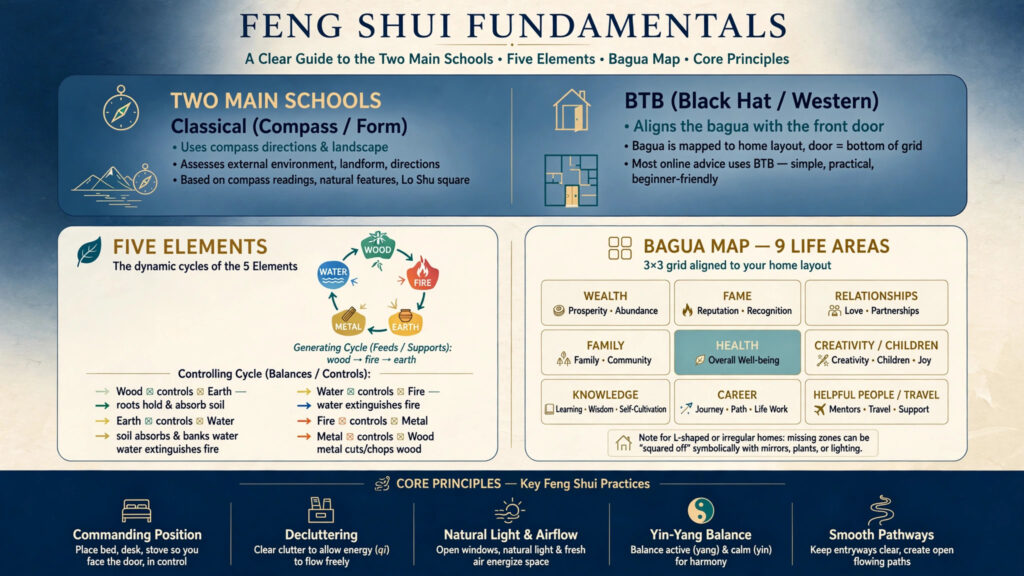
This is one of the biggest gaps in most feng shui interior design guides: there isn’t just one version of feng shui. Two distinct schools of practice exist, and knowing the difference will save you a lot of confusion when advice from different sources seems to contradict itself.
Classical (Compass/Form) Feng Shui
The older, traditional school uses a compass to determine the exact directional orientation of a home and aligns the bagua map according to compass direction and, in some approaches, the year a building was constructed. Classical feng shui also considers the surrounding landscape — hills, water features, and neighboring structures — as part of a site’s overall energy.
BTB (Black Hat/Western) Feng Shui
A more modern adaptation, popularized in the West, BTB feng shui simplifies the system by aligning the bagua map with the home’s front door rather than compass direction. This is the version most feng shui interior design content online actually teaches, largely because it’s easier to apply without specialized training.
Neither approach is universally “correct” — they’re different methodologies within the same broader tradition, and many modern practitioners blend elements of both. If you’re getting conflicting advice from two different sources, checking which school they’re using usually resolves the confusion.
The Five Elements and How They Interact
Every credible feng shui interior design guide mentions the five elements — wood, fire, earth, metal, and water — but most stop at a simple list without explaining how they actually interact, which is where the real design value lies.
- Wood — growth and vitality; represented by plants, wooden furniture, and green/brown tones.
- Fire — passion and transformation; represented by candles, warm lighting, and red/orange tones.
- Earth — stability and grounding; represented by ceramics, stone, and yellow/beige tones.
- Metal — clarity and precision; represented by metallic finishes, circular shapes, and white/gray tones.
- Water — flow and abundance; represented by mirrors, glass, and black/blue tones.
The generating cycle: wood feeds fire, fire creates earth (ash), earth produces metal, metal enriches water, and water nourishes wood — a continuous, supportive loop. Pairing elements in this sequence (like wood and fire tones together) tends to feel naturally harmonious.
The controlling cycle: wood parts earth, earth absorbs water, water extinguishes fire, fire melts metal, and metal cuts wood — a balancing, restraining relationship. Understanding this cycle helps explain why, for example, too much fire-element red in a room dominated by metal-element white can feel visually and energetically “off” rather than balanced, since fire overwhelms metal in the controlling cycle.
The Bagua Map: How to Apply It to Any Home
The bagua (“eight areas”) map is the central tool of feng shui interior design — a three-by-three grid overlaid on a home’s floor plan, with each of the nine zones corresponding to a different area of life: wealth, fame, relationships, family, health, creativity/children, knowledge, career, and helpful people/travel.
How to apply it, step by step:
- Draw or obtain an accurate, to-scale floor plan of your home or room.
- In BTB feng shui, align the bottom edge of the grid with the wall containing your main entrance.
- Divide the plan into nine equal zones, like a tic-tac-toe grid.
- Match each zone to its corresponding life area and note which rooms fall into which zones.
- Use color, element, and object placement within each zone to support or “activate” that area of life.
What most guides skip: irregular and L-shaped homes. Very few homes are perfectly square, and an L-shaped or irregular floor plan will often create a “missing” bagua area — a life zone that falls outside your home’s actual footprint. The most common fixes are to visually “square off” the floor plan on paper (treating the missing area as if it were there) and use landscaping, lighting, or a mirror near that corner to symbolically complete the shape, or to simply focus your feng shui interior design efforts on the zones that do exist within your home.
Core Principles of Feng Shui Interior Design
Beyond the elements and the bagua map, a handful of core principles show up across almost every reputable feng shui interior design resource:
- Commanding position. Your bed, desk, and stove — the three most important pieces in a feng shui home — should be positioned so you have a clear view of the door without being directly in line with it. This is considered the single most important placement rule in the entire practice.
- Decluttering. Clutter is treated as stagnant energy that blocks chi from circulating freely. This is also the one feng shui principle with the most obvious, universally agreed-upon practical benefit, regardless of belief in energy flow.
- Natural light and air flow. Maximizing daylight and fresh airflow is considered essential to supporting positive energy — and happens to align closely with well-documented practical wellbeing research around daylight exposure.
- Yin-yang balance. Every room should balance active (“yang”) elements like bright lighting and bold color with calm (“yin”) elements like soft textures and quiet corners, rather than leaning entirely toward one extreme.
- Smooth pathways. Chi is believed to move best through a home the way a gentle breeze moves through a space — furniture layouts that create narrow bottlenecks or force sharp, awkward turns are considered disruptive to that flow.
Room-by-Room Feng Shui Guide
Bedroom
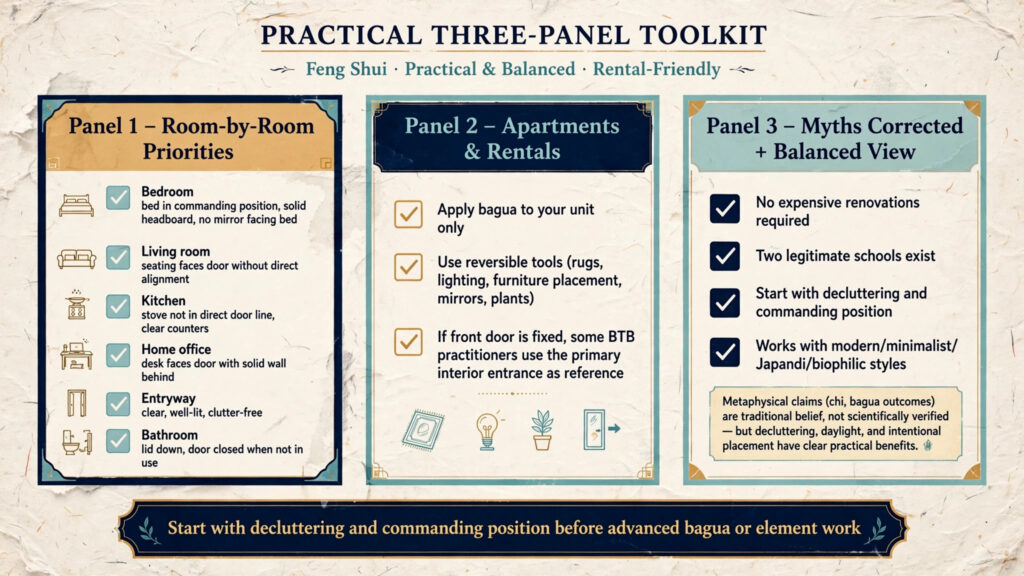
Position the bed in the commanding position, with a solid headboard against a wall (never directly under a window). Avoid placing the bed directly in line with the door, and keep electronics and mirrors facing the bed to a minimum, since mirrors reflecting a sleeping body are considered disruptive to restful energy.
Living Room
Arrange seating in the commanding position relative to the main entrance, ideally facing the door without being directly aligned with it. Use the bagua map to inform your dominant wall color based on which life zone the living room falls into.
Kitchen
Traditional feng shui interior design guidance places the stove away from a direct line with the door, since the stove is considered a key wealth and health symbol in the home. Keeping countertops clear and the space well-lit supports the same decluttering principle that applies throughout the home.
Home Office
Desk placement follows the same commanding-position rule as the bedroom and living room — facing the door, with a solid wall behind you, symbolizing support for career decisions. A clutter-free desk is considered essential to maintaining clear, focused energy for work.
Entryway
The entrance is considered the primary point where chi enters a home, so keeping it clear, well-lit, and free of clutter (including piles of shoes or mail) is treated as one of the highest-priority feng shui interior design fixes in the entire house.
Bathroom
Because water is associated with wealth flowing “away” if not managed carefully, traditional feng shui advises keeping the toilet lid closed and the bathroom door shut when not in use, to prevent that energy from escaping the rest of the home.
Feng Shui for Apartments and Rental Homes
Most feng shui interior design content assumes you’re working with a freestanding house you own outright — but apartment dwellers and renters make up a huge share of the people actually searching for this guidance, and the constraints are real: shared walls, fixed layouts, and limited ability to make structural changes.
A few adaptations that work well in apartments and rentals:
- Apply the bagua map to your unit’s specific floor plan rather than the whole building, since your unit is the space you actually control.
- Use furniture placement, rugs, and lighting — all fully reversible — to activate bagua zones instead of structural changes.
- If your front door isn’t adjustable (a common apartment constraint), some BTB practitioners recommend using your unit’s primary interior entrance as the reference point instead.
- Mirrors and plants are particularly useful renter-friendly tools since they require no permanent alteration to the space.
Feng Shui and Modern Interior Design: Do They Mix?
A common misconception is that feng shui interior design only works with traditional, ornate decor — in reality, its core principles (decluttering, natural light, balanced proportions, intentional furniture placement) align remarkably well with several contemporary interior design styles. Minimalist and Japandi styles in particular already emphasize clutter-free surfaces and natural materials, making them some of the easiest aesthetics to layer feng shui principles into without changing the overall look. If you’re still exploring which aesthetic fits your home before applying feng shui principles to it, our complete guide to interior design styles is a useful starting point.
Feng shui also pairs naturally with biophilic design, since both traditions place heavy emphasis on natural materials, plants, and a strong connection to daylight and the outdoors.
Common Feng Shui Myths, Corrected
A few misconceptions come up constantly in feng shui interior design conversations, and clearing them up tends to make the whole practice easier to actually use:
- Myth: Feng shui requires expensive renovations. In reality, most core principles — decluttering, furniture placement, color choices — cost nothing to implement.
- Myth: There’s only one “correct” bagua map. As covered above, Classical and BTB feng shui use genuinely different methodologies, and both have long-standing practitioners.
- Myth: You need to follow every rule perfectly or it “doesn’t work.” Most practitioners treat feng shui as a flexible framework to prioritize, not a rigid checklist — start with commanding position and decluttering before worrying about more advanced bagua activation.
- Myth: Feng shui is only relevant to Chinese or Asian design aesthetics. As shown above, its principles apply across virtually any interior design style, from Minimalist to Traditional.
Does Feng Shui Actually Work? A Balanced Perspective
It’s worth addressing directly: feng shui’s core concepts — chi, the bagua map’s influence on life outcomes, and the five elements’ metaphysical interactions — are part of a traditional belief system, not something that’s been independently verified by scientific research. Reasonable people hold very different views on this, from practitioners who take the metaphysical framework seriously to skeptics who view it purely as a decorating philosophy dressed in symbolic language.
That said, several individual feng shui interior design principles line up closely with well-supported practical research, independent of any belief in energy flow: decluttering is consistently linked to reduced stress, natural daylight exposure supports better mood and sleep, and thoughtful furniture placement genuinely does improve how a room functions day to day. Whether you approach feng shui as a spiritual practice or simply as a well-organized design framework, many of its recommendations hold up as sound, practical advice either way.
Frequently Asked Questions
1. What is the main goal of feng shui interior design? The core goal is to arrange a home’s layout, colors, and furniture so that energy (chi) flows smoothly through the space, which practitioners believe supports better health, relationships, and prosperity for the people living there.
2. What’s the difference between the bagua map and the five elements? The bagua map is a spatial tool — a nine-zone grid used to identify which area of your home corresponds to which area of life. The five elements (wood, fire, earth, metal, water) are the design language used within those zones, through color, material, and shape, to support or balance the energy of each area.
3. Do I need a compass to practice feng shui interior design? Only if you’re following Classical/Compass feng shui, which aligns the bagua map to true compass directions. BTB (Black Hat) feng shui, the more common Western adaptation, aligns the bagua map with your home’s front door instead and doesn’t require a compass.
4. Can feng shui interior design work in a small apartment? Yes — in fact, many core principles (decluttering, commanding position, clear entryways) are especially impactful in smaller spaces, where furniture placement and clutter have an outsized effect on how the whole space feels.
5. What should I do if my home has an irregular or L-shaped floor plan? This commonly creates a “missing” bagua area. The two most common solutions are to mentally square off the floor plan and treat the missing section as though it exists, or to use a mirror, plant, or exterior lighting near that corner to symbolically complete the shape.
6. Is it bad feng shui to have a mirror facing the bed? Yes, in most feng shui interior design traditions, mirrors directly facing the bed are considered disruptive to restful sleep energy and are generally advised against, along with placing the bed directly under a window without a solid headboard for support.
7. Which feng shui interior design principle should I start with if I’m a beginner? Decluttering and commanding position (positioning your bed, desk, and stove with a clear view of the door) are widely considered the two highest-impact starting points, since they require no purchases and form the foundation most other principles build on.
8. Can feng shui interior design be combined with modern or minimalist decorating styles? Absolutely — minimalist and Japandi interior design styles are particularly compatible with feng shui, since both prioritize clutter-free surfaces, natural materials, and intentional furniture placement.
9. Is there scientific evidence that feng shui works? The metaphysical elements of feng shui — chi, elemental energy interactions — haven’t been independently verified by scientific research and are best understood as part of a traditional belief system. That said, several individual practices it recommends, like decluttering and maximizing natural light, are supported by general wellbeing research independent of the broader belief system.
10. Do I need to hire a professional feng shui consultant, or can I DIY it? Most core principles — decluttering, commanding position, basic bagua mapping — are straightforward enough to apply yourself using a guide like this one. A professional consultant becomes more valuable for advanced applications, irregular floor plans, or when integrating feng shui principles into a larger renovation or new-build project.
Final Thoughts
Whether you approach feng shui interior design as a spiritual practice, a design philosophy, or simply a practical framework for decluttering and better furniture placement, its core principles have stayed relevant for thousands of years for a reason: they genuinely make homes feel calmer and more functional to live in. Start with the fundamentals — decluttering, commanding position, and natural light — before layering in the more advanced bagua and elemental work, and you’ll likely notice the difference in how your home feels well before you’ve mastered every rule.
If you’d like these principles built directly into a renovation or new home design from the ground up, our team at Archtra integrates thoughtful space planning into every project. Browse our project portfolio for examples of balanced, well-planned interiors, or reach out to our design team to start planning a space that feels as good as it looks.