Top architecture firms lists are usually the same names in a different order, copied from each other, with no explanation of what “top” means. Top by headcount? By revenue? By awards? By how good they’d be at designing your house? Those are four different questions, and the answers don’t overlap as much as you’d expect. This guide sorts firms into groups that actually mean something: the global giants, the design-led studios, leading practices in India, and boutique studios. It also explains what each ranking measures and how to choose a firm for your own project. Full disclosure: this is Archtra’s blog, and Archtra appears in the boutique group, labelled as such. It isn’t ranked against Gensler, and I’ll say plainly what it is and isn’t.
Who Decides the Top Architecture Firms, and What Are They Counting?
Three annual lists dominate, and they measure different things.
| Ranking | What it measures | Who it covers | Good for |
|---|---|---|---|
| World Architecture 100 (WA100), Building Design | Number of fee-earning architects | The world’s 100 largest practices | Seeing global scale |
| Top 300, Architectural Record | Architecture revenue | US firms | Seeing US market weight |
| Giants 400, Building Design+Construction | Revenue by building sector | US architecture and engineering firms | Seeing who leads in a sector, such as healthcare or government |
The 2026 WA100 was published in January. Its headline result: Gensler took the top spot as the world’s largest architect for the tenth year running, and the top 100 practices grew their architect headcount by 8.2 percent over the year. In BD+C’s 2026 list for nonresidential and multifamily building work, Jacobs, AECOM, Gensler, Kimley-Horn, Stantec, WSP, Fluor and Burns & McDonnell led. Notice the mix there: several are engineering-heavy firms with large architecture arms.
Awards tell a different story. Prizes such as the Pritzker, the RIBA Gold Medal or the AIA Gold Medal reward design reputation, and they often go to studios far smaller than the WA100 leaders. A commentator on the BD+C ranking put it well: revenue is a procurement signal, not a bragging right. It tells an owner how much design capacity a firm can field at once, not whether it will design a lovely house for you.
So “top” depends on your question. If you’re building an airport, you want scale. If you’re building a home, you probably want attention.
The Global Giants: Biggest by Size
These firms dominate the size rankings. They suit large, complex, multi-year projects with big budgets: campuses, hospitals, airports, headquarters and masterplans.
Gensler. The world’s largest architecture practice by fee-earning architects, with offices across the Americas, Europe, the Middle East and Asia, and a particular strength in workplace and interiors. Reported 2026 figures put its headcount at roughly 2,700 architects, and one industry roundup cites about $1.95 billion in architecture revenue for 2025, though I’d treat that number as indicative.
AECOM. A multidisciplinary design, engineering and consulting group that appears near the top of nearly every US ranking, especially for government and infrastructure-linked buildings.
HDR. A large US practice that appears in the top few by size in industry roundups, widely associated with healthcare, civic and science buildings.
Stantec. Based in Edmonton, Alberta, a very large design and engineering firm that shows up at or near the top of many BD+C sector lists, from industrial to government buildings.
Nikken Sekkei. Japan’s largest architecture and engineering practice and one of the largest in the world, known for large-scale buildings and urban projects across Asia.
Foster + Partners. London’s design heavyweight, and the one that moved most in the 2026 survey: it jumped ten places to become the 13th largest practice in the world, with headcount up more than 40 percent and turnover up 55 percent. It’s the clearest example of a studio that is both design-led and large, with work like Apple Park and 30 St Mary Axe.
If you want a house, a small office or a boutique hotel, these firms are usually the wrong fit. Their strength is scale, process and specialist teams, which come with higher fees, long timelines and, for small commissions, rarely the senior partner’s attention.
Design-Led Studios: Known for Ideas, Not Headcount
These practices matter because of the quality and influence of their design, not their size.
Zaha Hadid Architects (London). Known for fluid, parametric forms. The founder, Zaha Hadid, became the first woman to win the Pritzker Prize, in 2004.
BIG, Bjarke Ingels Group (Copenhagen and New York). Known for playful, large-scale ideas that mix housing, public space and sustainability.
Skidmore, Owings & Merrill (SOM). A US practice famous for skyscrapers and engineering-led design, with work including the Burj Khalifa and One World Trade Center.
Herzog & de Meuron (Basel). Pritzker winners in 2001, known for conceptual, material-led buildings such as Tate Modern in London.
These studios do take on a range of work, but they’re usually selected for a particular idea, and they carry the fees and waiting lists that come with reputation.
Leading Architecture Practices in India
India’s architecture scene is varied, from large corporate practices to small studios with international reputations. One list I read says candidly that its top ten “isn’t a ranking, just a collection of what I feel are the best”, and that honesty is worth keeping in mind with any India list. These are firms that appear repeatedly in credible roundups.
Hafeez Contractor (Mumbai, founded 1982). One of India’s best-known practices, associated with large residential towers, corporate buildings and campuses, including The Imperial in Mumbai and the Infosys Global Education Centre in Mysuru.
Sanjay Puri Architects (Mumbai, founded 1992). A practice of around 70 people, known for contemporary, climate-responsive and sculptural design, with projects in dozens of Indian cities and abroad. Different sources cite different award counts, though all agree on well over a hundred recognitions.
Morphogenesis (New Delhi, Mumbai, Bengaluru). An award-winning architecture and urban design firm with projects in eight countries, noted for sustainability and its early adoption of BIM.
Studio Lotus (New Delhi, founded 2002). A multidisciplinary practice founded by Ambrish Arora, Ankur Choksi and Sidhartha Talwar, known for hospitality, luxury residential and cultural projects.
RMA Architects (Mumbai). Led by Rahul Mehrotra, particularly known for urban design, cultural and institutional work and research.
Two names belong in any history of Indian architecture even though they’re not in these rankings. B.V. Doshi became India’s first Pritzker laureate in 2018, and Charles Correa popularised the phrase “form follows climate”, which anyone designing in a hot or monsoon country should keep in mind. Our modern house design guide explains how that idea shapes real plans.
Boutique Studios: Where Small Projects Often Get the Best Attention
Large rankings leave out the studios most homeowners actually hire. A boutique studio is typically 5 to 30 people, led by principals who stay on your project from first sketch to handover. The advantages are real: senior attention, flexibility, local knowledge and fees that suit a house or a small commercial fit-out. The limits are real too: less capacity for very large projects and smaller in-house specialist teams.
Archtra (Saharanpur, Uttar Pradesh, India)
Disclosure: Archtra publishes this blog. Everything below comes from the studio’s own website, so read it as self-description, not an independent ranking.
Archtra describes itself as an architecture and interior design studio creating residential, commercial and sustainable spaces. According to its website, it has 12+ years of experience, 48+ projects completed, work in eight cities and six design disciplines. Its listed services are architectural design, interior design, residential architecture, commercial architecture, renovation and restoration, 3D visualization, and planning and consultation. Selected work on the site includes a courtyard residence in New Delhi, a house in Dehradun, an office in Mumbai, an apartment interior in Chandigarh and a hillside retreat in Mussoorie.
Its working process follows four stages: Discover, Concept, Develop and Deliver, from understanding the site and brief through to documentation and construction support. It also offers 3D visualization and walkthroughs, which matters for clients who can’t visit a site often.
Best for: custom homes, apartment interiors, small and medium commercial fit-outs, hospitality interiors and renovations, particularly in North India, and clients who want a close working relationship with the designers. See the studio’s residential, interior, commercial and hospitality work, including interior architecture, commercial architecture and hospitality architecture.
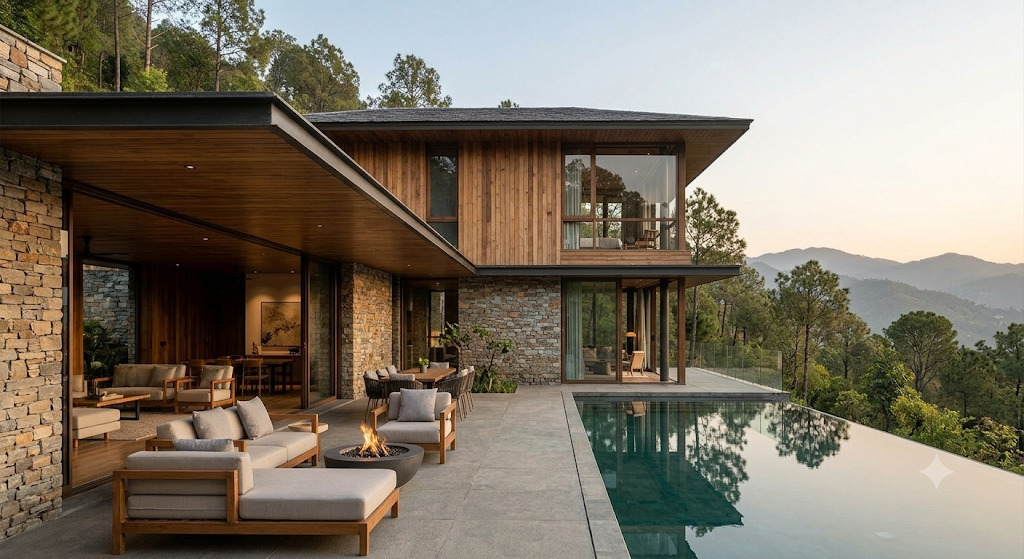
Not the right fit for: airports, 50-storey towers, hospitals or masterplans for thousands of homes. Those need the scale of the firms above.
What I can’t claim: awards, press coverage or a global ranking. The studio’s own site doesn’t list any, so I haven’t invented them. If you’d like to judge the work yourself, you can meet the team, read about the studio, browse the project pages, or start a conversation.
There’s a wider selection of finished work at https://archtra.com/our-portfolio/ if you’d like to see the quality before you decide.
Big Firm or Small Studio? A Plain Comparison
| Global giant | Design-led icon | Boutique studio | |
|---|---|---|---|
| Best project size | Very large, complex | Landmark or signature | Homes, interiors, small to mid commercial |
| Who designs your project | A team, often junior staff under a director | Principal sets the idea, teams execute | Principals closely involved |
| Fees | High | Very high | Moderate |
| Timeline | Long, process-heavy | Long, waiting lists | Often faster to start |
| Local knowledge | Broad but standardised | Limited | Strong, if local |
| Risk | Less personal attention | Cost and availability | Capacity limits, so check references |
How to Choose an Architecture Firm
Whichever group you pick from, the method is the same.
- Check they’re licensed. In India, architects must be registered with the Council of Architecture. In the UK, the title “architect” is protected and architects are registered with the Architects Registration Board. In the US, architects are licensed by state boards. Ask for the registration number and verify it.
- Look for finished work like yours. Judge on completed projects of similar size, budget and climate, not the best photograph.
- Visit one or two finished projects, or speak to past clients. Ask whether the project stayed on budget and how the architect handled problems.
- Ask who will actually work on your project. The person you meet in the pitch and the person who draws the plans aren’t always the same.
- Get the scope and fee in writing. Fees may be a percentage of construction cost, a fixed fee, an hourly rate or a rate per square foot, and what’s included varies a lot. Ask which stages are covered: concept, drawings, approvals, tender, site visits and supervision.
- Ask about site supervision. Many problems appear during construction, not on paper.
- Check the budget conversation. A good architect talks about cost early and doesn’t hide it.
- Ask how they work remotely, if you’re not local. Good studios use video reviews, 3D walkthroughs and regular drawings.
- Meet more than one firm. Three conversations will teach you more than any ranking.
- Trust the fit. You’ll work with this person for a year or more, so choose someone who listens.
For a sense of what a good brief and process look like, our guide to architectural designs and what they cost explains how a brief becomes a plan and a budget.
Red Flags and Green Flags
Green flags: clear written scope, a visible portfolio of finished work, willingness to discuss budget and mistakes, verifiable registration, references you can call and a described process.
Red flags: pressure to sign quickly, vague fees, no written contract, an unwillingness to show finished work or give references, promises of a ranking or award that can’t be verified, and a fee far below every other quote with no explanation.
Treat any “top architects” claim, including those in this article, with the same caution. Check the source, check what it measures and check whether the writer has an interest.
What Hiring an Architecture Firm Costs
Fees vary widely by country, project and firm, so I won’t quote one figure. What I can say is that large firms charge more and move more slowly, boutique studios usually charge less for small projects, and the cheapest quote often leaves out stages you’ll end up paying for later, such as detailed drawings, site visits or interior design. Ask each firm to quote against the same written scope. Add 10 to 15 percent for changes, and remember the architect’s fee is small compared with the cost of building the wrong thing.
Final Thoughts on Top Architecture Firms
“Top” depends on what you need. If you’re building something enormous, look at the giants and check sector rankings. If you want a landmark idea, look at the design-led studios. If you’re in India, the practices above are a good start, though no list is a ranking. And if you’re building a home, an interior or a small commercial space, a boutique studio with senior attention and relevant finished work may serve you better than any name on a size chart. Archtra is one such studio, and we’d like to earn that on its work, not on a list. Meet three firms, compare scopes in writing and choose the one that listens.
Frequently Asked Questions About Top Architecture Firms
1. Which is the largest architecture firm in the world?
Gensler, according to Building Design’s World Architecture 100. It took the top spot for the tenth year running in the 2026 survey, with roughly 2,700 fee-earning architects reported, and it operates dozens of offices across the Americas, Europe, the Middle East and Asia.
2. How are the top architecture firms ranked?
Different lists measure different things. The WA100 ranks by number of fee-earning architects, Architectural Record’s Top 300 ranks US firms by architecture revenue, and BD+C’s Giants 400 ranks by revenue within building sectors. Awards such as the Pritzker measure design reputation instead.
3. Does the biggest firm mean the best architects for my project?
Not necessarily. Large firms offer scale and specialist teams, which suit airports, hospitals and campuses. For a home or small commercial space, a smaller studio often gives more senior attention, better local knowledge and fees that suit the project.
4. Which are the top architecture firms in India?
Roundups commonly name Hafeez Contractor, Sanjay Puri Architects, Morphogenesis, Studio Lotus and RMA Architects, among others. India lists are usually subjective and not formal rankings, so judge firms on finished work similar to your project.
5. How do I know an architect is properly qualified?
In India, check registration with the Council of Architecture. In the UK, check the Architects Registration Board, and in the US, check your state licensing board. Ask for the registration number and verify it with the registering body.
6. How much do architects charge?
Fees may be a percentage of construction cost, a fixed fee, an hourly rate or a rate per square foot, and they vary widely by country and firm. Ask each firm to quote against the same written scope, and check which stages (concept, drawings, approvals, site supervision) are included.
7. Should I hire a large firm or a boutique studio for a house?
Usually a boutique studio, because the principals tend to stay involved and fees suit residential budgets. Large firms are built for big, complex projects. Whichever you choose, ask who will actually work on your drawings and check references from similar projects.
8. Can I work with an architecture firm remotely?
Yes. Good studios use video calls, detailed drawings and 3D walkthroughs so you can review a design from anywhere, and they coordinate local contractors and site visits. Ask how site supervision will work, since that’s the part that’s hardest to do remotely.
9. Is Archtra one of the top architecture firms?
Archtra is a boutique architecture and interior design studio based in Saharanpur, India. It’s listed in this article with a disclosure, because the studio publishes this blog. It isn’t ranked against the global giants and makes no claim to a ranking. The studio describes 12+ years of experience, 48+ projects and work in eight cities, and invites you to judge its portfolio directly.
10. What should I ask before hiring an architecture firm?
Ask who will work on your project, to see finished projects like yours, for references, how they handle budget and site supervision, what’s included in the fee, and how long each stage takes. Get everything in writing, and meet at least three firms before choosing.