By Team Archtra — Sustainable & Green Design — Last Updated: July 31, 2026
Quick Answer
The sustainable building materials worth genuinely prioritizing for a home in 2026 are fly ash or geopolymer concrete for structural work, recycled steel for framework, low-VOC paints and finishes for indoor air quality, and either cross-laminated timber, bamboo, or reclaimed wood for structure and flooring. Certified green homes (LEED, BREEAM, or an equivalent regional standard) typically cost 3–8% more upfront than conventional construction, but that premium is usually recovered within 5–8 years through lower utility bills, and certified homes are increasingly commanding a resale premium as buyers prioritize efficiency and healthier indoor environments. The right combination depends on your climate, local building codes, and how long you plan to own the home — not a single “best” material.
Why This Conversation Has Changed in the Last Few Years
In over a decade of practicing architecture, I’ve watched sustainable building materials go from a niche request a handful of clients asked about, to a question nearly every client raises in the first meeting. That shift isn’t just changing preferences — it’s backed by real market movement now, which is exactly why it’s worth understanding properly rather than treating it as a marketing checkbox.
The global green building materials market is projected to grow at a compound annual rate of roughly 11.6% through the mid-2030s, with commercial buildings alone accounting for around a third of that market. The U.S. currently leads global green construction adoption, driven by widespread LEED certification and strong ESG commitments from corporate developers, while the UK’s Net Zero 2050 strategy and Future Homes Standard are driving similar momentum through BREEAM certification. This scale matters practically: it means the supply chain, contractor familiarity, and material availability for sustainable options have matured considerably almost everywhere, not just in a handful of pioneering markets.
Understanding the Certifications First
Before choosing sustainable building materials, it helps to understand what you’re actually building toward, since certification requirements shape which material choices make sense — and the right certification depends heavily on where you’re building:
- LEED (Leadership in Energy and Environmental Design), run by the U.S. Green Building Council, is the most widely recognized certification globally, with LEED v5 — the newest version — launched in April 2026 with tightened requirements around embodied carbon and material transparency. Registration alone typically costs upward of $5,600 for non-members, before additional certification fees.
- BREEAM, the UK-based standard launched in 1990, remains the dominant certification across the UK and much of Europe, with hundreds of thousands of buildings certified globally to date.
- WELL Building Standard focuses specifically on occupant health and wellbeing — indoor air quality, lighting, and material toxicity — and is increasingly used alongside LEED or BREEAM rather than as a standalone replacement.
- Living Building Challenge is a more stringent, performance-based certification requiring buildings to demonstrate actual measured performance (net-positive energy and water, for instance) rather than just design intent.
- Regional systems — including IGBC and GRIHA in India, Green Mark in Singapore, and similar national programs elsewhere — apply comparable underlying principles adapted to local climate and construction practices, and are worth checking specifically if you’re building outside North America or Europe.
None of these certifications are mandatory for a private home, but understanding their criteria is useful even if you never pursue formal certification — they represent a well-vetted checklist of what genuinely moves the needle versus what’s just a sustainability buzzword.
10 Sustainable Building Materials Actually Worth Considering
1. Fly Ash and Geopolymer Concrete
Fly ash — a byproduct of coal combustion that would otherwise go to landfill — replaces a portion of cement in concrete mixes, reducing embodied carbon meaningfully. Geopolymer concrete takes this further, using industrial byproducts and alkaline activators instead of traditional Portland cement entirely, and is gaining real momentum in both developed and emerging construction markets as a lower-carbon structural option.
2. Cross-Laminated Timber (CLT)
Increasingly used as a genuine alternative to steel and concrete in mid-rise construction, CLT sequesters carbon rather than emitting it during manufacturing, and is a major driver of current U.S. and European green building materials growth, alongside other engineered timber products.
3. Recycled Steel
Steel can be recycled indefinitely without losing structural integrity, and recycled steel typically costs somewhat less than virgin steel while cutting embodied carbon substantially. For structural framework and reinforcement, this is one of the easiest sustainable swaps to make without any design compromise.
4. Hempcrete
A bio-based insulation and infill material made from the woody core of the hemp plant mixed with a lime binder, hempcrete offers strong thermal performance and, like CLT, sequesters carbon rather than emitting it — a trend specifically highlighted in recent U.S. green building materials market analysis.
5. Bamboo
As a rapidly renewable material — reaching harvestable maturity in a fraction of the time of hardwood — bamboo works well for flooring, screens, and select structural applications in the right climate. The caveat: always verify sustainable harvesting practices, since not all bamboo sourcing is equally responsible.
6. Rammed Earth and Compressed Stabilized Earth Blocks (CSEB)
A genuinely old technique seeing real revival in contemporary architecture worldwide, rammed earth uses on-site or locally sourced soil compacted into walls, offering excellent thermal mass with minimal transportation emissions. CSEB blocks offer a more standardized, construction-friendly version of the same underlying principle.
7. Low-VOC Paints and Finishes
Conventional paints off-gas volatile organic compounds for months after application, affecting indoor air quality — a core concern of the WELL Building Standard specifically. Low-VOC and zero-VOC alternatives are now widely available from mainstream manufacturers globally, and the switch requires no design changes, just a specification change.
8. Reclaimed and Certified Sustainable Wood
Reclaimed wood — from demolished structures, old furniture, or shipping materials — carries essentially zero new embodied carbon and often brings genuine character new wood can’t replicate. Where new wood is needed, certified sustainable sourcing (through FSC or equivalent regional certification) is worth specifying rather than assuming all timber is equal.
9. Solar Roof Tiles and Building-Integrated Photovoltaics (BIPV)
Rather than treating solar as a bolt-on addition after construction, integrating solar tiles or BIPV panels into the roof design from the outset improves both aesthetics and performance, and is increasingly specified in net-zero residential projects across multiple markets.
10. Cool Roofing and Reflective Materials
High-solar-reflectance roofing materials reduce heat absorption significantly compared to conventional dark roofing, directly cutting cooling loads — a genuinely high-impact, relatively low-cost intervention, especially valuable in hot and temperate climates alike.
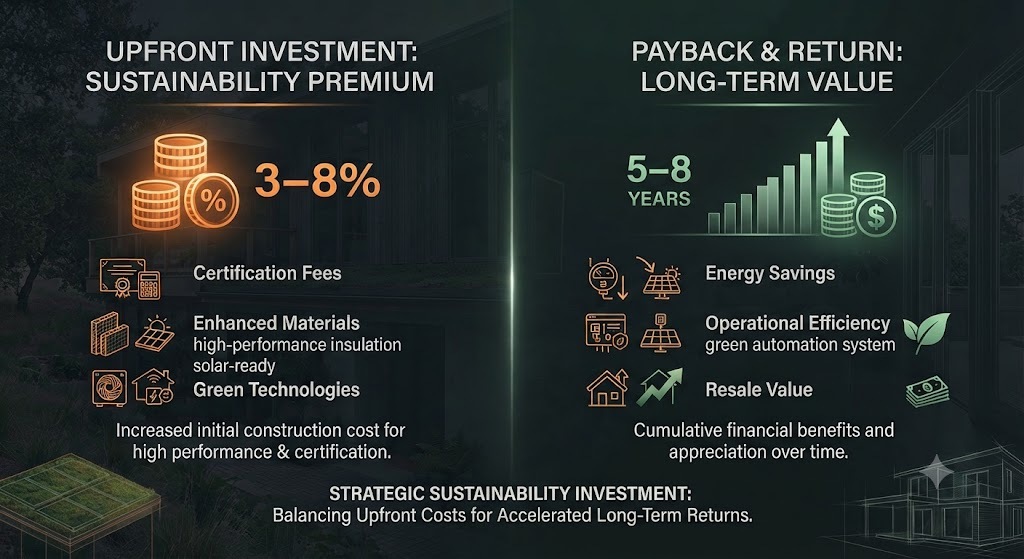
What Sustainable Building Materials Actually Cost — Real Numbers, Not Vague Claims
Cost is where a lot of sustainable-materials content gets vague, so here’s what current data actually shows:
- Certification premium: Certified green construction (LEED, BREEAM, or equivalent) typically costs 3–8% more upfront than conventional construction.
- Payback period: That premium is generally recovered within 3–5 years for commercial buildings and 5–8 years for residential projects, through lower utility bills alone.
- Market value: LEED- or BREEAM-certified buildings command higher rent, experience lower vacancy rates, and typically sell at a premium compared to uncertified comparables, as tenant and buyer demand for sustainable space continues rising.
- Embodied carbon now factors directly into procurement. Estimators increasingly calculate embodied carbon — the emissions tied to a material’s manufacturing, transport, and disposal — alongside upfront cost, which is reshaping how materials get specified even before construction begins. Note too that shifting mechanical and refrigerant standards (such as the move from R-410A to the more environmentally friendly R-454B) have pushed HVAC equipment costs up by roughly 10–20% recently, which is worth budgeting for separately from material costs.
If you’re weighing this against your overall construction budget, our Residential Architecture service page covers how layout and material choices interact with cost decisions for residential projects more broadly.
Common Mistakes and Greenwashing to Watch For When Choosing Sustainable Building Materials
A few patterns are worth knowing before you start specifying materials:
- Assuming “natural” automatically means “sustainable.” A material can be natural and still be poorly sourced, transported long distances, or harvested unsustainably — always verify the supply chain, not just the raw material.
- Chasing certification without understanding the underlying criteria. Comparative research on LEED, BREEAM, and other rating systems has found that the same building can score very differently depending on which framework assesses it, since points for lower-impact categories like bike racks can offset weaker performance in higher-impact areas like energy use. A plaque on the wall means little if the underlying choices weren’t genuinely load-bearing on energy, water, and material performance.
- Ignoring embodied energy in favor of operational energy alone. A material that saves electricity for 30 years but required enormous energy and emissions to manufacture and transport may not be the net win it appears to be on paper.
- Treating sustainability as a single material swap rather than an integrated system. The strongest results come from combining several sustainable choices together — structure, insulation, finishes, and systems — not swapping one material and calling the project “green.”
Expert Tips From Years of Specifying Sustainable Building Materials
- Start with your climate zone and local building code, not a generic materials list. What performs beautifully in a temperate climate can underperform badly in extreme heat, cold, or humidity — always match material choice to your specific regional conditions and code requirements.
- Prioritize the building envelope before chasing add-ons like solar. Better insulation, thermal mass, and reflective roofing reduce your baseline energy demand first — solar panels are far more cost-effective once that demand is already lowered.
- Get quotes from suppliers who can show certification documentation, not just verbal assurances. For recycled steel, bamboo, CLT, and reclaimed wood specifically, ask for the actual sourcing chain and chain-of-custody certification rather than taking sustainability claims at face value.
- Budget for the certification process itself if you’re pursuing LEED, BREEAM, or an equivalent. Registration fees alone can run into the thousands of dollars, and documentation, third-party verification, and consultant fees add real cost beyond the materials themselves — factor this in early rather than as an afterthought.
- Think in terms of the whole building system, the way we approach every project at Archtra. Our Residential Architecture and Commercial Architecture services both integrate sustainable material selection from the earliest design stage, not as a late addition — it genuinely produces better, more cost-effective outcomes than retrofitting sustainability onto a finished design.
Frequently Asked Questions
What are the most cost-effective sustainable building materials? Fly ash or geopolymer concrete, recycled steel, and low-VOC paints typically offer the best combination of lower or comparable upfront cost with genuine sustainability benefit, making these sustainable building materials the most practical starting point for most projects, regardless of location.
Is it more expensive to build a green certified home? Certified construction (LEED, BREEAM, or equivalent) typically costs 3–8% more upfront than conventional construction, but this premium is generally recovered within 5–8 years through lower utility bills, and certified buildings increasingly command higher resale or rental value as demand for sustainable space grows.
What’s the difference between LEED, BREEAM, and WELL? LEED and BREEAM assess overall building sustainability — energy, water, materials, and site — with LEED more dominant in North America and BREEAM in the UK and Europe. WELL specifically targets occupant health and wellbeing (air quality, light, material toxicity) and is often pursued alongside, rather than instead of, LEED or BREEAM.
Is bamboo actually a sustainable building material? Yes, when sustainably harvested — bamboo reaches maturity far faster than hardwood, making it genuinely renewable. The caveat is sourcing: always verify that the bamboo comes from a responsibly managed source rather than assuming all bamboo products are equally sustainable.
How do I avoid greenwashing when choosing building materials? Ask for actual certification documentation and sourcing chains rather than accepting general sustainability claims, and evaluate materials as part of an integrated system rather than judging a single swap in isolation — remember that different rating frameworks can score the same building quite differently.
Bringing Sustainable Building Materials Into Your Own Project
Choosing sustainable building materials well is ultimately a design decision, not just a procurement one — the biggest gains come from decisions made at the earliest design stage, when building orientation, envelope performance, and material selection can all work together rather than being retrofitted onto a finished plan. Seeing how these choices come together visually before construction begins is where a 3D architectural walkthrough genuinely earns its cost, since it lets you evaluate material and lighting decisions together before anything is built.
Explore our biophilic design in modern homes guide if natural materials and greenery are a priority for your project, or browse our portfolio to see sustainable material choices in projects we’ve delivered, including a net-zero residential complex built around many of the principles covered here.