Choosing among today’s most influential architectural styles is one of the first — and most permanent — decisions any homeowner makes, whether you’re building on a coastal lot in the Carolinas, renovating a mid-century apartment in Berlin, or planning a new build outside Sydney. Style isn’t just a look you pick off a mood board. It determines how a house handles light and climate, how much it costs to maintain over thirty years, and how it will read to buyers a decade from now. In this guide, we’re comparing three of the most searched architectural styles worldwide — Modern, Brutalist, and Art Deco — in plain language, with real examples from cities across the globe, so you can figure out which one actually fits how you live.
We work with clients making exactly this decision on projects large and small, and the same question comes up constantly: “which style will still feel right in twenty years?” Let’s break each one down.
Why Architectural Style Is a Global Conversation, Not a Local Trend
Every architectural style on this list started in one place and then traveled — reshaped by local climate, materials, and culture wherever it landed. Modern architecture took root in Germany and France before spreading to California and Scandinavia. Brutalism became a civic language from London to Brasília to Boston. Art Deco defined skylines from New York to Mumbai to Napier, New Zealand, all within the same decade. Understanding a style’s origin helps explain why it looks slightly different depending on where you encounter it — and helps you decide whether a version of it will actually suit your climate and lot. Our interior architecture team walks new clients through this exact comparison before a single sketch is drawn.
Modern Architecture: Clean Lines, Open Flow, Global Appeal
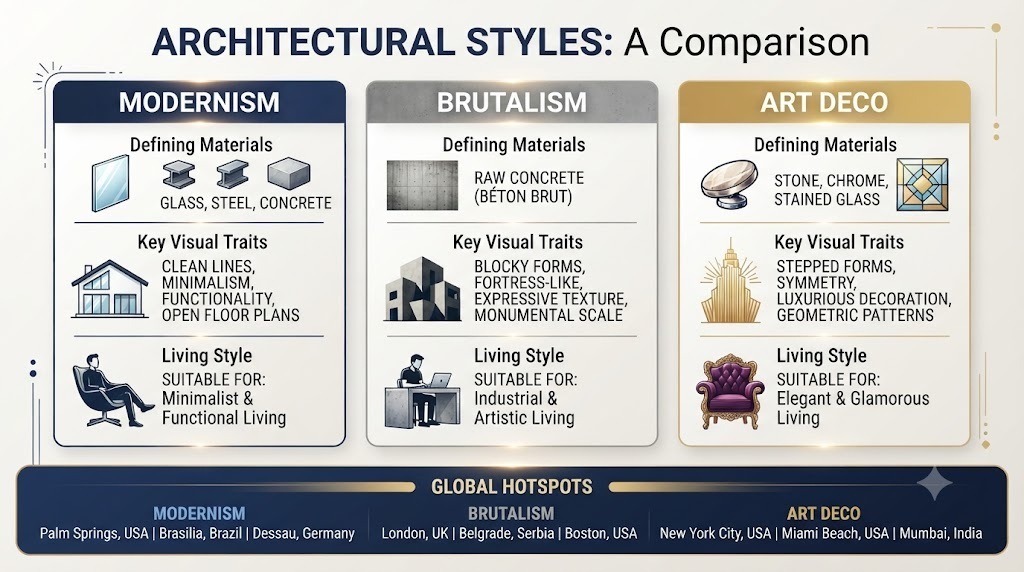
Modern architecture is likely the style you picture first, even without knowing its name: flat or low-pitched rooflines, expansive glass, minimal ornamentation, and open floor plans. It emerged in the early 20th century out of movements like the Bauhaus in Germany and the International Style, built on the idea that a home’s form should follow its function rather than inherited decoration.
What defines Modern architecture:
- Open-concept interiors with few load-bearing interior walls
- Large windows and glass walls that dissolve the boundary between indoor and outdoor space
- Neutral material palettes — glass, steel, concrete, and natural wood
- Flat or gently sloped rooflines instead of steep, traditional pitches
- A strong emphasis on natural light and passive energy efficiency
You’ll find Modern architecture’s fingerprints everywhere from California’s mid-century Case Study Houses to Scandinavian timber homes to contemporary builds across Asia and the Middle East, because the style adapts easily to different climates — deep overhangs for hot regions, larger glazing for northern light. It also tends to age well, since restraint doesn’t go out of fashion the way heavy ornamentation can. A number of the properties in our projects portfolio lean into this style for exactly that reason.
Brutalist Architecture: Raw, Sculptural, and Increasingly Sought-After
Brutalism has an image problem it doesn’t fully deserve. The name comes from the French “béton brut” — raw concrete — not from the English word “brutal,” though the style’s heavy, block-like forms invite the association anyway. It rose to prominence globally in the mid-20th century for civic, academic, and institutional buildings, prized for being affordable, durable, and structurally honest — nothing hidden behind a decorative facade.
What defines Brutalist architecture:
- Exposed, unfinished concrete as the dominant material
- Bold, geometric, often monolithic massing
- Small or deeply recessed windows
- A deliberate absence of applied ornamentation or color
- Repeating structural elements — columns, beams, modular forms
Iconic examples span continents: the Barbican Estate in London, Habitat 67 in Montreal, the National Theatre on the Thames, and countless university campuses from Boston to Brisbane. In residential design, the style has quietly resurged among architects who want a home that reads as sculpture rather than decoration. It’s not for every buyer — raw concrete is unforgiving and hard to soften later — but for the right owner, a Brutalist home feels like living inside a deliberate piece of architecture.
Art Deco: Glamour, Geometry, and Worldwide Reach
Art Deco is Brutalism’s opposite instinct — a style built entirely around decoration, symmetry, and glamour. It emerged in the 1920s and 1930s and became one of the most geographically widespread architectural movements in history, appearing almost simultaneously in cities that had little else in common.
What defines Art Deco architecture:
- Symmetrical, stepped or “ziggurat” building silhouettes
- Geometric motifs — chevrons, sunbursts, and zigzag patterns
- Rich materials: polished stone, chrome detailing, stained glass
- Bold color contrasts paired with metallic accents
- A strong vertical emphasis, even in low-rise residential buildings
You’ll find world-class Art Deco districts in New York (the Chrysler Building), Miami’s South Beach, Napier, New Zealand — rebuilt almost entirely in the style after a 1931 earthquake — and Mumbai, which holds one of the largest concentrations of Art Deco buildings anywhere on earth. The style’s global spread in such a short window makes it one of the few architectural movements that feels equally “local” in half a dozen countries at once.
Modern vs. Brutalist vs. Art Deco: A Quick Comparison
| Style | Defining Material | Best For | Global Hotspots |
|---|---|---|---|
| Modern | Glass, steel, concrete | Open, light-filled living | California, Scandinavia, Southeast Asia |
| Brutalist | Raw, exposed concrete | Statement, sculptural homes | UK, France, North America |
| Art Deco | Stone, chrome, stained glass | Formal, symmetrical spaces | New York, Miami, Mumbai, Napier |
If you’re weighing these for a renovation rather than new construction, our luxury villa design guide covers which structural features are realistic to retrofit versus which require starting from the foundation up.
How Climate and Location Should Shape Your Choice
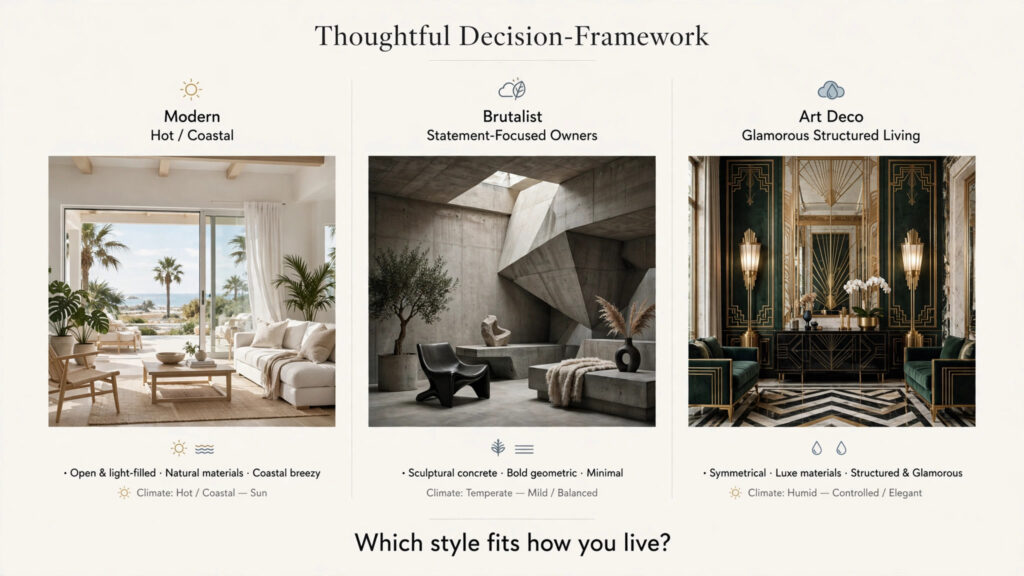
A style that works beautifully in one climate can perform poorly in another, which is why the same architectural style often looks different depending on where it’s built:
- Hot, coastal climates favor Modern architecture’s deep overhangs, cross-ventilation, and glass oriented to capture breezes rather than direct heat.
- Temperate, urban settings are historically where Brutalism thrives, since its thermal mass suits climates with fewer extreme swings.
- Humid, sun-heavy regions — think Miami or Mumbai — are exactly where Art Deco’s original architects solved for glare and heat using deep-set windows and reflective materials, a detail worth borrowing regardless of where you’re building today.
This is a conversation worth having early with your architect, and it’s one our commercial architecture clients raise just as often as residential buyers, particularly for hospitality projects designed to perform well for an international guest base.
Choosing the Right Architectural Style for How You Actually Live
Before committing to a style, ask yourself a few honest questions:
- Do you want a home that photographs beautifully and makes a strong first impression (Art Deco), or one that feels calm and functional day to day (Modern)?
- Are you comfortable with a bolder, more polarizing aesthetic that will always stand out (Brutalist)?
- How important is broad resale appeal versus personal expression?
- Does your climate and lot orientation naturally support the style you’re drawn to, or will it require extra engineering?
There’s no universally “correct” answer — the right architectural style is the one that matches how you plan to actually live in the home for the next decade, not just how it photographs in the first six months. If you’re relocating and weighing these choices against neighborhood character and zoning, our relocation guide covers how local rules can affect which styles are even permitted in certain districts.
Final Thoughts
Modern, Brutalist, and Art Deco architecture each tell a different global story — one built on restraint, one on raw honesty, one on glamour and geometry — and each has proven adaptable enough to take root on nearly every continent. The right choice comes down to climate, lifestyle, and how much visual boldness you actually want to live with every day. If you’re comparing architectural styles for an upcoming build or renovation, our team can help you weigh the trade-offs against your specific site and budget — reach out through our contact page to start that conversation, or browse more comparisons on our blog.
Frequently Asked Questions
1. What is the difference between Modern and Contemporary architecture? Modern architecture refers to a specific historical movement (roughly the 1900s–1970s) defined by minimalism and function-first design. Contemporary architecture simply means “current” and can borrow from many styles, including Modern, at once.
2. Is Brutalist architecture expensive to build? It can be, since raw concrete construction requires precise formwork and skilled labor. However, it often has lower long-term maintenance costs than styles that rely on painted or decorative facades.
3. Why is Art Deco architecture associated with the 1920s and 1930s? Art Deco emerged alongside the era’s fascination with speed, industry, and luxury, drawing inspiration from ocean liners, early skyscrapers, and geometric art movements popular at the time.
4. Which architectural style is most energy-efficient? Modern architecture generally performs best for passive energy efficiency, thanks to its emphasis on natural light, cross-ventilation, and adaptable overhangs, though any style can be engineered for efficiency with the right materials.
5. Are there famous examples of each style I can visit? Yes — the Barbican Estate (London) and Habitat 67 (Montreal) for Brutalism; the Chrysler Building (New York) and Napier’s rebuilt city center (New Zealand) for Art Deco; and the Case Study Houses (California) for Modern architecture.
6. Which architectural style ages best over time? Modern architecture tends to age the most gracefully due to its restrained, minimal design, while heavily trend-driven or ornamented styles can feel dated sooner.
7. Is Brutalist architecture making a comeback in residential design? Yes — it’s particularly popular among architects and buyers drawn to sculptural, low-maintenance exteriors, though it remains a niche preference compared to Modern styles.
8. Can Art Deco design work outside of a historic building? Absolutely. Many new builds borrow Art Deco detailing — geometric motifs, symmetry, and metallic accents — without replicating a full 1920s structure, often on interiors alone.
9. How do I know which architectural style will suit my climate? Look at how the style historically solved for heat, light, and ventilation in its region of origin — Modern architecture’s overhangs and cross-ventilation, for instance, translate well to hot climates, while Brutalism’s thermal mass suits more temperate zones.
10. Should I mix architectural styles in one home? It’s possible and increasingly common — many contemporary builds blend Modern’s open layouts with Art Deco detailing or Brutalist material honesty — but it works best when planned intentionally with an architect rather than added piecemeal.