Architectural audio is the quiet revolution happening inside high-end homes right now — sound systems so fully integrated into the walls, ceilings, and even the plaster finish that a room can fill with music without a single visible speaker in sight. If you’ve ever walked into a beautifully designed living room and wondered where the sound was actually coming from, you’ve experienced architectural audio done right. This guide breaks down how invisible sound systems actually work, where they make the most sense in a home, what they cost, and the mistakes we see homeowners make when they try to retrofit audio into a house that wasn’t planned for it. Whether you’re building new or renovating, this is the kind of decision that’s far easier — and far cheaper — to get right the first time.
We work with clients integrating architectural audio into everything from single-room media setups to whole-house systems, and the same question comes up in nearly every conversation: “can we really make this invisible, or is that just a marketing term?” The honest answer is yes, but only when it’s planned early and installed by people who understand both acoustics and construction. Let’s get into how it actually works.
What Architectural Audio Actually Means
Architectural audio refers to sound systems that are built into the physical structure of a home rather than added on top of it as furniture. Instead of freestanding speakers, cables, and a visible receiver stack, the entire system — speakers, wiring, amplifiers, and controls — is concealed within walls, ceilings, floors, and cabinetry, then finished flush with the surrounding surface. Done well, a room can deliver full, room-filling sound while looking, at a glance, like it has no audio equipment at all.
This isn’t the same thing as a basic in-ceiling speaker you’d buy off the shelf. True architectural audio is engineered around the room’s specific dimensions, materials, and acoustics, then coordinated with the interior architecture plan from the earliest design stage — which is exactly why it looks and sounds so different from a bolted-on retrofit.
How Invisible Sound Systems Actually Work
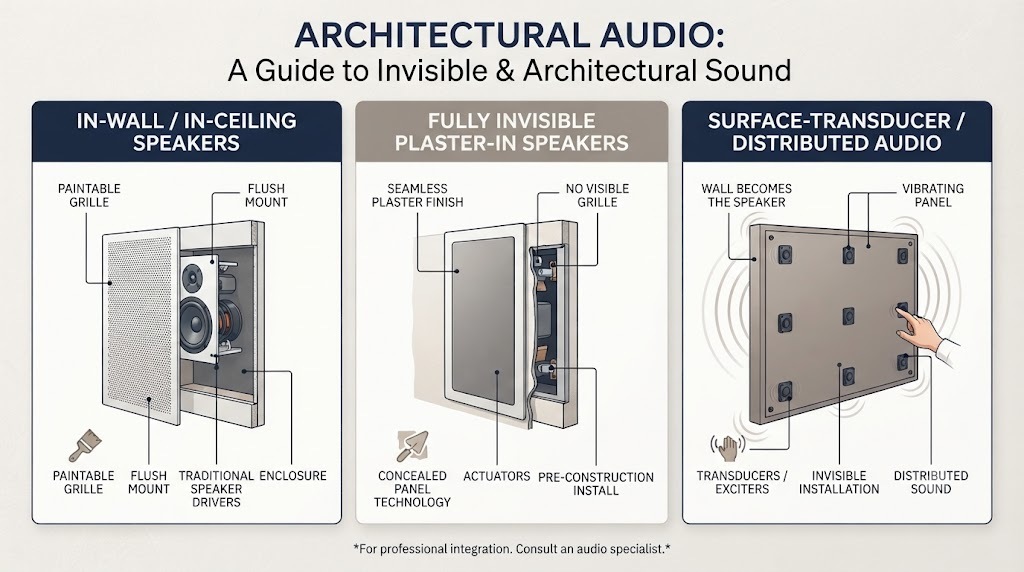
There are three main categories of hidden speaker technology used in modern architectural audio, and understanding the difference matters before you commit to any single approach.
1. In-wall and in-ceiling speakers These are the most common starting point — speakers recessed into a cavity in the wall or ceiling, covered with a paintable grille that blends into the surrounding surface. Quality varies enormously here; budget models sound thin, while high-end in-wall speakers rival freestanding units in output and clarity.
2. Invisible/plaster-in speakers This is where architectural audio gets genuinely impressive. These speakers are installed behind a thin layer of plaster, drywall compound, or specialty acoustic fabric, becoming completely invisible once finished and painted. There’s no grille at all — the entire wall or ceiling surface becomes the speaker face. It’s more expensive and requires precise installation before final finishing, but the payoff is a room with zero visible audio hardware.
3. Distributed and surface-transducer audio Rather than point-source speakers, this approach uses transducers attached to a surface — a wall panel, a piece of furniture, even a countertop — turning that surface itself into a diaphragm that produces sound. It’s less common in residential settings but increasingly used in commercial and hospitality spaces where a completely clean aesthetic is non-negotiable, something our commercial architecture clients ask about often for lobbies and dining areas.
Where Architectural Audio Makes the Most Sense
Not every room needs invisible sound, and part of doing this well is knowing where it earns its cost.
- Living and entertaining spaces — where a visible speaker stack would clash with a considered design, especially in open-concept homes where sightlines matter from every angle.
- Primary bedrooms — for ambient sound or a quiet late-night listening experience without a bulky soundbar.
- Kitchens — in-ceiling or plaster-in speakers let you keep countertops and cabinetry clean while still filling the space with sound.
- Bathrooms and wet areas — moisture-rated architectural speakers are now common enough to be a reasonable addition to primary suites.
- Outdoor living areas — landscape and eave-mounted speakers extend the same invisible-audio philosophy to patios and pool decks, a detail we cover in more depth in our luxury villa design guide.
Home theaters and dedicated media rooms are a partial exception — while architectural speakers are still used, a serious home theater usually still needs at least a subwoofer and possibly front-stage speakers positioned for precision, not full invisibility.
Planning Architectural Audio Into a New Build vs. Retrofitting an Existing Home
This is the single biggest factor in cost, quality, and how “invisible” the final result actually looks.
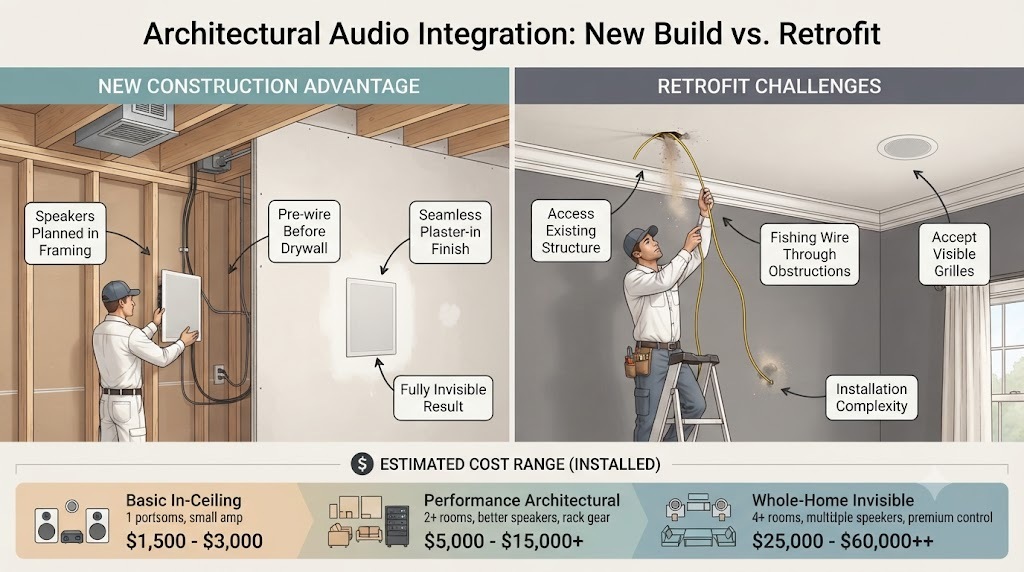
New construction or a full renovation gives you the biggest advantage: wiring, speaker placement, and wall cavities can all be planned around the audio system before drywall goes up. This is when plaster-in and fully invisible speakers make the most sense, since the finishing trades can work the speaker locations directly into the wall and ceiling plan alongside lighting and HVAC.
Retrofitting an existing home is absolutely possible, but it requires more creative problem-solving — running wire through existing wall cavities, using wireless or low-voltage solutions where fishing cable isn’t practical, and sometimes accepting a visible-but-minimal grille rather than a fully plaster-in finish. If you’re renovating an older home, it’s worth having this conversation with your design team at the same time you’re discussing structural or layout changes, which is a coordination point our artisan craftsmanship team handles regularly on custom projects.
What Architectural Audio Actually Costs
Pricing varies widely based on scope, but here’s a realistic range to set expectations:
| System Type | Typical Cost Range (per room) | Best For |
|---|---|---|
| Basic in-ceiling speakers | $800–$2,500 | Secondary rooms, budget-conscious upgrades |
| High-end in-wall/in-ceiling | $2,500–$6,000 | Living rooms, primary living spaces |
| Plaster-in / fully invisible | $6,000–$15,000+ | Formal spaces, statement rooms, new builds |
| Whole-home distributed audio | $15,000–$50,000+ | Full-property integration across multiple rooms |
These figures typically include speakers, wiring, amplification, and basic control integration, but not always the finishing labor (plastering, painting, cabinetry work) required to make the system truly invisible — a detail that catches a lot of homeowners off guard when comparing quotes.
Acoustics: The Part Most Homeowners Overlook
A speaker hidden inside a wall still has to fight the wall’s own acoustic properties, and this is where architectural audio separates from a simple product purchase. Drywall, plaster, insulation density, room dimensions, and even furniture placement all affect how sound actually travels once a speaker is sealed inside a surface. A poorly planned in-wall system can sound muffled or bass-heavy regardless of how good the underlying hardware is.
This is why architectural audio should be treated as part of the acoustic design of a room, not an accessory added after the fact. Coordinating speaker placement with ceiling height, window placement, and even furniture layout — the same considerations that shape any well-planned projects we take on — is what separates a genuinely invisible, great-sounding system from an expensive disappointment.
Common Mistakes When Adding Hidden Speakers to a Home
- Treating it as a last-minute add-on. Architectural audio planned after drywall is up almost always costs more and delivers a worse result than audio planned alongside the electrical and framing stage.
- Choosing speakers based on price alone. Budget in-wall speakers often sound noticeably worse than a quality bookshelf speaker at the same price point — you’re paying partly for invisibility, and that’s a legitimate trade-off, but it should be a conscious one.
- Ignoring room acoustics. A speaker that sounds great in a showroom can sound completely different once sealed behind plaster in a room with hard floors and high ceilings.
- Skipping proper wiring standards. Low-voltage wiring done incorrectly is one of the most common (and most expensive) things to have to fix after walls are closed up.
- Not planning for future upgrades. Conduit and accessible wiring pathways, even in a fully invisible system, make it far easier to upgrade components a decade from now without opening walls again.
Architectural Audio and Home Value
Beyond the day-to-day listening experience, professionally integrated architectural audio has become a genuine selling point in high-end residential markets, particularly for buyers relocating from urban markets where this kind of integration is already standard. It signals a level of overall build quality and design intent that resonates with the same buyer pool drawn to thoughtful neighborhoods and well-planned homes generally. If you’re weighing this investment against a broader renovation or relocation decision, our relocation guide covers how buyers in this market currently weigh integrated technology against other upgrades.
Final Thoughts
Architectural audio isn’t just about hiding speakers — it’s about designing a home where sound is treated with the same intentionality as lighting, materials, and layout. Done early and done well, invisible sound systems disappear into the architecture completely while still delivering genuinely excellent sound, and done poorly, they’re an expensive way to end up with muffled audio and a wall you can’t easily open back up. If you’re planning a new build or renovation and want architectural audio built into the process from day one, our team can walk you through what’s realistic for your space and budget — reach out through our contact page to start that conversation, or explore more design breakdowns on our blog, or see how it fits into our broader services.
Frequently Asked Questions
1. What is architectural audio, exactly? Architectural audio refers to sound systems built directly into a home’s walls, ceilings, or surfaces so that speakers and wiring are hidden rather than visible as standalone equipment.
2. Are invisible speakers as good as regular speakers? High-end in-wall and plaster-in speakers can sound excellent, but there’s typically a trade-off between full invisibility and absolute sound precision compared to a properly positioned freestanding speaker.
3. Can I add architectural audio to an existing home, or does it require new construction? It can be retrofitted into an existing home, though new construction or a full renovation makes fully invisible plaster-in systems far easier and more affordable to install.
4. How much does whole-home architectural audio cost? Whole-property systems typically range from $15,000 to $50,000 or more, depending on the number of rooms, speaker type, and level of finishing required to keep everything hidden.
5. Do invisible speakers work well in bathrooms or outdoor spaces? Yes, as long as moisture-rated or weatherproof architectural speakers are used, which are now widely available for primary suites, patios, and pool areas.
6. What’s the difference between in-wall speakers and plaster-in speakers? In-wall speakers sit behind a visible (though paintable) grille, while plaster-in speakers are covered with a thin layer of finish material, making them completely invisible once painted.
7. Does architectural audio affect home resale value? It can be a meaningful selling point in higher-end markets, particularly among buyers who associate integrated technology with overall build quality, though it’s rarely the sole driver of a sale.
8. Can hidden speakers be upgraded later without opening the walls? Sometimes — if conduit and accessible wiring pathways were planned during installation, upgrades are much easier. Without that planning, upgrades often do require opening the wall.
9. What room in the house benefits most from architectural audio? Living and entertaining spaces see the biggest design payoff, since they’re the rooms where a visible speaker stack is most likely to clash with the overall design intent.
10. Is architectural audio worth it for a home theater room? Partially — architectural speakers work well for surround and ambient channels, but most home theaters still benefit from at least one precisely positioned front speaker or subwoofer for accuracy.
11. How early should I plan architectural audio in a renovation? As early as possible — ideally at the same time as electrical and framing decisions, since wiring and speaker cavities are far cheaper to plan for than to retrofit after walls are closed.