Figuring out how to choose an architect is one of those decisions that quietly determines the outcome of an entire project, long before a single wall goes up. Most people searching this topic have already discovered the same frustrating pattern: dozens of articles telling you to “check their portfolio” and “trust your gut,” without ever explaining what you’re actually supposed to be evaluating, what fair fees look like, or which questions separate a genuinely good fit from a firm that’s simply good at marketing.
This guide is built to close that gap. We’ll cover the real difference between an architect, an interior designer, a draftsman, and a design-build firm, how licensing and credentials actually work across different countries, how architect fees are typically structured, the exact interview questions worth asking, the contract details most homeowners never think to check, and the red flags that predict a difficult project before it even starts. If you’re already leaning toward a design-build approach that handles both architecture and construction under one roof, that’s exactly the kind of integrated service our team offers through Archtra’s architecture and design services.
Table of Contents
- Why Your Choice of Architect Matters So Much
- Architect vs. Interior Designer vs. Draftsman vs. Design-Build Firm
- Step 1: Define Your Project Vision, Scope, and Budget
- Step 2: Verify Licensing and Credentials
- Step 3: Research and Build a Shortlist
- Step 4: Review Portfolios With a Critical Eye
- Step 5: Understand How Architect Fees Work
- Step 6: Interview Questions to Ask Every Architect
- Step 7: Visit Completed Projects in Person
- Step 8: Review the Proposal and Contract Carefully
- Red Flags to Watch For
- Common Mistakes When Choosing an Architect
- Frequently Asked Questions
Why Your Choice of Architect Matters So Much
An architect isn’t just someone who draws floor plans — on a well-run project, they act as your advocate throughout design, permitting, and construction, translating your goals into something buildable while protecting your interests when conflicts arise with contractors or budgets. Get this decision right, and the whole project moves with far less friction. Get it wrong, and even a generous budget can produce a home that never quite fits how you actually live. That’s the real reason learning how to choose an architect carefully, rather than picking based on price or the flashiest portfolio, matters so much.
Architect vs. Interior Designer vs. Draftsman vs. Design-Build Firm
This is one of the most common points of confusion, and almost no competing guide explains it clearly:
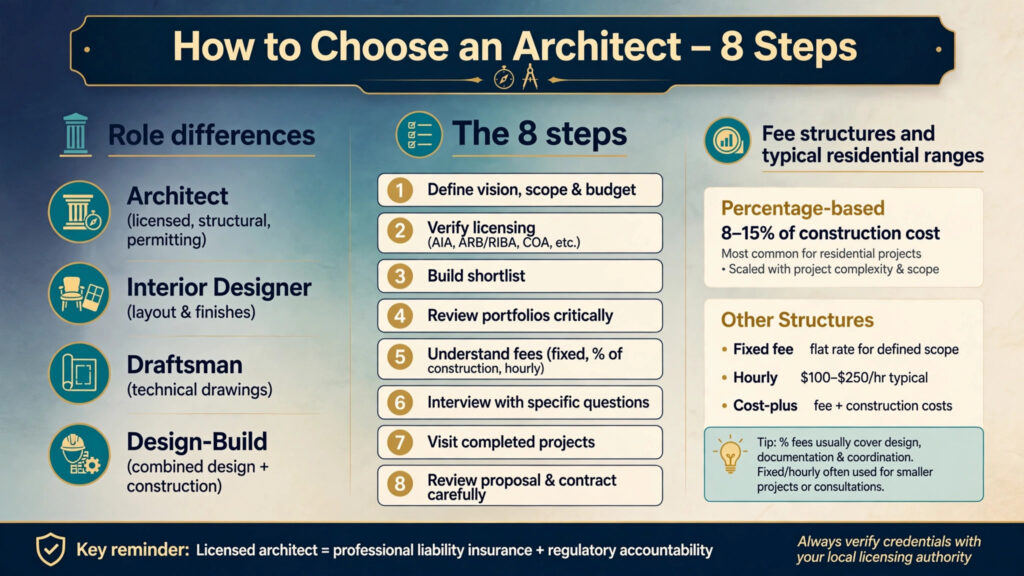
- Architect — licensed to design structurally sound buildings, navigate zoning and building codes, and (in most jurisdictions) legally stamp drawings for permitting. Best suited for new construction, additions, or projects involving structural changes.
- Interior designer — focuses on the function, layout, and finishes of interior spaces, generally without structural design authority. A strong fit for renovations that don’t involve moving load-bearing walls or changing a building’s footprint.
- Draftsman/drafter — produces technical drawings, often based on an architect’s or engineer’s design, but typically isn’t licensed to make independent design or structural decisions.
- Design-build firm — combines architectural design and construction management under a single contract and team, which can streamline communication and reduce the back-and-forth of coordinating separate firms.
Knowing which of these you actually need is the real first step in learning how to choose an architect — many people start the search too broadly and end up comparing professionals who aren’t even offering comparable services.
Step 1: Define Your Project Vision, Scope, and Budget
Before contacting a single firm, get clear on the basics: what type of project this is (new build, renovation, addition), your general style direction, your non-negotiables, and a realistic budget range. This single step is what most competing guides mention briefly and move past — but it’s what allows every later conversation with an architect to be specific and productive instead of vague. If you haven’t settled on a general layout or style direction yet, our guides to 3 bedroom house plans and interior design styles are useful starting points before you begin architect outreach.
Step 2: Verify Licensing and Credentials
This is a step almost every article treats as an afterthought — usually a single line about “checking credentials” — despite it being one of the most important parts of knowing how to choose an architect responsibly, especially for a global audience where licensing bodies differ by country:
- United States — look for AIA (American Institute of Architects) membership and state licensure, which confirms the individual has passed the Architect Registration Examination.
- United Kingdom — verify registration with the ARB (Architects Registration Board); RIBA (Royal Institute of British Architects) chartered membership is a strong additional signal of professional standing.
- India — confirm registration with the Council of Architecture (COA), which is legally required to practice and use the title “architect.”
- Australia — check registration with your relevant state or territory Architects Registration Board, coordinated nationally through the Architects Accreditation Council of Australia (AACA).
- Canada — verify membership with the relevant provincial architectural association (such as the OAA in Ontario or AIBC in British Columbia).
Regardless of country, a licensed architect carries professional liability insurance and is accountable to a regulatory body — protections an unlicensed designer or draftsman typically can’t offer. This single verification step is one of the fastest ways to filter your shortlist before investing time in consultations.
Step 3: Research and Build a Shortlist
With your project scope and licensing requirements clear, build a shortlist of three to five firms using a mix of sources:
- Personal referrals from friends, family, or colleagues who’ve completed similar projects.
- Professional directories maintained by licensing bodies (AIA, RIBA, COA, and similar organizations typically maintain searchable member directories).
- Local project visibility — architects whose completed work you’ve genuinely admired in your own area.
- Online portfolios and project galleries, used as a starting filter rather than a final decision-making tool.
Step 4: Review Portfolios With a Critical Eye
Most guides tell you to “look at the portfolio” without explaining what you’re actually evaluating. When reviewing an architect’s past work, look specifically for:
- Consistency of quality across projects, not just one standout image.
- Experience with your specific project type — a firm skilled at sleek modern renovations isn’t automatically the right fit for a historic restoration or a large new-build.
- Range within a recognizable point of view. The best architects show versatility while still demonstrating a clear, considered design sensibility rather than a scattershot mix of unrelated styles.
- Real completed projects, not just renderings. Renderings show intent; completed projects show execution.
You can see this kind of consistency across different project types and scales in our own project portfolio and project gallery.
Step 5: Understand How Architect Fees Work
Fee structures are one of the most misunderstood parts of learning how to choose an architect, largely because most guides mention the fee types without explaining the trade-offs of each:
- Fixed fee — a set total price for defined services, offering budget predictability but requiring a clearly defined scope upfront to avoid disputes over “extra” work later.
- Percentage of construction cost — typically ranging from roughly 8–15% of construction cost for residential projects, scaling naturally with project size and complexity, though it can create less budget certainty if construction costs shift during the project.
- Hourly rate — most common for smaller-scope work like consultations, feasibility studies, or limited advisory services, where the total time investment is harder to predict upfront.
A low-commitment starting point worth asking about: many architects offer a feasibility study or concept design package before a full commitment, which clarifies site potential, ballpark costs, and general design direction — a useful way to test the working relationship before signing on for the full project.
Step 6: Interview Questions to Ask Every Architect
This is where most competing content stays frustratingly vague. Here are specific questions worth asking in every consultation:
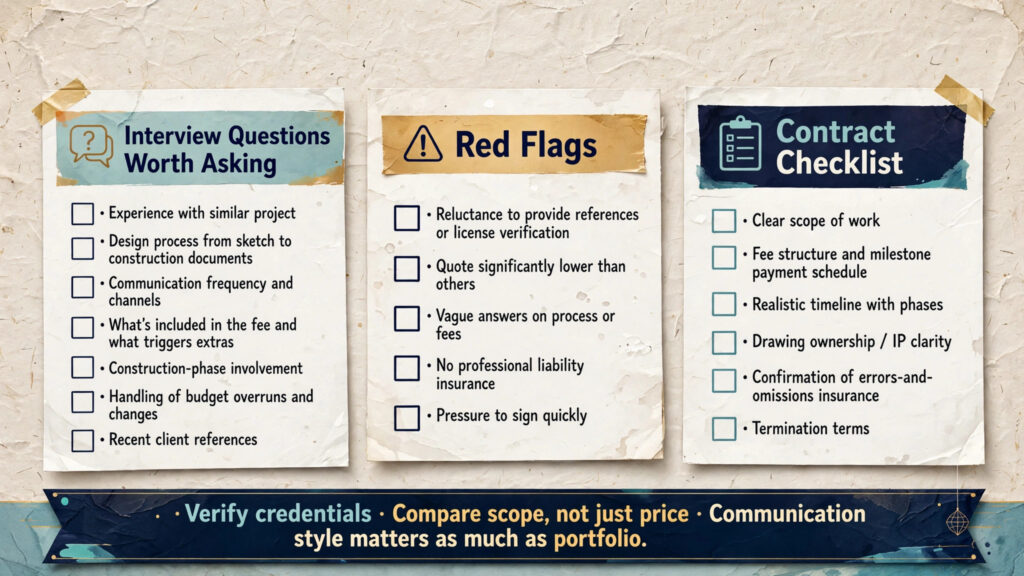
- “Have you completed projects similar in scope and style to mine?” — ask to see two or three directly comparable examples, not just their overall portfolio.
- “What does your design process look like from first sketch to construction documents?” — a clear, structured answer is a good sign; vague answers often predict a disorganized project.
- “How do you handle communication during the project — how often, and through what channels?” — mismatched communication expectations are one of the most common sources of client frustration.
- “What’s included in your fee, and what would trigger additional charges?” — get this in writing, not just verbally confirmed.
- “Will you be involved during construction, and to what extent?” — some architects provide full construction administration; others hand off drawings and step back.
- “How do you handle budget overruns or design changes mid-project?” — their answer reveals how they’ll actually behave when something inevitably shifts.
- “Can I speak with a recent client as a reference?” — a confident, established firm should have no hesitation connecting you with past clients.
Step 7: Visit Completed Projects in Person
Photos flatten a lot of important detail — material quality, spatial proportion, light, and finish-level craftsmanship are all much easier to judge standing inside a completed space than scrolling through a portfolio online. If a firm can arrange a visit to a completed or in-progress project (with the current owner’s permission), it’s one of the most valuable steps in the entire process of learning how to choose an architect, and it also gives you a chance to informally ask the homeowner about their experience working with the firm.
Step 8: Review the Proposal and Contract Carefully
Once you’ve narrowed your shortlist, request detailed written proposals and compare them on:
- Scope of work — does it clearly cover design through permitting, and does it specify whether construction administration is included?
- Fee structure and payment schedule — tied to specific project milestones, not vague timeframes.
- Timeline — a realistic schedule with clear phases, not just an overall estimate.
- Intellectual property and drawing ownership — clarify who retains rights to the design drawings, especially if you might switch builders mid-project.
- Professional liability insurance — confirm the architect carries adequate coverage, which is one of the practical protections licensure is meant to guarantee.
- Termination terms — understand what happens, and what you’d owe, if either party needs to exit the agreement early.
Red Flags to Watch For
A few warning signs worth taking seriously when evaluating how to choose an architect for your project:
- Reluctance to provide references or licensing verification.
- A quote significantly lower than every other firm you’ve spoken with, which often signals scope gaps that surface later as costly change orders.
- Vague answers about process, communication, or fee structure.
- No errors and omissions (professional liability) insurance.
- Pressure to sign quickly, rather than giving you time to compare proposals and think it through.
Common Mistakes When Choosing an Architect
After reviewing the guides currently ranking for how to choose an architect, a few recurring mistakes stand out that deserve more direct attention:
- Choosing based on price alone, without weighing experience, communication style, or design fit.
- Skipping the credential verification step, assuming anyone calling themselves a designer or architect is equally qualified and insured.
- Not clarifying construction-phase involvement upfront, then being surprised when the architect isn’t available during a critical building decision.
- Signing a proposal without a clearly defined scope, leading to disputes later over what counts as included work versus a billable extra.
- Ignoring communication style during the interview process, even when the portfolio is strong — a mismatch here tends to cause more day-to-day friction than any single design decision.
Frequently Asked Questions
1. How do I know if I need an architect versus an interior designer? If your project involves new construction, structural changes, an addition, or anything requiring permitted structural drawings, you need a licensed architect. If it’s purely about layout, finishes, and furnishings within an existing structure, an interior designer is often sufficient and more cost-effective.
2. What’s a typical architect fee for a residential project? Fees commonly range from roughly 8–15% of construction cost for percentage-based arrangements, though fixed-fee and hourly structures are also common, particularly for smaller-scope work like feasibility studies or design consultations. Rates vary by region and project complexity.
3. How important is it to hire a local architect? Very — a local architect typically has established relationships with permitting offices, familiarity with regional building codes and climate considerations, and knowledge of local contractors, all of which can meaningfully reduce delays and surprises during the project.
4. What questions should I ask before signing with an architect? At minimum, ask about their experience with comparable projects, their design process and communication style, exactly what’s included in their fee, whether they’ll be involved during construction, and how they handle mid-project changes or budget adjustments.
5. How can I verify an architect’s license and credentials? Most countries maintain a public, searchable register through their licensing body — the AIA and state boards in the U.S., ARB/RIBA in the UK, the Council of Architecture in India, and equivalent state or provincial boards in Australia and Canada.
6. What’s the difference between a fixed fee and a percentage-based architect fee? A fixed fee sets a defined total cost upfront for a clearly scoped project, offering budget predictability. A percentage-based fee scales with the final construction cost, which can better reflect project complexity but offers less certainty if construction costs shift during the project.
7. Should I hire an architect before or after buying land? Where possible, involving an architect before finalizing a land purchase is highly valuable — they can assess a site’s buildable potential, orientation, and constraints, helping you avoid buying a lot that doesn’t actually support your vision.
8. What’s a feasibility study, and do I need one? A feasibility study is a low-commitment, smaller-scope service that evaluates what a site can realistically accommodate, along with ballpark costs and timelines, before committing to a full design contract. It’s a useful way to test both the site’s potential and the working relationship with an architect before a larger commitment.
9. What should be included in an architect’s contract? At minimum, a clear scope of work, fee structure and payment schedule tied to milestones, an estimated timeline, confirmation of professional liability insurance, and clarity on drawing ownership and termination terms.
10. Is it a red flag if an architect’s quote is much lower than others? Often, yes — an unusually low quote frequently signals a narrower scope of work than competing proposals, which can lead to costly change orders once work is underway. It’s worth asking directly what’s excluded from a lower quote before assuming it’s simply a better deal.
Final Thoughts
Learning how to choose an architect well comes down to treating the search with the same rigor you’d apply to any major professional hire — verifying credentials, understanding fee structures clearly, asking specific questions rather than general ones, and paying close attention to communication style, not just portfolio quality. The right architect becomes a genuine partner in translating your vision into a buildable, well-executed project; the wrong one can turn even a well-funded project into a frustrating experience.
If you’re ready to start that conversation, our team at Archtra combines architectural design with construction oversight under one integrated process. Browse our project portfolio to see our design approach in practice, learn more on our about page, or reach out to our design team to start your project on the right foot.