Japandi style has quietly become one of the most searched interior aesthics of the past few years, and unlike a lot of design trends, it doesn’t seem to be fading — if anything, search interest has climbed steadily as more people discover just how livable this look actually is. At its heart, Japandi style blends the quiet, intentional minimalism of Japanese design with the warm, cozy functionality of Scandinavian interiors, producing rooms that feel calm without feeling cold, and simple without feeling empty.
This guide goes further than the typical mood-board roundup. We’ll cover where Japandi style actually comes from, how it’s genuinely different from Scandinavian, Minimalist, and Wabi-Sabi design (a distinction most articles blur together), the specific color palettes and materials that define it, a full room-by-room breakdown, realistic budget tiers, and the mistakes people make most often when trying to recreate the look. If you’d like these principles built directly into a renovation or new space, that’s exactly the kind of interior design work our team handles through Archtra’s interior design services.
Table of Contents
- What Is Japandi Style, Really?
- Where Japandi Style Comes From: A Quick History
- Japandi vs. Scandinavian vs. Minimalist vs. Wabi-Sabi
- Core Principles of Japandi Style
- The Japandi Color Palette
- Materials and Textures That Define Japandi Style
- Choosing Furniture for a Japandi Space
- Room-by-Room Japandi Style Guide
- Japandi on Any Budget
- Common Mistakes and Misconceptions
- Sustainability and Slow Living in Japandi Design
- How to Transition Your Home to Japandi Style, Step by Step
- Frequently Asked Questions
What Is Japandi Style, Really?
Japandi style is a design philosophy, not just a decorating scheme — it fuses the Japanese principle of intentional simplicity (rooted in Zen Buddhism’s idea that a clear space supports a clear mind) with the Scandinavian value of “hygge,” the sense of warmth and comfort that helped Nordic cultures make long, dark winters feel cozy rather than bleak. The result is a style that keeps a room visually calm and uncluttered, while still feeling genuinely warm and lived-in — a balance that’s harder to strike than it sounds, and exactly why Japandi style has resonated so widely across very different climates and cultures.
Where Japandi Style Comes From: A Quick History
The cultural connection between Japan and Scandinavia actually predates the “Japandi” label by decades. Japanese and Nordic design traditions share deep philosophical overlap — both cultures prize craftsmanship, natural materials, and functional simplicity, and design historians have long noted the mutual influence between Japanese minimalism and Nordic functionalism throughout the 20th century. The specific term “Japandi,” however, is a much more recent coinage, gaining real traction online and in design media over the past decade as homeowners began actively blending the two aesthetics in real spaces. Understanding this distinction matters: Japandi style isn’t a fabricated trend invented overnight — it’s a genuinely rooted design lineage that only recently got a catchy name.
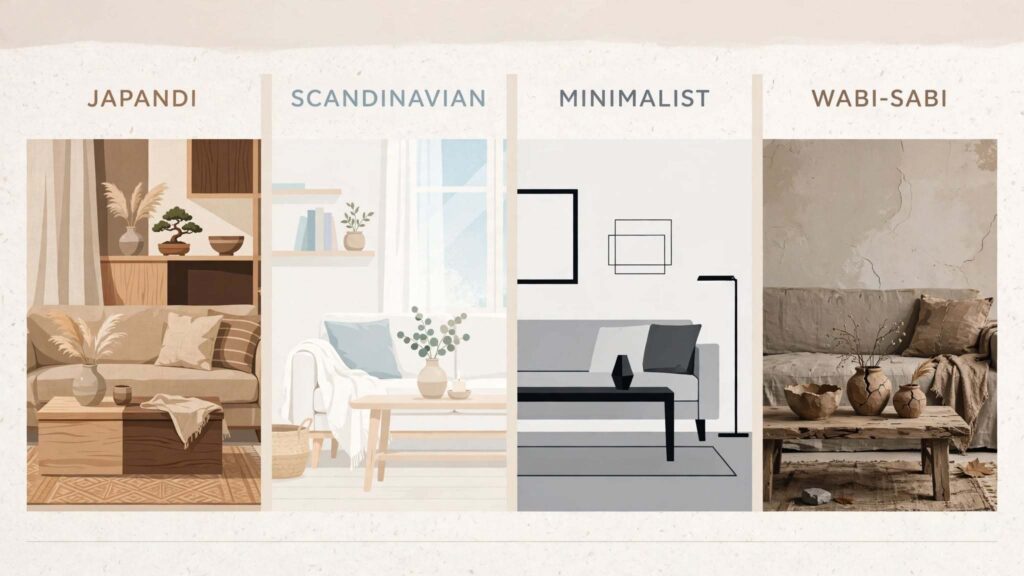
Japandi vs. Scandinavian vs. Minimalist vs. Wabi-Sabi
This is one of the biggest points of confusion in most Japandi style content, and almost no competing guide lays it out clearly side by side:
| Style | Core Focus | Color Palette | Feel |
|---|---|---|---|
| Japandi | Balance of Japanese simplicity + Scandinavian warmth | Warm neutrals, mixed light/dark wood | Calm, grounded, quietly warm |
| Scandinavian | Hygge, coziness, brightness | Crisp whites, pale woods | Airy, bright, cheerful |
| Minimalist | Function over decoration, “less is more” | Cool neutrals, monochrome | Clean, sometimes stark |
| Wabi-Sabi | Beauty in imperfection, natural aging | Muted earth tones | Raw, handcrafted, imperfect |
The clearest distinction worth internalizing: Minimalist design strips a room down to pure function and can feel cold or sparse if taken too far, while Japandi style strips a room to only intentional objects and then deliberately reintroduces warmth through texture, natural materials, and handmade imperfection. A stark white sofa on a white floor is Minimalist. That same room with an oatmeal linen sofa, an oak floor, a ceramic vase, and a woven throw is Japandi style — both are sparse, but only one feels genuinely alive.
Core Principles of Japandi Style
Every well-executed Japandi style space is built around three consistent pillars:
- Function first. Every piece of furniture earns its place — ideally serving more than one purpose, like a storage bench or a table that doubles as a desk. Nothing exists purely for decoration.
- Natural materials. Wood, bamboo, stone, linen, and ceramics form the material backbone of the style, bringing warmth and tactile richness that pure minimalism often lacks.
- Embracing imperfection. Borrowed directly from the Japanese concept of wabi-sabi, Japandi style welcomes visible grain, handcrafted irregularity, and natural aging rather than demanding flawless, factory-perfect surfaces.
The Japandi Color Palette
Japandi style color palettes stay deliberately narrow and warm, avoiding both the stark white-on-white of pure minimalism and the bold saturation of maximalist styles:
- Base neutrals — soft cream, warm white, oatmeal, and light greige tones for walls and larger surfaces.
- Grounding tones — charcoal, deep indigo, and muted black used sparingly as accent contrast, often through a single piece of furniture, framing, or textile.
- Wood tones — a deliberate mix of light woods (Scandinavian influence) and darker, richer woods (Japanese influence) used together rather than a single uniform tone.
- Earthy accents — muted sage green, soft terracotta, or dusty clay tones, used in small doses through ceramics or textiles rather than large color blocks.
The goal throughout is subtlety — colors in a Japandi style room should feel like they were drawn directly from natural materials (wood, stone, clay, linen) rather than selected from a bright, saturated paint deck.
Materials and Textures That Define Japandi Style
Material choice does more heavy lifting in Japandi style than in almost any other aesthetic, since the color palette stays intentionally restrained. Key materials include:
- Natural wood — oak, walnut, and bamboo, often left with visible grain rather than heavily lacquered.
- Linen and cotton — for upholstery, curtains, and bedding, chosen for their soft, slightly imperfect drape.
- Stone and ceramic — used for vases, tableware, and small decorative objects, embracing the handmade, slightly irregular quality central to wabi-sabi.
- Paper and rice-paper elements — often seen in lighting fixtures, referencing traditional Japanese shoji screens and lanterns.
- Wool and jute — for rugs and throws, adding the tactile warmth central to the Scandinavian half of the equation.
Choosing Furniture for a Japandi Style Space
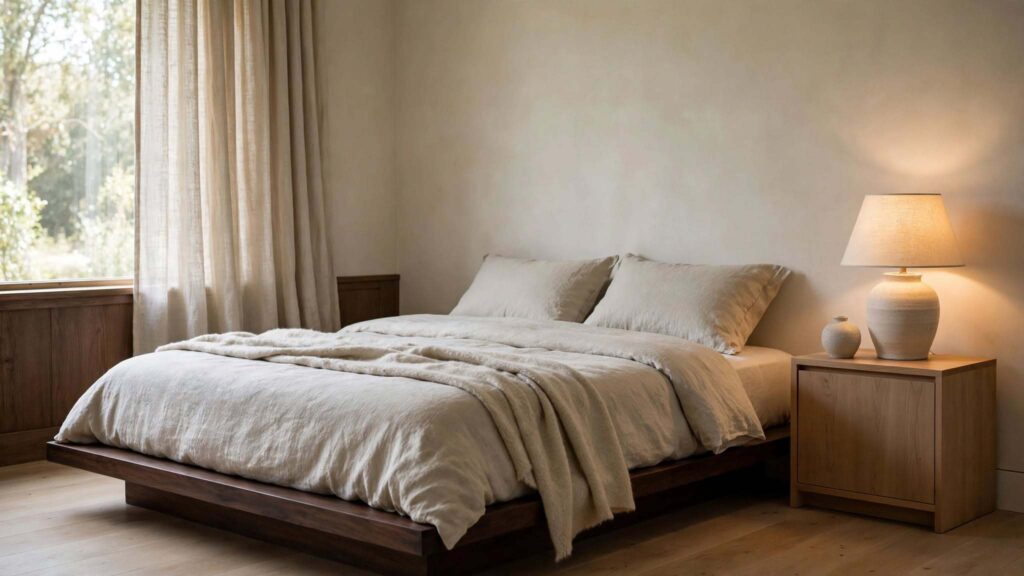
Japandi style furniture is defined by a distinct silhouette: low-profile pieces (a Japanese influence that keeps furniture closer to the ground) combined with clean, functional lines (the Scandinavian contribution). A few practical guidelines:
- Favor low platform beds over tall, ornate bed frames — this single choice does more to establish a Japandi style bedroom than almost any other decision.
- Choose furniture with exposed, natural wood legs rather than upholstered or boxy bases, which keeps the room feeling light and grounded simultaneously.
- Prioritize hidden and multi-functional storage — built-in cabinetry, storage benches, and under-bed storage keep surfaces clear without sacrificing function, directly supporting the style’s decluttered aesthetic.
- Mix, don’t match. Rather than buying a single matched furniture set, Japandi style favors individually chosen pieces that share a common material and color language without being identical.
Room-by-Room Japandi Style Guide
Living Room
Center the room around a low-profile sofa in a natural linen or cotton blend, paired with a solid wood coffee table and a single statement piece — a ceramic vase or woven wall hanging — rather than a cluster of small decorative objects.
Bedroom
A low platform bed, natural linen bedding in a muted neutral tone, and minimal nightstands with closed storage define a Japandi style bedroom. Keep wall décor to one or two intentional pieces rather than a gallery wall, and prioritize soft, warm lighting over bright overhead fixtures.
Kitchen
Open shelving with a small, curated collection of ceramics works well here, paired with natural wood cabinetry and matte (rather than glossy) countertop finishes. Keeping countertops largely clear is essential — visual clutter undermines the calm the style is built around.
Home Office
A simple wood desk, a single ergonomic chair chosen for both comfort and clean lines, and closed storage for cables and paperwork keep a Japandi style home office feeling focused rather than sterile.
Bathroom
Natural stone or wood-look tile, a simple ceramic vessel sink, and woven storage baskets bring the Japandi style palette into a room that’s traditionally harder to soften. Wall-mounted fixtures also help maintain the clean, uncluttered floor lines central to the aesthetic.
If you’re weighing Japandi style against other aesthetics before committing to a full room redesign, our complete guide to interior design styles is a useful place to compare it against Scandinavian, Minimalist, and Wabi-Sabi side by side.
Japandi on Any Budget
One of the most valuable things missing from most competing guides: realistic budget tiers. Japandi style is genuinely achievable at multiple price points, not just as a high-end aesthetic:
- Budget-friendly: Swap out clutter through decluttering (free), introduce a linen throw and a few ceramic pieces, and repaint a single accent wall in a warm neutral tone.
- Mid-range: Invest in one or two anchor furniture pieces — a solid wood coffee table or a low platform bed frame — while keeping smaller accessories budget-conscious.
- Higher investment: Full furniture replacement with solid wood pieces, custom built-in storage, and natural stone or wood flooring throughout the space.
The style’s emphasis on “fewer, better things” actually makes it one of the more budget-flexible aesthetics long-term, since it discourages the kind of frequent, trend-driven replacement that other styles often require.
Common Mistakes and Misconceptions
A few recurring mistakes show up across real Japandi style attempts that most guides don’t address directly:
- Confusing Japandi with pure minimalism and ending up with a room that feels cold rather than calm — remember, texture and natural material are what separate the two.
- Over-cluttering with “Japandi-coded” decor. Buying too many small ceramic objects or paper lanterns can ironically undermine the restraint the style is built on.
- Ignoring furniture proportion. Tall, bulky furniture clashes with the low-profile silhouette central to the look — even one oversized piece can throw off an otherwise well-executed room.
- Treating it as an all-white aesthetic. As covered in the color palette section, Japandi style relies on warm neutrals and mixed wood tones, not the stark white-on-white associated with pure Scandinavian or Minimalist interiors.
If you’re planning a broader renovation and want to avoid layout and design pitfalls beyond color and furniture choice, our guide to common interior design mistakes covers several related issues worth reviewing together with this one.
Sustainability and Slow Living in Japandi Design
This is a dimension of Japandi style that most competitor content mentions only in passing, despite it being central to the philosophy: both Japanese and Scandinavian design traditions emphasize buying fewer, higher-quality pieces built to last, rather than frequent, trend-driven replacement. This “slow living” mindset naturally aligns with sustainable material choices — solid wood over particleboard, natural fiber textiles over synthetic blends, and handcrafted pieces over mass-produced ones. For homeowners interested in a style that’s genuinely durable rather than a passing aesthetic trend, this underlying philosophy is arguably as valuable as the visual look itself.
How to Transition Your Home to Japandi Style, Step by Step
- Declutter first, decorate second. Remove anything that doesn’t serve a clear function or genuine value before introducing new pieces.
- Establish your base neutral palette on walls and large surfaces before adding any accent color or texture.
- Introduce one anchor wood-tone piece — a coffee table, bed frame, or dining table — to set the room’s material direction.
- Layer in natural textiles — a linen throw, a wool rug, cotton curtains — to add warmth without visual clutter.
- Add a small number of intentional decorative objects, favoring ceramics, woven textures, and simple greenery over anything purely decorative or trend-driven.
- Step back and edit. Once the room feels furnished, remove anything that feels excessive — Japandi style rewards restraint at every stage, including the final one.
Frequently Asked Questions
1. What is the difference between Japandi style and Scandinavian style? Scandinavian style leans toward brighter, crisper palettes and a cheerful, airy feel rooted in hygge. Japandi style shares that warmth but pulls in a more grounded, earthy palette and the Japanese principle of embracing natural imperfection, giving it a slightly more subdued, contemplative feel overall.
2. Is Japandi style the same as minimalism? No — while both value simplicity and function, minimalism can sometimes feel cold or sparse when taken to an extreme, while Japandi style deliberately reintroduces warmth through natural materials, texture, and imperfection, making it feel calm rather than stark.
3. What colors are used in Japandi style interiors? Warm neutrals like cream, oatmeal, and light greige form the base, layered with grounding tones like charcoal or deep indigo used sparingly, and a deliberate mix of light and dark natural wood tones throughout furniture and flooring.
4. Is Japandi style expensive to achieve? Not necessarily — while a full furniture overhaul with solid wood pieces can be a larger investment, the style is genuinely achievable on a budget through decluttering, a few natural-material accessories, and a single well-chosen accent piece, since its philosophy prioritizes fewer, more intentional purchases over volume.
5. Can Japandi style work in a small apartment? Yes — in fact, Japandi style’s emphasis on multi-functional furniture, hidden storage, and clutter-free surfaces makes it particularly well suited to smaller spaces, where visual calm has an outsized impact on how spacious a room feels.
6. What furniture style is used in Japandi design? Low-profile furniture with clean, natural wood legs is central to the look — combining the low-to-the-ground silhouette of Japanese furniture with the functional, uncluttered lines of Scandinavian design.
7. Does Japandi style work in warm or humid climates, not just cold Nordic-style homes? Yes — the style’s reliance on natural, breathable materials like linen, cotton, and light wood tones actually translates well to warmer climates, and the emphasis on natural light and airflow aligns closely with design strategies already used in many warm-climate homes.
8. How is Japandi style different from Wabi-Sabi? Wabi-Sabi is one of the philosophical influences within Japandi style, specifically the embrace of natural imperfection and aging materials. Japandi style is broader, combining that Japanese influence with Scandinavian warmth and functional design principles, rather than being a purely Japanese aesthetic on its own.
9. What’s the biggest mistake people make when trying to achieve Japandi style? Confusing it with stark, all-white minimalism is the most common mistake — Japandi style depends on warm neutrals, mixed wood tones, and natural texture to feel calm rather than cold, and skipping that warmth is what usually makes a room feel more like generic minimalism than genuine Japandi style.
10. Is Japandi style a passing trend, or is it here to stay? Given that it’s rooted in decades of genuine cultural and design overlap between Japan and Scandinavia — rather than being a manufactured trend — most design experts view Japandi style as a durable aesthetic rather than a short-lived fad, reinforced by its emphasis on quality, longevity, and intentional purchasing over disposable trend-chasing.
Final Thoughts
Japandi style endures because it solves a real tension a lot of other minimalist aesthetics struggle with: how to keep a space calm and uncluttered without it feeling cold or impersonal. The answer lies in its dual roots — Japanese restraint paired with Scandinavian warmth — and in prioritizing fewer, more intentional, naturally made pieces over sheer volume of decor.
If you’re ready to bring these principles into your own home, whether as a full renovation or a room-by-room refresh, our team at Archtra can help translate the Japandi style philosophy into a space designed specifically around how you actually live. Browse our project portfolio for real examples of calm, considered interiors, or reach out to our design team to start planning your space.