Picking exterior paint color combinations is one of those decisions that feels simple right up until you’re standing in front of a wall of paint chips, completely frozen. Unlike an interior room you can repaint on a whim, your home’s exterior palette is expensive to change, visible to the entire street, and directly tied to how much of a first impression your home makes — which is exactly why getting it right matters so much more than most homeowners expect going in.
This guide goes beyond the usual “here are some pretty houses” roundup you’ll find on most paint brand websites. We’ll cover the fixed elements that should actually drive your color choices, the color theory principles that make a palette feel cohesive rather than random, how architectural style should shape your options, climate-specific considerations most guides ignore entirely, real testing methods, HOA considerations, and the most common mistakes homeowners make. If you’re planning a full renovation alongside your exterior refresh, our team handles that kind of holistic project through our architecture and design services at Archtra.
Table of Contents
- Why Exterior Paint Color Combinations Matter So Much
- Start With What You Can’t Change: Your Fixed Elements
- Color Theory Basics for Exterior Palettes
- How Many Colors Should You Actually Use?
- Exterior Paint Color Combinations by Architectural Style
- Climate Considerations for Exterior Paint
- Popular Exterior Color Combination Formulas
- How to Test Paint Colors the Right Way
- HOA Rules and Neighborhood Considerations
- Common Mistakes to Avoid
- Cost to Paint a Home Exterior
- Frequently Asked Questions
Why Exterior Paint Color Combinations Matter So Much
Your home’s exterior palette isn’t just about personal taste — it directly affects curb appeal, resale value, and how well your home reads architecturally from the street. A poorly chosen combination can make a beautifully designed home look flat or disjointed, while the right exterior paint color combinations can make an ordinary structure look genuinely considered. Because repainting an entire exterior is a significant investment of both time and money, this is a decision worth slowing down for rather than rushing based on a single Pinterest photo.
Start With What You Can’t Change: Your Fixed Elements
This is the step almost every competing guide buries as an afterthought, despite it being the single most important starting point: before choosing any paint color, catalog everything on your home’s exterior that you’re not planning to change.
- Roofing material and color — asphalt shingles, tile, or metal roofing all carry an undertone (warm, cool, or neutral) that your paint palette needs to complement.
- Stone, brick, or masonry — these materials carry fixed, often warm undertones that should anchor your overall color direction rather than fight against it.
- Driveway and hardscaping — concrete, pavers, and walkways contribute a subtle background tone that’s easy to overlook but does affect how a palette reads in person.
- Landscaping — the greens, browns, and seasonal colors already present in your yard interact visually with your exterior palette far more than most homeowners expect.
Once you know the undertone direction of your fixed elements — generally warm (yellow, orange, red-based) or cool (blue, green, gray-based) — choosing exterior paint color combinations that complement rather than clash becomes dramatically easier.
Color Theory Basics for Exterior Palettes
A handful of color theory principles, borrowed and adapted from interior design, apply directly to exterior palettes:
- The 60-30-10 rule, adapted for exteriors. Roughly 60% of the visible exterior (the main body/siding) should be your dominant color, about 30% a secondary color (trim, a second-story accent, or a garage door), and 10% a bold accent (typically the front door). This ratio consistently produces balanced, professional-looking exterior paint color combinations.
- Warm vs. cool undertones. Matching your paint’s undertone family to your fixed elements’ undertone (from the previous section) prevents the subtle “off” feeling that happens when, say, a cool gray siding sits next to warm-toned brick.
- Light Reflectance Value (LRV). This is a detail almost no consumer-facing guide explains clearly: LRV measures how much light a color reflects, on a scale from 0 (absolute black) to 100 (pure white). Darker colors (low LRV) absorb more heat and can fade faster or stress certain siding materials in hot, sun-intensive climates — a genuinely important consideration for homeowners choosing bold, dark exterior colors in warmer regions.
How Many Colors Should You Actually Use?
Most well-executed exterior paint color combinations use three to four colors total: a dominant body color, a trim color, an accent color (commonly the front door), and sometimes a fourth for shutters or architectural details. Going beyond four colors on a single exterior tends to read as busy or uncoordinated, while a single flat color across the entire exterior can make even well-designed architecture look unfinished, since trim and architectural details lose their definition without contrast.
Exterior Paint Color Combinations by Architectural Style
This is one of the biggest gaps in most exterior paint guides — they show pretty photos without explaining why certain palettes suit certain architectural styles. Matching your palette to your home’s actual architecture (rather than a trend you saw online) consistently produces the most cohesive results:
- Modern Farmhouse — crisp white or warm off-white body, black or charcoal trim and window frames, often with a natural wood front door or accent.
- Craftsman/Bungalow — earthy, muted palettes (sage green, warm brown, deep clay) paired with cream or off-white trim, reflecting the style’s natural-material roots.
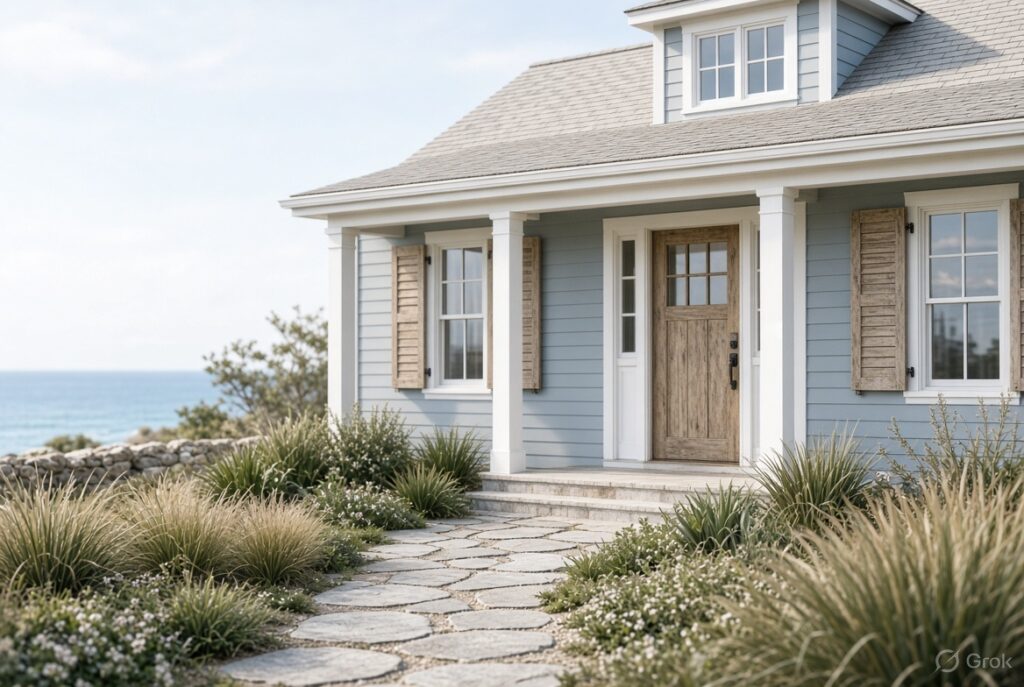
- Coastal — soft blues, crisp whites, and light grays, often paired with natural wood accents on doors or shutters.
- Mediterranean — warm terracotta, soft stucco tones, and deep wood-toned doors and shutters, avoiding stark white or cool grays that clash with the style’s warm origins.
- Traditional/Colonial — classic white or soft cream body with black or deep navy shutters and a bold, contrasting front door.
- Modern/Contemporary — monochromatic or near-monochromatic palettes (charcoal, black, warm gray) with minimal trim contrast, letting architectural form rather than color do the visual work.
- Victorian — historically, multiple colors (sometimes four or more) highlighting individual architectural details like trim, brackets, and gingerbread woodwork, since Victorian architecture was specifically designed to be read in layered color.
If you’re not yet sure which architectural style actually fits your home or your taste, our complete guide to interior design styles is a useful companion read, since exterior and interior style direction generally work best when they’re aligned rather than mismatched.
Climate Considerations for Exterior Paint
This is a section almost entirely missing from paint-brand guides (understandably, since most are written for a single regional market), but it matters enormously for a global audience choosing exterior paint color combinations:
- Hot, high-sun climates — lighter colors and higher LRV values reflect more heat, reducing thermal stress on siding materials and helping interior cooling costs; very dark exterior colors in intense sun can also fade noticeably faster.
- Humid or coastal climates — mold- and mildew-resistant exterior paint formulations matter as much as the color choice itself, and lighter colors tend to show mildew growth more visibly than mid-tone colors.
- Cold, snow-heavy climates — darker, richer tones can help a home stand out against snow-covered landscapes, and exterior paints rated for wider temperature-cure ranges are worth confirming with your contractor.
- High-UV regions — regardless of color choice, UV-resistant exterior paint formulations reduce fading over time, which is a worthwhile upgrade conversation with your painter regardless of which exterior paint color combinations you land on.
Popular Exterior Color Combination Formulas
A few dependable, broadly-loved formulas that show up again and again across successful exteriors, described generically here (exact paint names and codes vary by brand and region, so always sample locally before committing):
- Classic black, white, and gray — a timeless, universally flattering combination that works across nearly every architectural style and rarely feels dated.
- Soft warm neutral body + charcoal or black trim — currently one of the most popular modern farmhouse-adjacent combinations, offering strong contrast without feeling harsh.
- Deep navy body + crisp white trim — a coastal-leaning combination that reads as classic and sophisticated on a wide range of home styles.
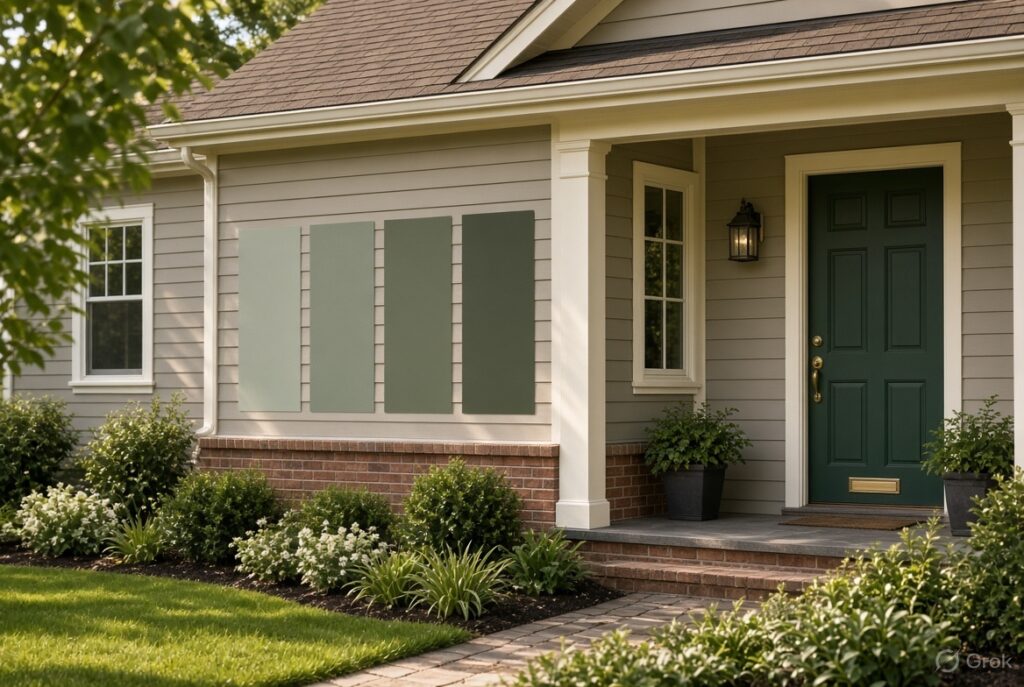
- Warm greige body + cream trim + a bold door accent (deep green, terracotta, or navy) — a versatile, resale-friendly combination that photographs well and suits most neighborhoods.
- Earthy terracotta or warm taupe + off-white trim — particularly well suited to Mediterranean and warm-climate homes, working with rather than against natural stucco or stone tones.
How to Test Paint Colors the Right Way
Skipping this step is one of the most common reasons homeowners end up disappointed with their finished exterior paint color combinations:
- Buy actual sample-size paint, not just chips, and paint large swatches (at least 2×2 feet) directly on multiple sides of your home, since sun exposure varies significantly by orientation.
- View swatches at different times of day. Morning, midday, and evening light all shift how a color reads, sometimes dramatically.
- Step back and view from the street, not just up close — exterior colors are experienced primarily from a distance.
- Compare directly against your fixed elements (roof, stone, brick) in natural daylight, not indoors or under artificial lighting.
HOA Rules and Neighborhood Considerations
Many homeowners skip this step until after they’ve already fallen in love with a color — a mistake worth avoiding. If your property is governed by a homeowners association, check color approval requirements before finalizing any exterior paint color combinations; many HOAs maintain an approved palette or require formal submission and approval before work begins. Even without a formal HOA, it’s worth considering how your chosen palette relates to your immediate neighborhood — a home that stands out tastefully tends to boost curb appeal more reliably than one that clashes sharply with its surroundings.
Common Mistakes to Avoid
After reviewing the leading paint-brand and design guides currently ranking for exterior paint color combinations, a few recurring homeowner mistakes stand out:
- Choosing a color from a small chip without testing a large swatch outdoors. Small samples consistently look different once scaled up across an entire facade.
- Ignoring fixed elements. A beautiful paint color can still clash badly with an unchangeable roof or stone foundation if undertones aren’t considered together.
- Using too many colors. As covered above, most successful exteriors stay within three to four total colors.
- Testing only in one lighting condition. A color that looks perfect at noon can shift dramatically by evening.
- Ignoring climate suitability. Choosing a very dark color in an intense-sun climate without considering LRV and heat absorption can lead to faster fading and added cooling costs.
- Choosing a trendy color without considering resale. Highly personal or unusual color choices can narrow your buyer pool if you plan to sell within a few years.
Cost to Paint a Home Exterior
Costs vary significantly by region, home size, and material condition, but as a general, illustrative reference point: exterior painting projects for an average-sized home commonly range from a few thousand dollars for a straightforward single-color repaint to significantly more for larger homes, detailed trim work, or specialty finishes like stucco or masonry paint. Getting a location-specific quote from a local contractor is always the most reliable way to budget, since labor and material costs vary considerably by region.
Frequently Asked Questions
1. How many colors should I use in my exterior paint color combination? Most well-balanced exteriors use three to four colors total: a dominant body color, a trim color, and an accent color (often the front door), with a fourth sometimes used for shutters or specific architectural details.
2. What’s the easiest way to choose exterior paint color combinations that won’t clash? Start with your fixed elements — roofing, stone, brick, and driveway — and identify whether they lean warm or cool. Choosing paint colors within that same undertone family is the most reliable way to avoid unintentional clashing.
3. Should my exterior paint colors match my interior design style? While not strictly required, aligning your exterior palette with your home’s overall architectural and interior style tends to create a more cohesive, intentional-feeling result. Our guide to interior design styles is a useful reference for understanding which color families suit which aesthetic.
4. What is LRV, and why does it matter for exterior paint? Light Reflectance Value (LRV) measures how much light a color reflects, on a scale from 0 to 100. It matters because darker, low-LRV colors absorb more heat, which can accelerate fading and add thermal stress to siding in hot, sun-intensive climates.
5. What exterior paint color combinations work best for resale value? Classic, broadly appealing combinations — soft neutrals with black, gray, or navy trim, or a timeless black-white-gray palette — tend to appeal to the widest range of buyers and are generally considered the safest resale-friendly choices.
6. How do I choose exterior paint colors for a Mediterranean or warm-climate home? Lean into warm terracotta, soft stucco tones, and deep wood-toned doors or shutters rather than stark white or cool gray, which tend to clash with the warm materials typical of Mediterranean-style architecture.
7. Do I need special paint for humid or coastal climates? Yes — mold- and mildew-resistant exterior paint formulations are worth prioritizing in humid or coastal regions, since lighter colors in particular can show mildew growth more visibly over time without the right formulation.
8. How do I test exterior paint colors before committing? Paint large sample swatches (at least 2×2 feet) directly on multiple sides of your home, view them at different times of day, and step back to view from the street rather than judging colors only up close.
9. Do I need HOA approval before repainting my home’s exterior? Many HOAs require color approval or maintain a pre-approved palette, so it’s worth checking your community’s specific guidelines before finalizing any exterior paint color combinations to avoid a costly repaint or dispute later.
10. How much does it typically cost to repaint a home’s exterior? Costs vary significantly by home size, region, and material condition, ranging from a few thousand dollars for a straightforward repaint to considerably more for larger homes or detailed trim and masonry work. A local contractor quote is the most reliable way to budget accurately.
Final Thoughts
The best exterior paint color combinations aren’t the boldest or most trend-driven ones — they’re the ones that work honestly with your home’s fixed elements, architectural style, and climate, rather than fighting against them. Start with what you can’t change, keep your palette to three or four colors, and always test large swatches outdoors in real daylight before committing. Get those fundamentals right, and even a modest color refresh can transform how your entire home reads from the street.
If you’re planning a larger exterior renovation alongside a fresh paint palette — new siding, an addition, or updated architectural details — our team at Archtra can help design the whole exterior cohesively rather than treating paint as an isolated decision. You might also find our guide to home addition ideas useful if a color refresh is part of a bigger renovation plan. Browse our project portfolio for real examples, or reach out to our design team to start planning your exterior.