Solar energy in home design has gone from a niche add-on to one of the fastest-growing priorities homeowners are searching for, and the number backing that up is genuinely striking. Houzz’s 2026 Emerging Summer Trends Report, which compares U.S. search activity on its platform from January through March 2026 against the same period in 2025, found that searches for “solar energy” soared nearly eighteenfold — a jump in the same range as the 1,675% figure now circulating in design coverage. That’s not a rounding error or a marketing exaggeration; it’s one of the sharpest single-category increases in the entire report, alongside smaller but still notable jumps in “repurposed materials” and “low-voltage lighting.”
Before going further, it’s worth being precise about what that number actually measures, because most articles repeating it skip this part. It’s platform-specific search growth on Houzz, not a claim about total solar installations, total electricity generated, or search volume across the entire internet. It’s a real and meaningful signal of surging homeowner interest, and this guide treats it exactly that way, rather than stretching it into a bigger claim than the data supports.
What follows goes beyond “here’s why people want solar panels.” We’ll cover the different ways solar energy can be built into a home’s design, the often-overlooked difference between passive and active solar strategies, how architects integrate solar without it looking bolted-on, the real financial case with sourced figures, battery storage, how this works even in less sunny climates, and the mistakes that derail solar-ready design. If you’re planning a build or renovation with solar in mind, this is exactly the kind of integrated planning our sustainable building design services at Archtra work through with clients.
Table of Contents
- The 1,675% Number: What It Actually Means
- Why Solar Interest Is Surging Right Now
- Types of Home Solar Systems
- Passive Solar Design vs. Active Solar (PV)
- Designing a Home Around Solar, Architecturally
- The Financial Case: ROI, Home Value, and Payback
- Battery Storage and Energy Independence
- Does Solar Work in Cloudy or Cold Climates?
- Common Mistakes When Planning for Solar
- How to Plan for Solar From the Design Stage
- Frequently Asked Questions
The 1,675% Number: What It Actually Means
Houzz’s report, based on year-over-year U.S. search data from its own platform, found that “solar energy” search interest rose roughly eighteenfold in early 2026 compared with the same period a year earlier — a scale of growth consistent with the 1,675% figure that’s since been widely cited. For context, the same report found “sustainable” searches up 42%, “passive house” up 37%, and “repurposed materials” nearly tripling, which means solar’s growth wasn’t just part of a general uptick in eco-conscious searching — it dramatically outpaced every other sustainability-related term Houzz tracked that period.
It’s worth being clear about what this figure is and isn’t. It reflects search behavior on one design platform, over one specific three-month comparison window, in the U.S. It’s not a global figure, and it’s not a measure of actual solar installations (those numbers, covered in the next section, come from different sources entirely). Treated accurately — as a striking, well-documented spike in homeowner interest in solar energy in home design — it’s a genuinely useful signal for anyone planning a project, which is exactly how we’re using it throughout this guide.
Why Solar Interest Is Surging Right Now
A handful of factors are converging at once:
- Rising electricity costs are pushing more homeowners to actively search for ways to reduce long-term utility bills.
- The broader solar market has scaled significantly. Industry tracking from the Solar Energy Industries Association shows the U.S. crossed 5 million solar-powered homes as of 2024, with California alone accounting for roughly 1.8 million of them.
- Battery storage and EV adoption are reinforcing each other. Industry surveys of residential solar professionals have found a large majority reporting rising homeowner interest in battery storage, with a similar share crediting electric vehicle adoption as a driver of new solar interest.
- Resale value data has become harder to ignore. As covered in more detail below, multiple independent studies now show a consistent, measurable home value premium tied to solar.
- Aesthetics have genuinely improved. A dedicated field of “solar architecture” has emerged specifically to solve the visual objections that used to keep homeowners away from panels, covered in the design section below.
Types of Home Solar Systems
Most competing articles on solar energy in home design stop at rooftop panels. In reality, homeowners today have several distinct options, each with different design implications:
- Rooftop mounted panels — the most common and typically the most cost-effective option, installed on top of the existing roof structure.
- Solar roof shingles / Building-Integrated Photovoltaics (BIPV) — panels engineered to replace, rather than sit on top of, conventional roofing material, offering a more seamless architectural look at a generally higher cost.
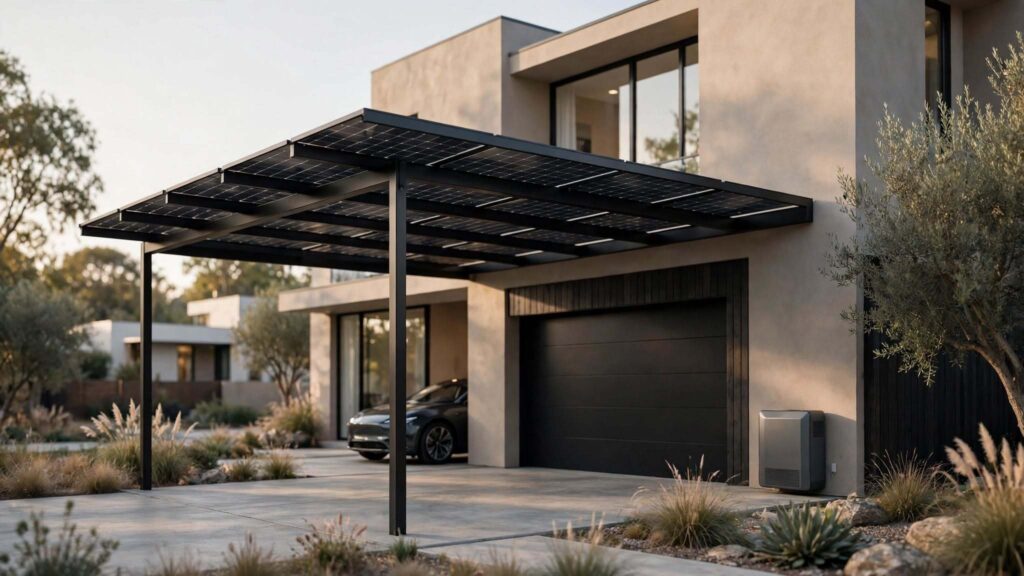
- Solar canopies and carports — freestanding structures that generate power without requiring roof space at all, useful for homes with unsuitable roof orientation or shading.
- Ground-mounted arrays — installed directly on the property rather than the building, a strong option where land is available but roof conditions aren’t ideal.
- Hybrid systems with battery storage — increasingly popular configurations combining solar generation with on-site battery storage for energy independence and backup power.
Passive Solar Design vs. Active Solar (PV)
This is the single biggest content gap in almost every article covering solar energy in home design — most treat “solar” as synonymous with photovoltaic panels and never mention passive solar design at all, despite it being one of the most cost-effective strategies available.
Passive solar design uses a building’s orientation, glazing, shape and thermal mass to capture and retain heat from the sun directly, without any mechanical or electrical components. According to the American Solar Energy Society, homes designed with south-facing glazing (in the Northern Hemisphere) can receive anywhere from 20% to 90% or more of their space heating needs directly from the sun, and well-executed passive strategies combined with strong insulation can reduce a home’s heating and cooling energy use by around 25%. Key passive solar design elements include:
- Building orientation — positioning the home and its glazing to maximize winter sun exposure while minimizing unwanted summer heat gain.
- Thermal mass — dense materials (like concrete, brick, or stone) that absorb heat during the day and release it slowly, moderating indoor temperature swings.
- Overhangs and shading — designed specifically to block high summer sun while allowing lower winter sun to reach interior spaces.
- Compact building shape — minimizing exterior wall and roof surface area relative to interior volume reduces heat loss overall.
The most effective approach to solar energy in home design combines both: passive strategies to reduce the total energy a home needs in the first place, paired with active photovoltaic systems to generate clean power for what remains. Treating them as separate, unrelated decisions — as most home solar guides do — misses a huge amount of potential efficiency.
Designing a Home Around Solar, Architecturally
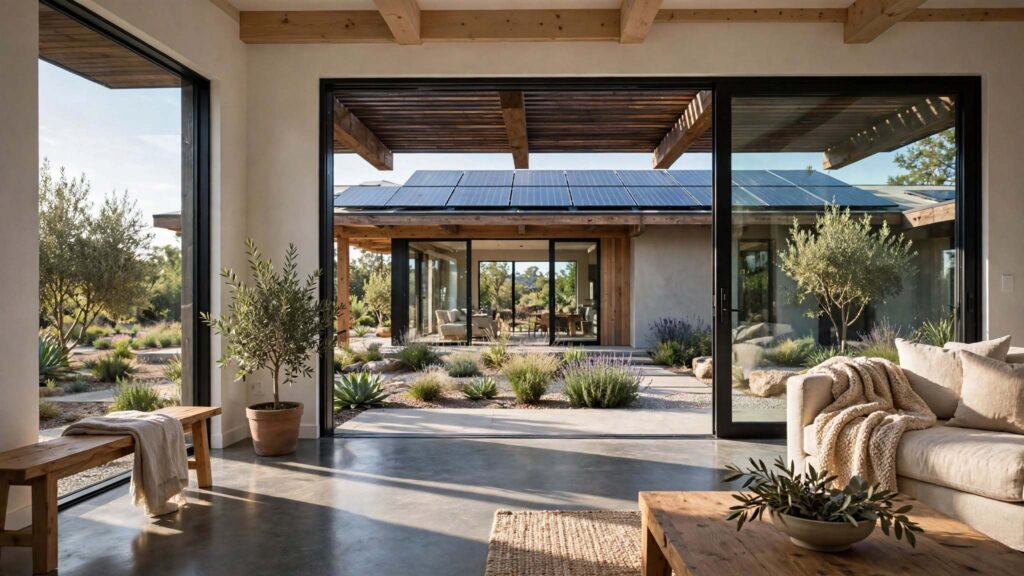
Aesthetic concerns have historically been one of the biggest reasons homeowners hesitated on solar, and it’s given rise to an entire specialization within architecture. Solar architects focus specifically on integrating solar technology into a building’s design so it enhances rather than detracts from the home’s appearance — either by disguising panels within the roofline and material palette, or by treating them as a deliberate, visible design feature rather than an afterthought bolted on after construction.
A few practical principles that separate well-integrated solar from an obvious retrofit:
- Plan roof orientation and pitch during initial design, not after the home is already built — this alone dramatically expands what’s aesthetically and technically possible.
- Match panel framing and color to the roofing material where full BIPV integration isn’t in budget, minimizing visual contrast.
- Consider canopy or carport-mounted systems where roof geometry doesn’t suit panels, turning a constraint into an intentional design feature.
- Coordinate with HOA or historic district guidelines early, since aesthetic approval requirements for visible solar installations vary significantly by location and can affect design options.
The Financial Case: ROI, Home Value, and Payback
The financial data behind solar energy in home design has become considerably more robust in recent years. A few figures worth knowing, each sourced from independent analyses:
- Home value increase. Recent studies replicating original Zillow research have found homes with solar selling for roughly 4% to 7% more than comparable homes without it, translating to real dollar premiums in the tens of thousands depending on regional home prices.
- Faster sale times. Research from the National Renewable Energy Laboratory has found that solar-equipped homes, particularly those with owned (rather than leased) systems, can sell notably faster than comparable homes without solar.
- Payback period. Depending on system size, local electricity rates, and available incentives, home solar installations commonly pay back their upfront cost over a period of roughly ten to twenty years, after which electricity generation is effectively free for the remaining lifespan of the system.
- Ownership structure matters. Owned systems tend to contribute more clearly to resale value than leased systems, since a lease can complicate a future sale rather than adding straightforward equity.
Battery Storage and Energy Independence
Battery storage has moved from a niche add-on to a mainstream consideration within solar energy in home design, driven largely by falling battery costs and rising interest in backup power during grid outages. Industry surveys of residential solar professionals have found a strong majority reporting rising homeower interest in battery storage specifically, often tied closely to growing electric vehicle ownership, since a home battery and EV charging setup can be planned and installed together far more efficiently than added separately later. For anyone designing a new home or major renovation, running the electrical infrastructure needed for both solar and future battery storage during initial construction — even if the battery itself is added later — avoids a costly retrofit down the line.
Does Solar Work in Cloudy or Cold Climates?
This is a common misconception worth addressing directly, especially for a global audience. Solar panels generate electricity from daylight, not exclusively direct sunlight, which means genuinely overcast regions remain viable for solar generation, even if overall output is somewhat lower than in consistently sunny climates. The United Kingdom is a useful real-world example: despite its famously overcast reputation, UK solar capacity has grown substantially in recent years, with generation setting new records even in a climate most people would assume is unsuitable for solar. The practical takeaway for anyone planning solar energy in home design outside a classically sunny region: it’s very likely still viable, but system sizing and payback expectations should be based on your specific regional solar data rather than assumptions based on climate stereotypes.
Common Mistakes When Planning for Solar
A few recurring mistakes show up across real solar-integrated home projects, and most competing guides don’t address them directly:
- Treating solar as an afterthought rather than a design input. Roof orientation, pitch, and structural loading are dramatically easier and cheaper to plan for during initial design than to retrofit later.
- Ignoring passive solar design entirely. As covered above, reducing a home’s baseline energy demand through orientation and thermal mass often delivers better returns than simply adding more panels to an inefficient building.
- Underestimating shading. Mature trees, neighboring structures, or even future additions can significantly reduce system output if not accounted for during planning.
- Skipping HOA or local approval research. Aesthetic and permitting requirements for visible solar installations vary considerably and are far easier to navigate before committing to a specific system design.
- Sizing a system for today’s needs only. Not planning for future additions like an EV charger, a home addition, or battery storage can mean an undersized system within just a few years.
- Choosing a lease over ownership without understanding the resale trade-off. As covered above, ownership structure meaningfully affects how much value solar actually adds at resale.
How to Plan for Solar From the Design Stage
- Bring solar into the conversation at the earliest design stage, not after floor plans and roofline are finalized — this is the single biggest factor in how well-integrated and cost-effective the final system will be.
- Combine passive and active strategies. Orient the home and plan glazing and overhangs to reduce baseline energy demand before sizing your active solar system.
- Confirm roof structure and orientation early, ideally during architectural design rather than after construction, when structural reinforcement becomes far more expensive.
- Plan electrical infrastructure for future battery storage and EV charging, even if you’re not installing them immediately.
- Check local permitting, net metering rules, and HOA requirements before finalizing your system design, since these vary significantly by region and can affect both feasibility and cost.
If you’re planning a full renovation or new build around energy performance, our guides to the custom home building process and home addition ideas cover the broader planning steps worth coordinating alongside solar design, and our piece on emerging sustainable building materials is a useful companion if you’re taking a holistic approach to sustainability across the whole project.
Frequently Asked Questions
1. Is the 1,675% figure for solar energy searches accurate? It’s consistent with Houzz’s 2026 Emerging Summer Trends Report, which found “solar energy” search interest on its platform rose nearly eighteenfold in the U.S. comparing January–March 2026 to the same period in 2025. It reflects platform-specific search growth, not total installations or global search volume, but it is a real, sourced figure rather than an exaggerated claim.
2. What’s the difference between passive solar design and solar panels? Passive solar design uses a building’s orientation, glazing, and materials to capture and retain the sun’s heat directly, without any electrical components. Solar panels (active solar, or photovoltaics) convert sunlight into electricity. The strongest approach to solar energy in home design uses both together.
3. Does adding solar actually increase a home’s resale value? Yes — recent independent studies replicating original Zillow research have found homes with solar selling for roughly 4% to 7% more than comparable homes without it, and solar-equipped homes have also been shown to sell notably faster in some research.
4. How long does it take for solar panels to pay for themselves? Typically somewhere between ten and twenty years, depending on system size, local electricity rates, and available incentives, after which the system generates effectively free electricity for its remaining lifespan.
5. Can solar panels work in cloudy or cold climates? Yes — solar panels generate electricity from daylight rather than exclusively direct sunlight, so genuinely overcast regions can still generate meaningful power, though overall output will generally be lower than in consistently sunny climates. The UK, despite its cloudy reputation, has significantly grown its solar capacity in recent years.
6. What’s the best time to plan for solar in a new home build? As early as possible — ideally during initial architectural design, when roof orientation, pitch, and structural loading can be planned around solar from the start, rather than retrofitted later at greater cost and design compromise.
7. Are solar roof shingles worth it compared to traditional panels? Solar shingles (BIPV) offer a more seamless, integrated appearance since they replace rather than sit on top of conventional roofing, but they typically cost more than standard rooftop panels. The right choice depends on your budget and how much aesthetic integration matters for your specific project.
8. Should I add battery storage along with solar panels? It depends on your goals — battery storage adds backup power during outages and supports greater energy independence, and industry data shows homeowner interest in battery storage rising quickly. Even if you don’t install a battery immediately, planning your electrical infrastructure to support one later is a smart, low-cost design decision.
9. Is leased or owned solar better for home value? Owned solar systems generally contribute more directly and predictably to resale value than leased systems, since a lease can complicate the sale process for a future buyer rather than adding straightforward home equity.
10. How do I make solar panels look good on my home instead of bolted-on? Planning roof orientation and pitch during the initial design phase, matching panel framing to your roofing material, and considering canopy or carport-mounted alternatives where roof geometry doesn’t suit panels are the most effective ways to integrate solar energy into home design without it looking like an afterthought.
Final Thoughts
The surge behind solar energy in home design is real, well-documented, and driven by more than just search curiosity — rising electricity costs, meaningful resale value data, and genuine architectural progress on aesthetics have all converged at once. The homeowners and architects getting the best results aren’t the ones bolting panels onto a finished roof; they’re the ones bringing solar, and often passive solar strategies alongside it, into the conversation from the very first design sketch.
If you’re planning a new build or renovation and want solar considered as part of the architecture from day one, our team at Archtra integrates sustainable design principles into every project stage. Browse our project portfolio for examples of our design approach, or reach out to our design team to start planning your project.