Three of the most promising sustainable building materials in architecture right now aren’t new inventions at all. Seaweed, straw and lime have been used to build homes for centuries, quietly disappearing from mainstream construction once concrete, steel and synthetic insulation took over in the 20th century. Now, as architects and builders look for genuine alternatives to carbon-heavy materials, all three are back, and this time they’re showing up in serious, code-conscious, architect-led projects rather than one-off experiments.
This guide goes further than the usual “eco materials to watch” roundup, which typically covers one material in isolation and stops at a single sentence on each. We’ll explain what makes seaweed, straw and lime genuinely different from other sustainable building materials, how they’ve actually been used historically and today, the real limitations nobody likes to mention, and how the three combine into building systems that are more durable and effective together than any one of them alone. If you’re planning a project that leans into this kind of material-forward, low-carbon design, our team works through exactly these decisions as part of our sustainable building design services at Archtra.
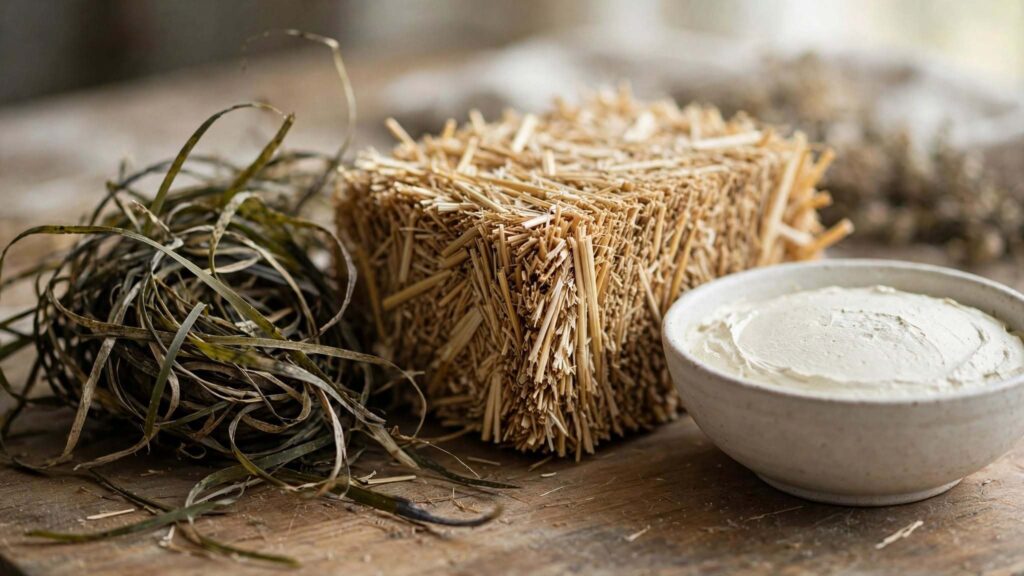
Table of Contents
- Why These Materials, Why Now
- Seaweed as a Building Material
- Straw as a Building Material
- Lime as a Sustainable Binder
- How Seaweed, Straw and Lime Work Together
- Performance: Thermal, Fire, Acoustic and Moisture
- Where You Can Use Them Today
- Challenges and Limitations
- Cost and Availability
- How to Bring These Materials Into a Renovation or New Build
- Frequently Asked Questions
Why These Materials, Why Now
Mainstream sustainable building materials conversations tend to circle the same handful of options — recycled steel, cross-laminated timber, low-carbon concrete. Seaweed, straw and lime rarely get equal billing, despite offering something those materials can’t: they’re grown or harvested rather than manufactured, they sequester carbon rather than emitting it during production, and in most cases, they’re compostable or reusable at the end of a building’s life. A growing coalition of architecture practices and materials researchers has been pushing specifically for wider adoption of bio-based materials like these, arguing that the supply chains simply haven’t caught up to the genuine performance and sustainability case for using them at scale.
Seaweed as a Building Material
Seaweed’s use in construction isn’t a modern invention — it’s a rediscovery. On the Danish island of Læsø, where trees have historically been scarce, residents built distinctive thatched cottages using eelgrass (a type of seaweed) piled thick over the roof structure, some of which have survived for centuries thanks to the material’s natural resistance to fire, mold and pests. In Japan, a traditional lime plaster technique called Shikkui has used seaweed extract as a natural glue since as early as the 16th century, prized for being naturally fire-retardant, antibacterial and remarkably durable — it’s still visible today on structures like Himeji Castle.
Modern architecture is now building on that foundation rather than starting from scratch. Henning Larsen Architects used eelgrass as a ventilation and acoustic material in a school expansion in Rønde, Denmark, specifically choosing it for its high salt content, which naturally resists fire and mold while also helping absorb odors. On the other side of the Atlantic, an architect working in Mexico has developed “sargablocks” — construction blocks made from roughly 40% sargassum seaweed, addressing the growing problem of seaweed washing ashore in large quantities while producing a genuinely low-carbon building material at the same time.
Today, seaweed shows up in buildings primarily as insulation, cladding, and as an ingredient in natural plasters and renders — rather than as a structural, load-bearing material on its own.
Straw as a Building Material
Straw bale construction has a documented history stretching back to the late 1800s, when Nebraska settlers with limited access to timber began stacking and rendering straw bales into surprisingly durable homes, some of which are still standing more than a century later. What’s changed is the sophistication of how straw gets used today.
As a bio-based material, straw sequesters a meaningful amount of carbon as it grows, and using it in construction locks that carbon into the building for as long as the structure stands, rather than releasing it back into the atmosphere the way burning or rapid decomposition would. Straw’s cellular structure also makes it a genuinely strong natural insulator, and modern straw bale walls, properly rendered and protected from moisture, perform impressively well thermally compared to many conventional insulation materials.
Research is also pushing straw beyond simple bale walls. A joint research project between architecture programs in Singapore, Germany and Ethiopia has been developing straw panel building technology specifically aimed at low-cost, low-weight construction for fast-growing cities, treating agricultural straw waste as a genuine building resource rather than a byproduct to dispose of. This kind of engineered straw panel — rather than raw stacked bales — is one of the more promising directions for straw as a mainstream sustainable building material going forward.
Lime as a Sustainable Binder
Lime is arguably the most quietly important of these three sustainable building materials, because it’s often what holds the other two together. Lime plaster and lime render have been used in construction for thousands of years, valued for being breathable (allowing moisture to pass through walls rather than trapping it, which reduces mold and rot) and for actually reabsorbing carbon dioxide from the atmosphere as it cures — a genuinely unusual property among common binders.
There are two broad categories worth knowing: hydraulic lime, which sets through a chemical reaction and can cure in damper conditions, and non-hydraulic (or “fat”) lime, which cures purely through exposure to air and carbon dioxide, making it slower to set but often gentler and more breathable for historic or natural-material construction. Compared to Portland cement, lime production requires significantly less energy and produces meaningfully lower emissions, while also offering better long-term compatibility with older or natural-material buildings, since it flexes and breathes in ways rigid cement render simply doesn’t.
If you’re working on a period property, our guide to modern heritage design covers how restoration-minded material choices like lime render fit into a broader design approach that blends historic character with contemporary comfort.
How Seaweed, Straw and Lime Work Together
This is the piece almost every competing article on sustainable building materials misses entirely, because most cover these three materials in complete isolation. In practice, they’re frequently used together, and the combination is often more effective than any single material alone:
- Lime binds straw. Straw bale walls are typically finished with a breathable lime render rather than cement, since lime’s breathability prevents moisture from becoming trapped inside the straw, which would otherwise lead to rot.
- Seaweed strengthens lime. As covered above, the traditional Japanese Shikkui technique uses seaweed extract specifically as a natural adhesive within lime plaster, improving workability and durability without introducing synthetic additives.
- All three share a core property: breathability. Unlike airtight synthetic building envelopes, wall systems built from straw, lime and seaweed-based components allow moisture vapor to move through the wall assembly gradually, which is a major factor in why traditional buildings using these materials have survived for centuries with minimal maintenance.
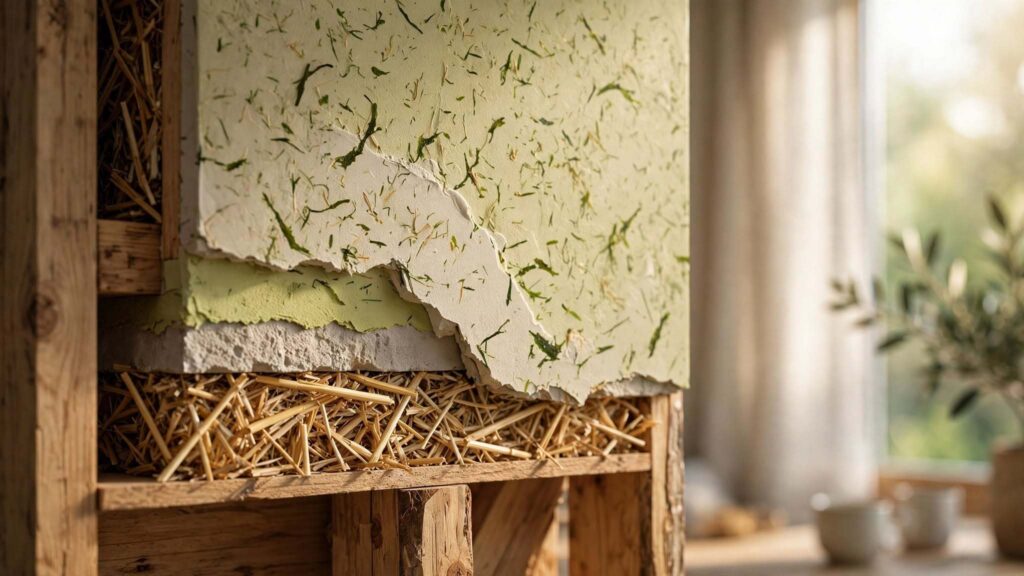
Layered structures like these — a straw-insulated frame, lime-rendered exterior, and seaweed-enhanced plaster interior — represent one of the more sophisticated applications of bio-based sustainable building materials currently being explored by research-driven architecture practices.
Performance: Thermal, Fire, Acoustic and Moisture
A genuinely useful comparison most consumer-facing articles skip:
- Thermal performance. Straw bale walls offer strong natural insulation, reducing heating and cooling demand; lime-rendered assemblies add thermal mass that helps moderate indoor temperature swings.
- Fire resistance. Counterintuitively, densely packed straw (once rendered) performs reasonably well in fire testing due to limited oxygen penetration, while seaweed’s naturally high salt content gives it genuine fire-retardant properties, a quality specifically cited by architects choosing eelgrass for the Danish school project mentioned earlier.
- Acoustic performance. Eelgrass and similar seaweed-based materials have documented acoustic benefits, making them a compelling option for interior sound dampening in addition to their insulating properties.
- Moisture regulation. Lime’s breathability, combined with straw’s natural vapor permeability, allows these wall systems to manage humidity more gently than sealed synthetic assemblies, reducing the risk of trapped moisture and mold over time.
Where You Can Use Them Today
Realistically, most current applications of these sustainable building materials fall into a few categories rather than full structural systems:
- Insulation — seaweed and straw both perform well as wall, roof, or panel insulation.
- Plaster, render and finishes — lime, often combined with seaweed extract, remains one of the most established uses across all three materials.
- Non-structural cladding and roofing — particularly for seaweed, following traditional thatching techniques adapted with modern detailing.
- Load-bearing straw bale walls — a genuinely structural application in single- and low-rise construction, though it requires specific engineering and detailing knowledge.
- Acoustic and interior panels — an emerging use case for both seaweed- and straw-based composite panels.
Challenges and Limitations
Being upfront here matters more than most sustainability-focused content is willing to be. These materials, while promising, come with real constraints:
- Supply chains are genuinely underdeveloped. Even as demand grows, materials researchers have pointed out that reliable, at-scale supply chains for straw, seaweed and other bio-based materials still barely exist in most regions, which limits availability and consistency.
- Certification and code compliance vary significantly by region. Depending on your local building code, straw bale construction, lime render, or seaweed-based products may require specific engineering documentation, testing, or variance approval — this is not universally streamlined yet.
- Cost is often higher than conventional materials, largely due to limited supply chains and specialized labor rather than any inherent expense in the raw material itself.
- Sourcing sustainability isn’t automatic. Seaweed cultivation, for example, needs to be managed responsibly to avoid ecological strain, and not every species of seaweed is actually suitable for construction use.
- Skilled labor is limited. Lime rendering, straw bale detailing and seaweed-based plaster application all require specific expertise that isn’t as widely available as conventional construction trades.
Cost and Availability
Because supply chains for these sustainable building materials remain regional and relatively early-stage, costs vary enormously depending on where you’re building and how much local sourcing infrastructure already exists. In regions with established straw bale or lime plaster traditions (parts of Europe, for example), costs are often more competitive with conventional materials than in regions where these systems are still niche or largely experimental. The most reliable way to budget accurately is a direct conversation with a local architect or builder who has real experience sourcing and specifying these materials in your specific region — generic global cost figures for materials this regionally variable would do more harm than good.
How to Bring These Materials Into a Renovation or New Build
- Start with a single application rather than a full structural commitment. A lime-rendered feature wall, straw-based insulation in one section of a build, or a seaweed-glued lime plaster finish are all lower-risk ways to introduce these sustainable building materials into a project.
- Confirm local code requirements early. Structural straw bale construction in particular often requires specific engineering sign-off, so this needs to happen well before finalizing a design.
- Find contractors with direct experience. These materials reward specialized skill; a conventional builder without lime or straw bale experience can produce a technically weaker result than the materials are actually capable of.
- Pair with a breathable overall wall assembly. These materials perform best as part of a coherent, vapor-permeable wall system, not layered awkwardly against sealed synthetic materials.
- Think regionally. Seaweed availability, straw sourcing and local lime traditions vary enormously — the best-performing project leans into what’s genuinely local rather than importing materials from far away, which undercuts much of the sustainability case in the first place.
If you’re planning a full renovation or addition that could incorporate these materials, our guides to the custom home building process and home addition ideas cover the broader planning steps worth reviewing alongside material selection.
Frequently Asked Questions
1. Is seaweed actually a strong, durable building material? Yes, when used appropriately — historical seaweed-thatched roofs on the Danish island of Læsø have survived for centuries, and seaweed’s natural salt content provides genuine resistance to fire, mold and pests. It’s typically used for insulation, cladding, and as an additive in plaster rather than as a load-bearing structural material.
2. Can you build a load-bearing wall out of straw? Yes — straw bale construction has been used structurally since the late 1800s and remains a viable, code-recognized (in many regions) building method today, though it requires specific engineering and detailing knowledge, particularly around moisture protection and load distribution.
3. Why is lime considered more sustainable than cement? Lime production generally requires less energy and produces lower emissions than Portland cement, and critically, lime actually reabsorbs carbon dioxide from the atmosphere as it cures — a property cement doesn’t share. Lime is also more breathable, which benefits long-term building health.
4. What is Shikkui, and why does it matter for sustainable building materials? Shikkui is a traditional Japanese lime plaster technique, in use since at least the 16th century, that uses seaweed extract as a natural adhesive. It’s a clear historical example of exactly the kind of multi-material, bio-based building system that modern sustainable architecture is now rediscovering and adapting.
5. Are these materials fire-safe? Both seaweed and properly installed, densely packed straw perform better in fire situations than most people expect — seaweed’s salt content is naturally fire-retardant, and dense straw construction limits oxygen penetration. That said, proper installation and, where required, testing and certification remain essential.
6. Do seaweed, straw, and lime work in all climates? Not universally — these materials perform best when matched to appropriate regional conditions and paired with breathable, well-detailed wall assemblies. A local architect or builder experienced with bio-based sustainable building materials can advise on the right approach for your specific climate.
7. Why haven’t these materials become more mainstream already? Primarily due to underdeveloped supply chains, inconsistent code recognition across regions, and a shortage of contractors with direct hands-on experience — not because of any fundamental flaw in the materials themselves. Materials researchers have specifically flagged supply chain development as the biggest barrier to wider adoption.
8. Are seaweed, straw, and lime more expensive than conventional building materials? Often yes, currently, though the premium is mostly driven by limited supply chains and specialized labor rather than the raw material cost itself. In regions with established traditions of using these materials, costs are frequently more competitive.
9. Can these materials be used in a renovation, or only new construction? Both — lime render and plaster in particular are extremely well suited to renovating older buildings, since lime’s breathability is often more compatible with historic wall assemblies than modern cement-based products. Straw and seaweed insulation can also be incorporated into renovation projects, particularly during additions or major retrofits.
10. Where can I see real examples of buildings using seaweed, straw, or lime? Notable examples include the traditional seaweed-thatched cottages of Læsø, Denmark; the Shikkui lime-and-seaweed plaster tradition in Japan, visible on structures like Himeji Castle; the straw-and-eelgrass Feldballe School expansion by Henning Larsen Architects in Denmark; and emerging “sargablock” seaweed construction projects in Mexico.
Final Thoughts
Seaweed, straw and lime aren’t experimental novelties — they’re some of the oldest sustainable building materials humans have used, now being re-engineered with modern detailing, testing, and design sophistication. The real opportunity isn’t choosing one over the other; it’s understanding how they’ve historically worked together, as they still do in techniques like Shikkui plaster, and applying that same layered thinking to contemporary, low-carbon architecture.
If you’re interested in incorporating genuinely sustainable, bio-based materials into a renovation or new build, our team at Archtra can help navigate what’s realistic for your region, budget, and building code. Browse our project portfolio for examples of our design approach, or reach out to our design team to start a conversation about your project.