If you’ve spent an evening searching for interior design cost per sq ft, you’ve probably ended up more confused than when you started. One site says ₹800. Another says ₹3,500. A third says ₹50. A fourth quotes dollars and says $12. They can’t all be right, and here’s the thing nobody tells you up front: most of them are right, because they’re answering different questions.
That’s the real reason this topic is so frustrating. “Cost per square foot” is one of the most misleading numbers in home design, not because anyone is lying, but because it can mean the designer’s fee, the full turnkey project, or just the finishes, depending on who’s quoting it. This guide untangles that. We’ll show you what the number actually covers, what pushes it up or down, realistic 2026 ranges for India (with a global comparison), the hidden costs that cause bill shock, and how to read a quotation without getting fooled by a flattering rate. If you’d rather get a project-specific estimate than a generic range, our team does exactly that through Archtra’s interior design services.
Table of Contents
- Why the Numbers Online Don’t Agree
- What a Per Sq Ft Rate Actually Covers
- Interior Design Cost Per Sq Ft in India (2026 Ranges)
- Cost by Home Size: 1BHK, 2BHK, 3BHK and Villas
- What Drives the Cost Up or Down
- Where the Money Actually Goes
- Carpet Area vs Built-Up Area: The Quiet Source of Bill Shock
- Hidden Costs Most Quotes Skip
- How Interior Design Cost Per Sq Ft Compares Globally
- Why Per Sq Ft Pricing Can Mislead You
- How to Read a Quotation
- Sensible Ways to Control Your Budget
- Frequently Asked Questions
Why the Numbers Online Don’t Agree
I went through a stack of 2026 pricing guides for this piece, and the spread is almost comical. Some put basic interiors at ₹800 to ₹1,200 per sq ft; others start the same category at ₹300 or ₹900. Premium work shows up as anything from ₹2,000 to ₹6,000+. Meanwhile, one guide describes design fees alone running ₹50 to ₹500+ per sq ft, and another page on the same site quotes ₹1,500 to ₹2,500 for a standard 2BHK.
Three things explain most of the gap:
- Scope. A number might cover only the designer’s fee, or the whole job: design, materials, carpentry, labour, installation and finishing.
- Measurement basis. Some rates are per carpet-area sq ft, others per built-up area. The same flat gives you a different total depending on which is used.
- Finish level and city. A modular kitchen with branded hardware in Mumbai is a different animal from a basic one in a smaller town.
Once you see that, the contradictions stop being contradictions. The useful question is never “what’s the rate?” but “what’s included in that rate?”
What a Per Sq Ft Rate Actually Covers
This is the part most articles skip, and it’s the heart of the matter. When someone quotes you an interior design cost per sq ft, they’re usually describing one of three very different things:
| What’s being quoted | What it typically includes | Typical scale in India |
|---|---|---|
| Design fee only | Concept, layouts, 3D visuals, drawings, material selection, sometimes site visits | Roughly ₹50 to ₹500+ per sq ft |
| Turnkey interiors | Design plus carpentry, modular kitchen, wardrobes, false ceiling, painting, lighting, electrical points, labour, installation | Roughly ₹800 to ₹3,500+ per sq ft |
| Fully furnished and styled | Everything above plus loose furniture, soft furnishings, decor, sometimes appliances | Higher again, and often quoted as a flat package |
If a designer says “₹250 per sq ft” and you assume that’s your whole project, you’ll be wildly off. If another says “₹1,800 per sq ft” and you compare it to the first, you’re comparing apples to oranges. Always ask, in plain words: “Is this design fee only, or turnkey? What’s excluded?” It is the single most useful question in this entire process.
Interior Design Cost Per Sq Ft in India (2026 Ranges)
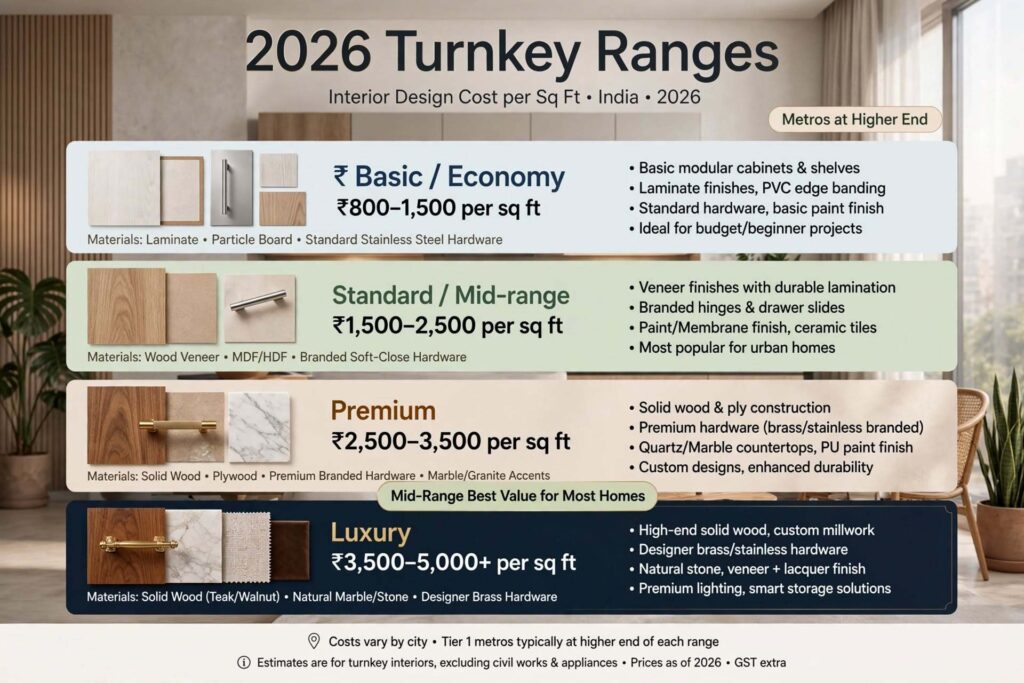
Different guides slice the tiers differently, but when you line up the 2026 market sources, a fairly consistent picture emerges for turnkey residential interiors:
| Tier | Typical interior design cost per sq ft | What you generally get |
|---|---|---|
| Basic / economy | ₹800 to ₹1,500 | Simpler modular work, basic finishes, limited customisation, standard hardware |
| Standard / mid-range | ₹1,500 to ₹2,500 | Full-home interiors with quality laminates, decent hardware, proper lighting and a false ceiling |
| Premium | ₹2,500 to ₹3,500 | Better materials, more customisation, designer fixtures, richer detailing |
| Luxury | ₹3,500 to ₹5,000+ | Bespoke joinery, imported or high-end finishes, statement lighting, extensive custom work |
Treat these as planning ranges, not quotes. Sources vary, and metro cities generally sit at the higher end while smaller cities come in lower. Some guides use a formula of carpet area multiplied by the per-sq-ft rate and a city multiplier, which is a handy way to sanity-check a quote.
As a rule of thumb, mid-range interiors are where most apartment owners land, and that’s the tier where the quality-for-cost balance tends to be best.
Cost by Home Size: 1BHK, 2BHK, 3BHK and Villas
Totals depend on carpet area, finish level and how much is built-in versus loose. Across the 2026 guides I reviewed, the commonly reported ranges look like this (again, wide, and finish-dependent):
| Home type | Typical area | Commonly reported total range |
|---|---|---|
| 1BHK | 500 to 700 sq ft | ₹5 to ₹10 lakh |
| 2BHK | 800 to 1,100 sq ft | ₹8 to ₹20 lakh |
| 3BHK | 1,200 to 1,700 sq ft | ₹12 to ₹30 lakh |
| 4BHK / villa | 2,000+ sq ft | ₹20 lakh to ₹70 lakh+ |
You’ll see some guides quote lower for budget work and far higher for luxury, which is exactly why a range beats a single “average.” A 2BHK done at economy level and the same flat done at luxury level can differ by several multiples.
What Drives the Cost Up or Down
Eight factors do most of the heavy lifting:
- Finish level. Laminate versus veneer versus solid wood; basic versus branded hardware; standard versus designer fittings.
- Scope. Full home versus one or two rooms; whether civil work (breaking walls, re-plumbing) is involved.
- Customisation. Off-the-shelf modular units cost less than bespoke carpentry built to your measurements.
- City and labour rates. Metros cost more; so does hard-to-source skilled labour.
- Kitchen and wardrobes. These two items often dominate the budget in Indian homes.
- False ceiling and lighting. Complex ceiling profiles and layered lighting add up fast.
- Design complexity. Curved walls, textured finishes, feature panelling and custom details all take more time and skill.
- Timeline. Rushed schedules can raise labour costs; a realistic timeline usually saves money.
If you’re weighing a bigger structural change alongside your interiors, it’s worth reading our guide on home addition ideas, since adding or reconfiguring space changes the whole cost picture.
Where the Money Actually Goes
A per-sq-ft rate hides how a budget actually divides up. In most Indian apartment projects, carpentry (the modular kitchen and wardrobes) takes the biggest share, followed by flooring and finishes, the false ceiling, electrical and lighting, painting, and then furniture and decor. A few indicative unit rates from the 2026 guides give a flavour of how the pieces add up:
- False ceiling: roughly ₹120 to ₹250 per sq ft
- Wall paint or texture: roughly ₹12 to ₹150 per sq ft depending on finish
- Engineered wood flooring: roughly ₹350 to ₹900 per sq ft
- Granite countertop: roughly ₹250 to ₹450 per sq ft
- Bathroom: roughly ₹1,000 to ₹2,200 per sq ft overall
Notice how a bathroom can cost far more per square foot than a living room. That’s why a flat with many bathrooms and a big kitchen runs higher than a flat of the same size with a simpler layout. It’s also why blended per-sq-ft figures can mislead (more on that below).
For context, interior finishes and furnishings commonly account for something like 15 to 35 percent of a home’s total construction budget, depending on how premium you go. If you’re building from scratch, our custom home building process guide shows where interiors fit in the bigger budget.
Carpet Area vs Built-Up Area: The Quiet Source of Bill Shock
This one catches a lot of people. In India, flats are described by carpet area (the usable floor area inside the walls), built-up area (carpet plus wall thickness and balcony) and super built-up area (built-up plus a share of common areas). Many interior designers quote and calculate per carpet-area sq ft, but some use built-up area, and a few use whichever number is bigger.
The same flat can swing by 20 to 30 percent between carpet and super built-up figures, so the same ₹1,800 per sq ft rate produces very different totals depending on the base. Before you compare two quotes, ask: “Is this per carpet area or built-up area, and what’s the exact square footage you’re using?” Then check it against your sale agreement or drawings. If you want to be confident reading those numbers, our guide on how to read architectural drawings helps.
Hidden Costs Most Quotes Skip
Even a clear per-sq-ft figure can leave out items that add up quickly. Ask whether the quote includes:
- GST and taxes, which can add a meaningful percentage on top
- Civil work, such as breaking or building walls, re-doing bathroom plumbing, waterproofing or flooring removal
- Electrical rewiring and extra points beyond a standard allowance
- Appliances, loose furniture, curtains, mattresses and decor, which are often excluded
- Site supervision and project management fees
- Design revisions after approval
- Warranty terms on carpentry and hardware
- Cleaning, debris removal and final handover costs
A cheaper-looking quote that excludes half of this list can end up more expensive than a higher, more complete one. Get inclusions and exclusions written down.
How Interior Design Cost Per Sq Ft Compares Globally
If you’re reading from outside India, the same confusion applies, just with different numbers. In the United States, designers’ fees are commonly reported at roughly $5 to $17 per sq ft, with most homeowners paying around $7 to $12, usually for design and coordination with furnishings priced separately. Other common models are hourly rates (often $100 to $500), flat per-room fees (anywhere from about $2,000 to $12,000 depending on scope) and a percentage on furnishings (typically 10 to 30 percent).
But when you add furniture, materials, labour and installation, full-service projects in high-cost metros can run well beyond the design-fee figure; some local guides cite $150 to $250 per sq ft for a fully executed project. Same lesson, different currency: the per-sq-ft figure only means something once you know whether it’s fee-only or the full job.
Why Per Sq Ft Pricing Can Mislead You
I’ll be honest with you: per-sq-ft pricing is convenient for designers and comparison sites, but it isn’t always fair to the client. Two flats of identical size can have completely different real costs:
- A 1,000 sq ft flat with a large modular kitchen, three wardrobes and two bathrooms costs much more to finish than a 1,000 sq ft flat with a compact kitchen and open storage.
- A sparse, minimalist design might cost less per square foot than a heavily detailed one, even at the same finish quality.
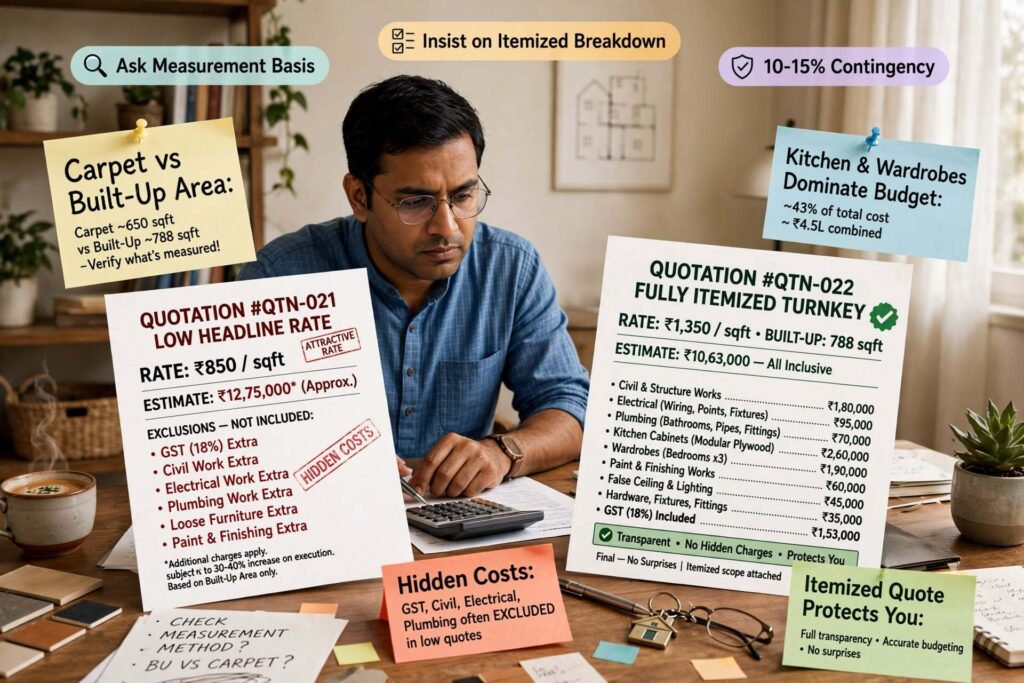
- Some firms quote a low headline rate and make it up through add-ons and variations later.
That’s why the smartest approach is to treat the per-sq-ft rate as a rough filter, not a contract. What actually protects you is an itemized breakdown, which brings us to the next point.
How to Read a Quotation
A trustworthy quote should be itemized, room by room, so you can see exactly what you’re paying for. Look for:
- A clear scope of work and a list of exclusions
- Material specifications, including brand, thickness and grade for plywood, laminates and hardware
- Quantities and unit rates, not just lump sums
- A payment schedule tied to milestones rather than a heavy upfront demand
- A realistic timeline with defined phases
- Warranty and after-sales terms
A few red flags worth taking seriously: an unusually low quote that nobody can explain, vague material descriptions (“good quality ply”), pressure to sign quickly, and refusal to provide references or past project photos. If you’re also deciding who should lead the project, our comparison of architect vs interior designer will help you pick the right professional first, and our guide on how to choose an architect covers the credential checks.
Sensible Ways to Control Your Budget
You don’t have to compromise on everything to keep costs in check. A few approaches that tend to work:
- Fix your scope and priorities before you start. Changes mid-project are the single biggest cause of overruns.
- Spend where it counts. Put more into the kitchen, wardrobes and lighting, which you’ll use daily, and keep decor and soft furnishings flexible.
- Phase the project. Do structural and built-in work now; add loose furniture and decor over time.
- Choose standard modular where it works and reserve bespoke carpentry for the pieces that genuinely need it.
- Compare itemized quotes, not headline rates.
- Keep a contingency of around 10 to 15 percent for surprises, especially in older properties.
- Avoid common design pitfalls that lead to expensive fixes later; our list of common interior design mistakes is worth a read first, and our guide to interior design styles can help you choose a direction before you commit to materials.
Frequently Asked Questions
1. What is the average interior design cost per sq ft in India? There isn’t one meaningful average, because the number depends on scope and finish. As a planning guide for 2026, turnkey interiors commonly run roughly ₹800 to ₹1,500 per sq ft for basic work, ₹1,500 to ₹2,500 for mid-range, ₹2,500 to ₹3,500 for premium, and ₹3,500 to ₹5,000+ for luxury, with metros at the higher end.
2. Why do different websites quote such different interior design cost per sq ft figures? They’re often measuring different things: design fee only, full turnkey, or finishes alone. Measurement basis (carpet versus built-up area), finish level and city also change the number. Always ask what’s included before comparing.
3. How much does a 2BHK interior cost in India? Commonly reported ranges for a 2BHK are around ₹8 to ₹20 lakh for mid-range work, with budget projects coming in lower and luxury far higher. The exact figure depends on area, kitchen and wardrobe scope, and finish quality.
4. How much does a 3BHK interior cost? A 3BHK commonly falls somewhere around ₹12 to ₹30 lakh, depending on size, customisation and materials, with premium and luxury projects going well beyond that.
5. Does the per sq ft rate include furniture? Often it doesn’t. Many turnkey rates cover built-in carpentry, false ceiling, painting and lighting but exclude loose furniture, curtains, appliances and decor. Confirm this in writing.
6. Is interior design cost calculated on carpet area or built-up area? It varies by firm. Many designers use carpet area, but some use built-up area, which gives a larger base and a higher total. Ask which one is used and verify the square footage against your documents.
7. How much does an interior designer charge in India for design only? Design-only fees are commonly reported at roughly ₹50 to ₹500+ per sq ft, depending on the designer’s experience, scope and city. Some charge a percentage of the project value or a fixed package instead.
8. How much does interior design cost per square foot in the US? Designer fees are commonly reported at around $5 to $17 per sq ft, with many homeowners paying roughly $7 to $12 for design and coordination, and furnishings billed separately. Fully executed projects, including furniture and labour, can cost considerably more, especially in high-cost metros.
9. What are the hidden costs in interior design? Common ones include GST, civil and plumbing work, electrical rewiring, appliances, loose furniture, site supervision, design revisions and debris removal. Asking for an itemized list of inclusions and exclusions protects you from surprises.
10. How can I reduce my interior design cost per sq ft without losing quality? Fix your scope early, prioritize the kitchen, wardrobes and lighting, use standard modular units where possible, phase the project over time, compare itemized quotes rather than headline rates, and keep a 10 to 15 percent contingency. Avoiding mid-project changes saves more than almost any material swap.
Final Thoughts
The honest answer to “what’s the interior design cost per sq ft?” is: it depends on what that number is covering. A design-fee rate, a turnkey rate and a fully furnished rate can differ by several multiples, and a flattering headline figure can hide exclusions that arrive later as extra invoices. Ask what’s included, confirm the measurement basis, and insist on an itemized quote, and you’ll avoid most of the nasty surprises.
If you’d like a clear, itemized estimate for your own home rather than a generic range, our team at Archtra will walk you through scope, materials and budget before any work begins. Browse our project portfolio and project gallery to see what different budgets can achieve, or get in touch with our design team to start planning your space.