Quick Answer: For most Indian homes, an RCC vs steel frame structure decision comes down to this — RCC (Reinforced Cement Concrete) remains the cheaper, more familiar choice for low- and mid-rise residential construction, with typical structural costs of ₹1,200–3,500 per sq ft in 2026 and no additional fireproofing needed. Steel frame structures cost more for the frame itself but build 20–40% faster, weigh roughly 20% less (easing foundation load), and generally outperform RCC under seismic stress. For a standard 2-3 storey home, RCC is usually still the right call; steel earns its premium on larger spans, tight timelines, or genuinely high-seismic sites.
Choosing between an RCC vs steel frame structure isn’t really a style decision — it’s a structural engineering call that shapes your budget, your construction timeline, and how your home performs for the next 50-plus years, which is exactly why we get asked about it constantly during the early planning stage, right around the same conversation as choosing between an architect, structural engineer, and contractor. This guide breaks the comparison down honestly across cost, speed, strength, fire resistance, and maintenance — using real 2026 Indian construction data rather than the generic pros-and-cons lists most articles on this topic recycle.
RCC vs Steel Frame Structure: The Core Difference
RCC (Reinforced Cement Concrete) is a composite structural system where concrete — strong in compression but weak in tension — is reinforced internally with steel (TMT) bars, which handle the tension loads. It’s cast in place on-site, requires shuttering and curing time, and has been the dominant residential construction method in India for decades, largely because the materials, labour, and expertise are widely and cheaply available almost everywhere in the country.
A steel frame structure instead uses fabricated steel beams, columns, and connections — either bolted or welded — to carry the building’s loads, with the steel doing the structural work directly rather than through a concrete-steel composite. It’s been the standard for commercial buildings, warehouses, and industrial sheds in India for years, and it’s slowly making inroads into residential construction, particularly for larger, faster, or architecturally ambitious homes.
Cost Comparison: RCC vs Steel Frame Structure in 2026
This is usually the deciding factor, and it’s more nuanced than a single number suggests.
| Factor | RCC | Steel Frame |
|---|---|---|
| Structural cost (2026, per sq ft) | ₹1,200 – ₹3,500 depending on city, grade, and scope | Generally 15–30% higher for the frame itself in residential-scale projects |
| Foundation cost | Higher — RCC structures are roughly 20% heavier, requiring larger foundations | Lower — reduced structural weight eases foundation load and cost |
| Construction timeline | Slower — 7 to 28 days of curing time per pour, labour-intensive | Faster — prefabricated components assembled on-site; studies show 20–40% timeline reduction |
| Best cost fit | Low- to mid-rise residential (G+1 to G+3) | Large-span, time-sensitive, or taller structures |
The honest summary: for a typical residential project under three or four storeys, RCC usually wins on total delivered cost once you account for foundation savings not being large enough to offset steel’s higher frame cost. Steel starts winning on total project economics — not just frame cost — once speed itself becomes financially valuable, such as a commercial fit-out with revenue riding on an early handover, which is part of why steel dominates in the industrial and warehousing space we cover on our Industrial Buildings service page.
Construction Speed: Where Steel Genuinely Wins
If your project has a hard deadline, this comparison matters more than the per-square-foot rate. RCC construction is inherently slower because concrete needs real curing time — typically 7 to 28 days depending on the element and load requirements — and each pour has to be sequenced around this. Steel frame construction uses prefabricated components bolted or welded together on-site, which isn’t weather- or curing-dependent in the same way, and multiple industry studies point to a 20–40% reduction in overall construction timeline compared to equivalent RCC structures.
For most homeowners building on a standard, unhurried timeline, this speed advantage doesn’t fully offset steel’s higher frame cost. It becomes genuinely decisive for commercial projects, rental properties where every month of construction is a month of lost income, or sites where monsoon timing makes a faster dry-construction method meaningfully valuable.
Seismic Performance: A Genuine Structural Consideration, Not Just a Cost Line
This is where the comparison moves from budget spreadsheet to real safety engineering, and it deserves honest treatment rather than being buried under cost figures.
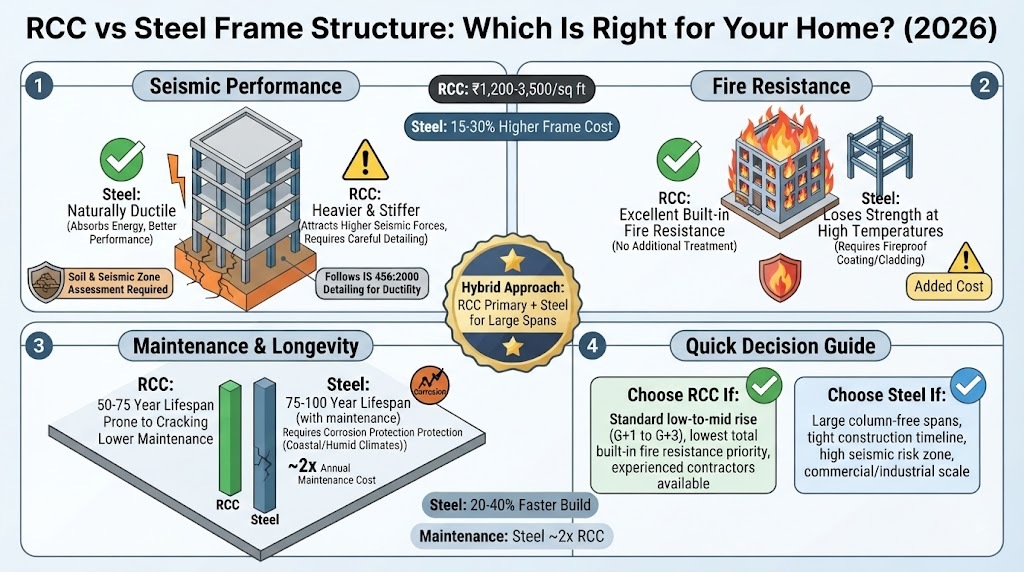
Structural steel is naturally ductile — it can bend and stretch significantly under load without fracturing, which allows it to absorb and dissipate seismic energy rather than transferring the full force through a rigid structure. RCC, by contrast, is inherently heavier and stiffer, which means it attracts higher seismic forces in the first place, and while modern RCC design (following IS 456:2000 detailing guidelines) can achieve good ductility when reinforcement is correctly detailed and executed, poor workmanship introduces real brittle-failure risk that a steel frame is comparatively more forgiving of. Comparative seismic research has found steel-frame buildings can perform meaningfully better under seismic stress than equivalent RCC structures — a genuinely important data point if you’re building in a higher seismic zone.
This is exactly the kind of judgment call that shouldn’t be made from a blog comparison table alone — it’s precisely why proper structural engineering assessment matters at the design stage, factoring in your specific soil conditions, seismic zone classification, and building height, rather than applying a generic “RCC vs steel” rule of thumb to every project.
Fire Resistance: RCC’s Clearest Advantage
This is one comparison point where RCC has a genuinely decisive edge for residential use. Concrete can withstand high temperatures for extended periods without losing structural integrity, and RCC construction requires no additional fireproofing treatment to meet standard fire safety codes. Steel, by contrast, loses structural strength rapidly at high temperatures and requires dedicated fireproof coating or cladding to perform acceptably in a fire scenario — an added cost and maintenance consideration that’s easy to underestimate when comparing raw structural rates. For a typical residential home, RCC’s built-in fire resistance is a real, practical advantage that doesn’t show up in a simple per-square-foot comparison.
Maintenance and Long-Term Durability
- RCC: Generally resistant to corrosion when properly designed and constructed, but prone to surface cracking from thermal stress or shrinkage over time, and once cracks develop beyond acceptable limits, the embedded steel reinforcement loses its protective concrete cover and becomes vulnerable to corrosion from within — a slower-developing but genuinely serious long-term risk if maintenance is neglected.
- Steel: Requires proactive corrosion protection — coatings or galvanisation — particularly in humid, coastal, or monsoon-heavy regions, which describes much of India’s climate. One comparative study estimated annual maintenance cost for steel structures at roughly double that of RCC, driven largely by ongoing corrosion prevention.
- Typical lifespan: RCC buildings generally offer 50–75 years of service life with reasonable maintenance; steel structures can reach 75–100 years, but only with consistent protective maintenance — meaning steel’s longevity advantage depends entirely on upkeep discipline that RCC doesn’t require to the same degree.
RCC vs Steel Frame Structure: Quick Decision Guide
- Choose RCC if: You’re building a standard low- to mid-rise home (up to G+3), want the lowest total project cost, prioritize built-in fire resistance, or you’re working with contractors and labour more experienced with RCC — which describes most residential markets across India
- Choose steel if: You need large, column-free spans (open-plan living areas, double-height spaces), you’re on a tight construction timeline, your site sits in a high seismic risk zone where ductility is a priority, or the project is closer to commercial/industrial in scale and use
- Consider a hybrid approach: Many modern homes use RCC for the primary structure and steel selectively for large spans, mezzanines, or feature elements — combining RCC’s cost and fire advantages with steel’s flexibility exactly where it’s needed, rather than treating the choice as strictly binary. Whichever system you choose, it directly affects your total budget alongside interior fit-out costs, so it’s worth finalizing structure before locking in your interior budget, not after.
Frequently Asked Questions
Is RCC or steel cheaper for a residential building in India? RCC is generally cheaper for standard low- to mid-rise residential construction once total project cost — including foundation size — is factored in. Steel becomes more cost-competitive at larger spans or when construction speed carries real financial value.
Which is better in an earthquake, RCC or steel? Steel structures generally perform better under seismic stress due to their natural ductility, though a well-designed and correctly executed RCC structure, following proper detailing guidelines, can also achieve strong seismic performance. This is a decision worth making with a structural engineer based on your specific site’s seismic zone, not a generic rule.
Does a steel frame home need more maintenance than RCC? Yes, generally. Steel requires ongoing corrosion protection, particularly in humid or coastal climates, with one study estimating annual maintenance costs at roughly double RCC’s. RCC’s main maintenance concern is crack monitoring and timely repair rather than continuous corrosion prevention.
How much faster is steel construction compared to RCC? Industry data points to a 20–40% reduction in overall construction timeline for steel frame structures compared to equivalent RCC buildings, largely because steel avoids concrete’s curing-time dependency.
Can I mix RCC and steel in the same building? Yes, and it’s increasingly common — using RCC for the primary structure and steel for large-span areas, mezzanine floors, or specific architectural features is a practical way to get the cost and fire-resistance benefits of RCC alongside the flexibility of steel exactly where you need it.
The Bottom Line
The RCC vs steel frame structure decision for most Indian homes still favours RCC — it’s cheaper for typical residential scale, requires no additional fireproofing, and is what the vast majority of Indian contractors and labour are genuinely experienced building well. Steel earns its higher upfront cost specifically when you need large open spans, a faster build timeline, or stronger seismic performance for a higher-risk site — and increasingly, a hybrid approach lets you capture the best of both rather than forcing an all-or-nothing choice. Either way, this isn’t a decision to make from cost tables alone: it belongs in the same conversation as your plot size and house plan, reviewed properly by a structural engineer before your design is finalized.
If you’re at the stage of deciding between structural systems for your home, book a consultation with our team — we’ll assess your plot, soil conditions, and seismic zone before recommending a structural approach, rather than defaulting to whatever’s fastest to quote.