Quick Answer: The most effective passive cooling techniques for homes — proven across real building studies, not just theory — are cross ventilation combined with high-mass materials, cool or reflective roof coatings, and correctly oriented shading. Research shows well-designed cross ventilation and thermal mass can lower indoor temperatures by 3–6°C compared to outdoors without any mechanical cooling, reflective roof coatings have cut indoor temperatures by 2.4–8°C in real building trials, and cool roofs alone can cut air conditioning energy use by up to 15%. None of this requires exotic materials — it requires getting orientation, ventilation, and surface reflectivity right at the design stage, which is far cheaper than retrofitting a cooling system onto a heat-trapping building later.
Passive cooling techniques for homes matter more with every passing summer, and the honest appeal is straightforward: reducing how much heat your home absorbs and traps in the first place is both cheaper and more sustainable than compensating for a poorly designed building with a bigger air conditioner. This is true whether you’re building in Chennai, Phoenix, Dubai, or southern Spain — climate-responsive design principles are largely universal even though the specific techniques that matter most shift depending on whether your climate is hot-dry or hot-humid. This guide breaks down what genuinely reduces indoor heat, with real research and measured temperature data behind each technique, rather than the generic “paint your roof white” advice most articles stop at.
Why Passive Cooling Beats Retrofitted Air Conditioning
Every degree of heat your building envelope keeps out is a degree your mechanical cooling system never has to remove — which means lower running costs for the life of the building, not just a one-time saving. Passive design strategies have been shown in systematic reviews to meaningfully decrease cooling loads and improve energy efficiency across both residential and commercial buildings, and unlike mechanical cooling upgrades, most passive strategies are far cheaper — sometimes free — when built into the original design rather than retrofitted afterward. This is exactly the reasoning behind pairing your exterior colour choices with genuine heat-reflection performance rather than aesthetics alone — the two decisions are really one decision viewed from different angles.
Cross Ventilation: The Foundation of Passive Cooling
Air movement through a building is one of the oldest and still most effective passive cooling strategies, but how well it works depends heavily on window placement, room layout, and climate type — not just “leave windows open.”
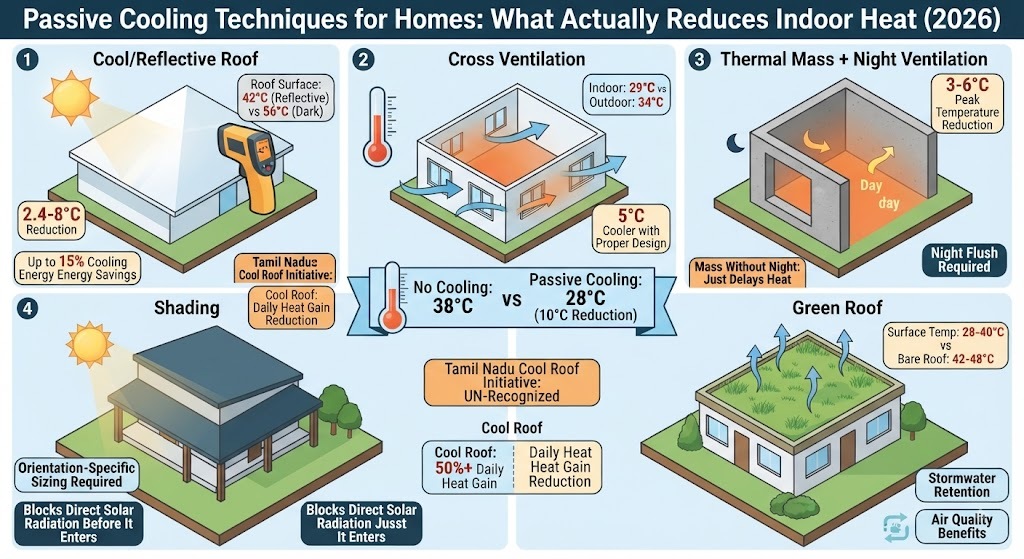
Research comparing traditional building typologies in hot-humid climates found that homes with well-designed cross ventilation combined with high thermal mass — such as courtyards paired with heavy construction materials — maintained daytime indoor temperatures up to 5°C cooler than outdoor conditions, while poorly ventilated, lightweight structures spent the overwhelming majority of time outside comfortable temperature ranges. Window type matters more than most homeowners realize too — comparative studies on natural ventilation performance found side-hung windows outperformed sliding and top-hung designs for driving effective airflow through a room, a small design detail with a genuinely measurable effect.
The practical takeaway: position windows on opposite or adjacent walls to create a real air path through the building rather than a single dead-end opening, and favor window types that open fully rather than partially, since airflow volume scales directly with usable opening area.
Thermal Mass and Night Ventilation: A Genuinely Powerful Combination
Thermal mass — using materials like concrete, stabilized earth blocks, or stone that absorb heat slowly during the day and release it gradually — only works as a cooling strategy when it’s paired with a way to flush that stored heat back out overnight. Used alone, high-mass construction just delays heat rather than removing it.
Research modeling this combination in hot climates found that thermal mass paired with night ventilation reduced maximum indoor temperatures by 3 to 6°C compared to outdoor peaks, without any mechanical cooling running at all. Crucially, researchers found night ventilation is considerably more effective in high-mass buildings than lightweight ones — the mass has to be there to store the coolness night ventilation brings in, or the benefit disappears by mid-morning. This is part of why traditional heavy-walled construction in hot-dry climates — from adobe in the American Southwest to thick masonry in Rajasthan — wasn’t just cultural preference; it was a genuinely effective, empirically sound cooling strategy that modern lightweight construction has to work harder to replicate.
Cool and Reflective Roofs: The Single Highest-Impact Retrofit
If you can only implement one passive cooling strategy, this is very likely it — the research behind reflective roofing is some of the most robust in this entire category, and it applies almost anywhere hot sun is a factor, independent of humidity or building type.
A validated building model in Singapore found that cool coating with a reflectance of 0.74 applied to a concrete roof reduced peak roof surface temperature by 14.1°C and indoor air temperature by 2.4°C, cutting daily heat gain by over 50%. In an even more dramatic real-world example, Tamil Nadu’s Cool Roof Initiative — deploying reflective coatings across mass housing in India — reduced indoor temperatures by 5–8°C, a program significant enough to earn United Nations recognition for its scalable climate-resilience impact. In terms of energy savings specifically, cool roofs have been shown to cut cooling energy demand by up to 15% on single-story buildings, and by up to 30% for peak cooling demand on larger commercial and warehouse roofs — directly relevant if you’re evaluating roofing for the kind of large-span industrial buildings where roof area is substantial relative to total building volume.
Why this works so well: a standard dark roof can run 50–90°F (28–50°C) hotter than surrounding air temperature and transfers a meaningful share of that heat directly into the building below. A reflective surface keeps roof temperature only marginally above ambient air temperature, which is the core reason this single change produces such an outsized effect relative to its cost.
Green Roofs: Slower to Install, but Genuinely Effective
Green (vegetated) roofs work through a different mechanism than reflective coatings — evapotranspiration from plants actively cools the roof surface rather than simply reflecting solar radiation away. Comparative research testing bare roofs against green roofs found bare roof surface temperatures ranging from 42–48°C, while equivalent green roof surfaces stayed in the 28–40°C range under the same conditions — a genuinely substantial difference. Green roofs don’t reflect as much direct solar radiation as a bright cool-roof coating, but they add real secondary benefits: meaningful stormwater retention (a 3-inch green roof layer can hold up to 2 inches of rainfall on average) and measurable air quality improvement, on top of the direct cooling effect.
The trade-off worth knowing upfront: green roofs require structural capacity for the added weight, ongoing maintenance, and a higher installation cost than a reflective coating — which is why we typically recommend them as a complementary strategy for a portion of roof area, rather than the sole cooling strategy for an entire structure, particularly on renovation projects where structural load has to be verified first alongside any RCC vs steel structural decision.
Shading: Position Matters More Than Material
Shading devices — overhangs, brise-soleil louvers, deep verandas, or traditional jaali screens — block direct solar radiation before it ever reaches your walls or glazing, which is more effective than trying to manage heat after it’s already inside. Research on arid residential buildings found that combined shading and natural ventilation strategies significantly improved thermal comfort, with the shading component doing much of the heavy lifting on the hottest, highest-sun-angle days.
The design detail that actually determines effectiveness is orientation-specific sizing: a fixed horizontal overhang sized correctly for a south-facing window (in the northern hemisphere) can block high-angle summer sun while still admitting lower-angle winter sun, giving you cooling benefit in summer without a heating penalty in winter — but the same overhang depth is close to useless on an east- or west-facing wall, where the sun sits low in the sky during the hottest parts of the day. This is exactly the kind of orientation-specific detail that needs to be resolved during elevation and façade design, not added as an afterthought once the walls are already up.
Putting It Together: A Realistic Passive Cooling Strategy
- Start with orientation and shading at the design stage — this is free if planned early and expensive to retrofit later
- Design genuine cross ventilation with openings on opposite or adjacent walls, favoring window types that open fully
- Choose a cool or reflective roof coating as close to a default as your climate allows — the cost-to-benefit ratio here is difficult to beat with any other single intervention
- Add thermal mass only where you can also ventilate it at night — mass without night flushing just delays the heat problem rather than solving it
- Reserve green roofs for areas where the added structural, maintenance, and stormwater benefits justify the higher upfront cost, rather than treating them as a default across the whole roof
Frequently Asked Questions
What is the most effective passive cooling technique for hot climates? Reflective or cool roofing tends to offer the best cost-to-benefit ratio, with real-world programs like Tamil Nadu’s Cool Roof Initiative showing 5–8°C indoor temperature reductions. Cross ventilation combined with thermal mass is comparably effective (3–6°C reduction) but depends more heavily on correct design execution.
Do passive cooling techniques work in humid climates, not just dry ones? Yes, though the specific strategy shifts — courtyards and cross ventilation perform particularly well in hot-humid climates by enabling night-time stack-effect ventilation, while pure thermal mass strategies (more common in hot-dry regions) need to be paired carefully with humidity management to avoid trapping moisture.
How much can passive cooling reduce my air conditioning costs? Research points to cool roofs alone cutting cooling energy use by up to 15% on residential-scale buildings, and up to 30% peak demand reduction on larger commercial roofs. Combined with proper shading and ventilation, the cumulative effect on total cooling load can be considerably higher.
Is a green roof or a reflective roof coating better for cooling? Reflective coatings generally produce a larger direct temperature reduction for lower upfront cost. Green roofs cool through a different mechanism (evapotranspiration) and add stormwater and air quality benefits, but come with higher installation cost and structural requirements — the right choice depends on your budget and whether those secondary benefits matter for your project.
Can I add passive cooling to an existing home, or does it need to be designed in from the start? Some strategies — reflective roof coatings, exterior shading devices, better window operation — retrofit reasonably well onto existing homes. Others, particularly optimal cross ventilation and orientation-specific design, are genuinely far cheaper and more effective when planned from the start, which is worth factoring in if you’re still finalizing your house plan and layout.
The Bottom Line
Passive cooling techniques for homes aren’t a niche sustainability add-on — they’re genuinely measurable, research-backed strategies that reduce both indoor temperature and long-term energy cost, often for a fraction of what a larger air conditioning system would cost to install and run. Cross ventilation and thermal mass can cut indoor temperatures by 3–6°C without any mechanical cooling; cool roofs alone have delivered 5–8°C reductions in real-world programs; and correctly positioned shading prevents heat from ever becoming a problem your cooling system has to solve. The common thread across all of them: passive cooling works best when it’s part of the original design conversation — orientation, window placement, roof material, shading geometry — not something bolted onto a finished building after the first uncomfortable summer.
If you’re planning a new build or major renovation and want passive cooling strategy built into your design from day one, book a consultation with our team — we factor climate-responsive design into every project, not as an optional upgrade at the end.