Quick Answer: Genuine energy-efficient home design delivers real, measurable savings — homes designed and built with efficiency in mind typically use 20-35% less energy than a conventional build, and the U.S. Department of Energy confirms efficiency upgrades alone can cut energy use by 20-30% or more. The catch most homeowners miss is sequencing: air sealing and insulation come first (payback in 3-5 years), then right-sized HVAC and windows, and only then solar — putting solar on a leaky, poorly insulated home is like buying a gym membership while eating fast food three meals a day, spending money on savings you’ll never actually capture.
Energy-efficient home design isn’t a single feature you bolt onto a house — it’s a sequence of decisions, each one making the next more effective, and getting that order wrong is the single most common reason homeowners feel like their “green” upgrades never delivered the savings they were promised. We hear this constantly from clients who installed solar panels first, expecting dramatic bill reductions, only to realize the home was still bleeding conditioned air through poor insulation and leaky windows the whole time. This guide walks through what genuinely moves the needle on energy use, real 2026 cost and payback data, and the order that actually maximizes both your savings and your investment.
Why the Building Envelope Comes Before Everything Else
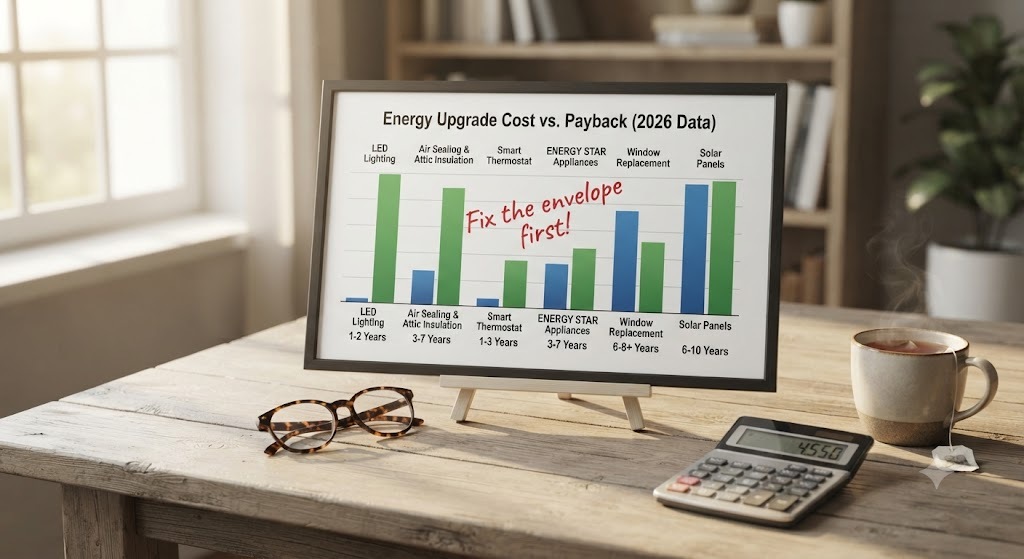
Before any equipment upgrade — HVAC, solar, smart thermostats — the building envelope (walls, roof, windows, and how airtight the whole structure is) determines how much energy your home needs in the first place. Insulation doesn’t generate heating or cooling; it preserves what your HVAC system already produced, which is exactly why insulation upgrades consistently deliver the best dollar-for-dollar return of any energy investment. Proper insulation can reduce heating and cooling costs by 15-30%, and air sealing combined with attic insulation typically costs $2,500-$6,000 with annual savings of $500-$1,000 — a payback period of just 3-7 years on the full installed cost.
This is also exactly the logic behind passive cooling design — orientation, shading, and thermal mass reduce the heat load a building has to manage before any mechanical system gets involved, which is the same “reduce demand before adding supply” principle that governs energy-efficient design generally, whether you’re managing heat gain in a hot climate or heat loss in a cold one.
Windows: Where the Numbers Get More Nuanced Than Marketing Suggests
Windows account for roughly 25-30% of residential heating and cooling energy loss, making them a genuinely significant factor in energy-efficient home design — but the payback math here is more situation-dependent than most window sales content admits.
Replacing genuinely old, single-pane windows with modern double-pane, low-E glass delivers the biggest jump — typically $250-$400 in annual savings, since single-pane glass performs at roughly R-1 insulation value compared to R-13 or more for a properly insulated wall. But replacing already-decent double-pane windows with new double-pane low-E units saves considerably less — $125-$225 annually — and moving from double to triple pane saves less still, often just $75-$150 a year. Full window replacement projects can run $10,000-$12,000+ for a mid-size home, with realistic payback periods of 6-8 years for genuinely necessary replacements, stretching to 10-40+ years for upgrades on windows that weren’t actually failing.
The practical takeaway: if your current windows are drafty, failing, or genuinely single-pane, replacement earns its cost. If they’re modern and functional, fixing air leaks and insulation elsewhere in the envelope typically delivers better returns first — a detail that ties directly into how we approach elevation and façade design, where window specification is resolved alongside the building’s overall thermal strategy, not chosen in isolation.
HVAC, Lighting, and Appliances: The Mid-Tier Upgrades
Once the envelope is addressed, equipment efficiency delivers the next tier of returns, and several of these — particularly ceiling-integrated lighting and cooling — are worth planning alongside your false ceiling and lighting design rather than treating electrical efficiency as a separate decision:
- LED lighting: The fastest payback of any upgrade on this list — typically 1-2 years, with 50-75% energy savings versus incandescent lighting. This is close to a no-brainer regardless of what else you’re planning.
- Smart thermostats: Payback of 1-3 years, saving 10-15% on heating and cooling costs through better scheduling and zone control.
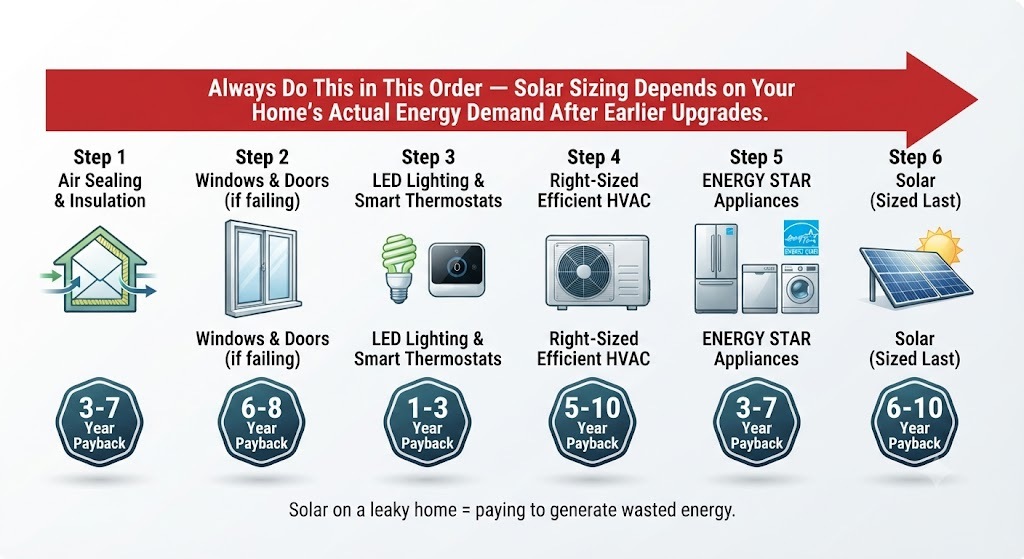
- Right-sized, high-efficiency HVAC (including heat pumps): Payback of 5-10 years, but critically, HVAC should be sized to the home’s actual post-insulation heat load — installing an oversized system in a home that hasn’t been properly sealed and insulated wastes money on unnecessary capacity.
- ENERGY STAR appliances: Payback of roughly 3-7 years depending on the appliance category, with the biggest gains typically coming from refrigerators, washing machines, and water heaters.
Solar: The Upgrade Everyone Wants First, and Why That’s Usually Backwards
Solar panels are the most visible, most discussed energy-efficient home design feature — and also the one most commonly installed out of sequence. Solar installations typically cost $15,000-$35,000 for a residential system, with payback periods of 6-10 years under current market conditions, extending further without local incentives.
The sequencing problem is straightforward: a solar system is sized based on your home’s energy consumption. Install it before addressing insulation, air sealing, and HVAC efficiency, and you’re sizing (and paying for) a larger system than a genuinely efficient home would need — quite literally paying to generate power you’re wasting through a leaky envelope. Address the envelope and equipment efficiency first, then size solar to your home’s actual, reduced energy demand, and the system costs less while delivering the same or better bill reduction.
What Genuine Energy-Efficient Home Design Costs, Realistically
Energy-efficient home design for new construction typically adds a 30-50% premium over conventional construction — energy-efficient new builds run roughly $150-$400 per square foot compared to $100-$250 for a conventional build, depending on how aggressively the project pursues efficiency (from solid upgrades to full Passive House-standard performance). Retrofitting an existing home runs anywhere from $25,000 for basic efficiency improvements to $150,000+ for a comprehensive sustainable retrofit, with insulation, high-performance windows, and mechanical systems as the largest cost drivers in either case.
This is comparable in scale to the investment decisions we walk clients through for luxury villa design, where material and systems quality genuinely pay for themselves over a home’s lifetime rather than being a purely aesthetic upgrade — energy efficiency is simply the version of that principle that shows up directly on a monthly utility bill rather than in how a room feels.
The Right Order: A Practical Sequence
- Air sealing and insulation — the foundation, and the best return on any energy dollar spent
- Windows and doors — only if genuinely failing or single-pane; otherwise deprioritize
- LED lighting and smart thermostats — fast, cheap, high-ROI wins to implement alongside step 1
- Right-sized, efficient HVAC — sized to the home’s post-insulation heat load, not its pre-upgrade demand
- ENERGY STAR appliances — as existing appliances reach end of life, rather than replacing functional units early
- Solar (with or without battery storage) — sized last, once actual energy demand has already been reduced
Getting this sequence right is exactly the kind of planning decision that belongs in the same conversation as your architect, structural engineer, and contractor discussion at the very start of a project, since building envelope decisions are far cheaper to get right during design and construction than to retrofit afterward.
Frequently Asked Questions
What is the single best energy-efficient home upgrade for the money? Air sealing and attic insulation consistently deliver the best dollar-for-dollar return of any residential energy improvement, with a typical payback of 3-7 years and savings that amplify the benefit of every other upgrade made afterward.
Should I install solar panels or upgrade insulation first? Insulation and air sealing first, almost always. Solar systems are sized to your home’s energy consumption, so reducing that consumption first through a tighter, better-insulated envelope means a smaller, cheaper solar system delivers the same or better results.
How much does energy-efficient home design actually cost for new construction? Expect roughly a 30-50% premium over conventional construction, translating to approximately $150-$400 per square foot depending on how aggressively you pursue efficiency, compared to $100-$250 for a standard build.
Do energy-efficient windows really pay for themselves? It depends heavily on your starting point. Replacing genuinely old single-pane windows with modern low-E double-pane units delivers strong savings and a reasonable 6-8 year payback. Replacing already-functional modern windows delivers far more modest returns and can take decades to pay back.
What’s the payback period for a typical home energy retrofit? Most individual upgrades pay back within 3-10 years, though the full range spans from under 2 years for LED lighting to 15-25 years for larger investments like geothermal heat pump systems.
Is it worth insulating before replacing an old HVAC system? Yes, strongly. Installing a new HVAC system before addressing insulation and air sealing means sizing (and paying for) more heating and cooling capacity than a properly insulated home would actually need.
How much can energy-efficient home design actually reduce my utility bills? Realistically, 20-35% total energy reduction is achievable through combined envelope, equipment, and lighting upgrades, based on U.S. Department of Energy estimates and multiple 2026 industry cost studies — with solar reducing bills further once sized to that lower baseline demand.
Do LED lights really make a meaningful difference in overall energy use? Yes — LEDs use roughly 90% less energy than incandescent bulbs and last up to 25 times longer, with one of the fastest payback periods (1-2 years) of any efficiency upgrade, making it one of the easiest high-ROI decisions in the entire list.
What certifications or standards matter for energy-efficient home design? Standards like the Passive House standard focus on reducing how much energy a home needs in the first place, rather than relying on larger mechanical systems to compensate — a design-first philosophy that generally produces better long-term results than equipment-first approaches.
Is it better to build energy-efficient from the start, or retrofit later? Building efficiently from the start is almost always more cost-effective, since envelope decisions (insulation, orientation, window placement) are dramatically cheaper to get right during initial construction than to retrofit into a finished structure — which is why we build efficiency into the architectural design phase rather than treating it as a later add-on.
The Bottom Line
Energy-efficient home design genuinely saves real money — but only when the investment follows the right sequence. Address the building envelope first (insulation and air sealing deliver the strongest return of any single upgrade), add fast, cheap wins like LED lighting and smart thermostats alongside it, right-size your HVAC to the home’s new, lower heat load, and only then size solar to match your actual reduced demand. This same “get the sequence right” discipline applies across construction generally — the same reasoning behind resolving staircase and circulation design early rather than as an afterthought. Skip the sequence, and you’re spending real money generating or conditioning energy your home is still wasting through gaps you never fixed. Get the order right, and both your monthly bills and your home’s long-term value benefit together.
If you’re planning new construction or a major renovation and want energy efficiency built into your design from the very first conversation, book a consultation with our team — we factor building envelope performance into every project’s structural and architectural planning, not as an optional add-on at the end. envelope performance into every project’s structural and architectural planning, not as an optional add-on at the end.