Resin driveways have quietly taken over the front of British streets, and plenty of other places too. The appeal is easy to see: a smooth, seamless surface in a colour you actually chose, no weeds poking through, and, if it’s done properly, no planning application for a front drive. But the sales pages tend to skip the awkward bits. The permeability depends on what’s under the resin, not just the resin. Prices swing wildly between quotes. And the drive is rarely judged on its own: it sits at the foot of the house and decides how the whole front elevation reads. Here’s what I’d want to know before spending a penny.
(Insert your image here with the alt text above.)
Resin Bound vs Resin Bonded: Two Very Different Products
People say “resin driveway” as if it’s one thing. It’s two, and the difference changes everything from drainage to lifespan.
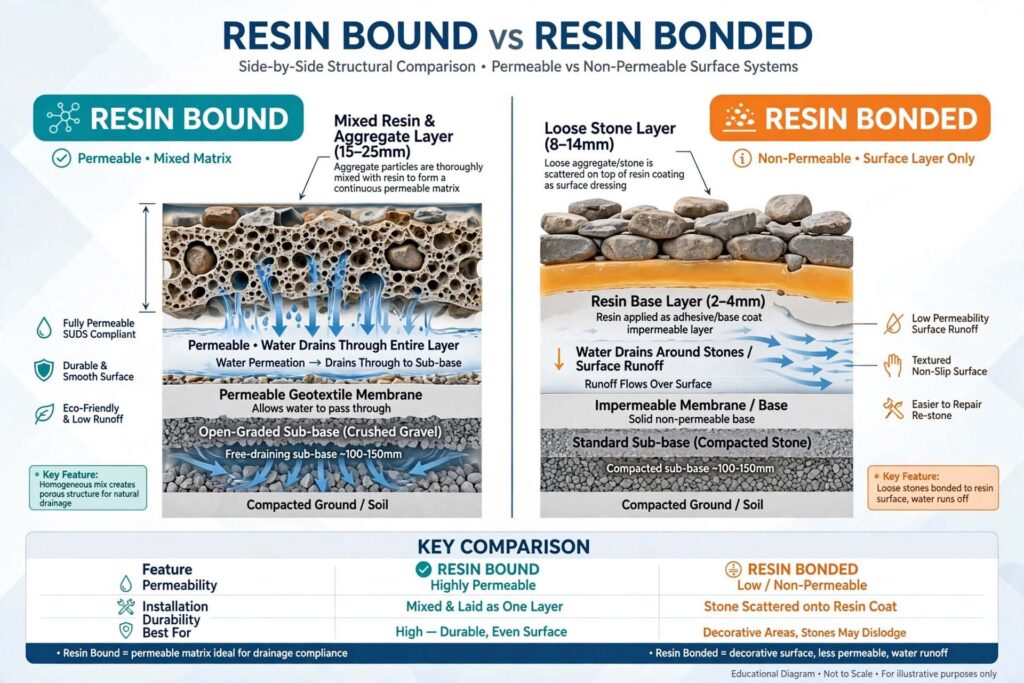
Resin bound is a mix of stone aggregate and clear, UV-stable resin, mixed together and trowelled onto the base in a layer. The stones are coated and stuck to each other, leaving tiny gaps, so water drains through. The surface is smooth and seamless.
Resin bonded is the other way round. A layer of resin is spread on the base, then loose stone is scattered over the top while it’s wet. The surface is rougher, and it isn’t permeable.
| Resin bound | Resin bonded | |
|---|---|---|
| Finish | Smooth, seamless | Rough, textured, some loose stone |
| Permeable | Yes, if the base is too | No |
| Typical lifespan | About 15 to 25 years | About 10 to 15 years |
| Typical price | Higher | Lower |
| Planning (England, front drive over 5 m²) | Usually fine if permeable build-up | Needs drainage or permission |
For most front drives, resin bound is the one you want. Resin bonded has its place on steep slopes, where grip matters, or for tight budgets where permeability isn’t a concern, but it isn’t an equivalent product and shouldn’t be priced as one.
SuDS, Permeability and the Planning Rule That Catches People Out
This is the part that earns resin driveways their reputation, and also the part where installers and homeowners get things wrong.
In England, since 2008, if you pave more than 5 m² of front garden with a non-permeable surface, you need planning permission unless the rainwater drains to a lawn, border or other permeable area within your property. SuDS means sustainable drainage systems: the idea is to let rainwater soak in where it falls, instead of rushing into the road drains and, in a downpour, flooding someone downstream.
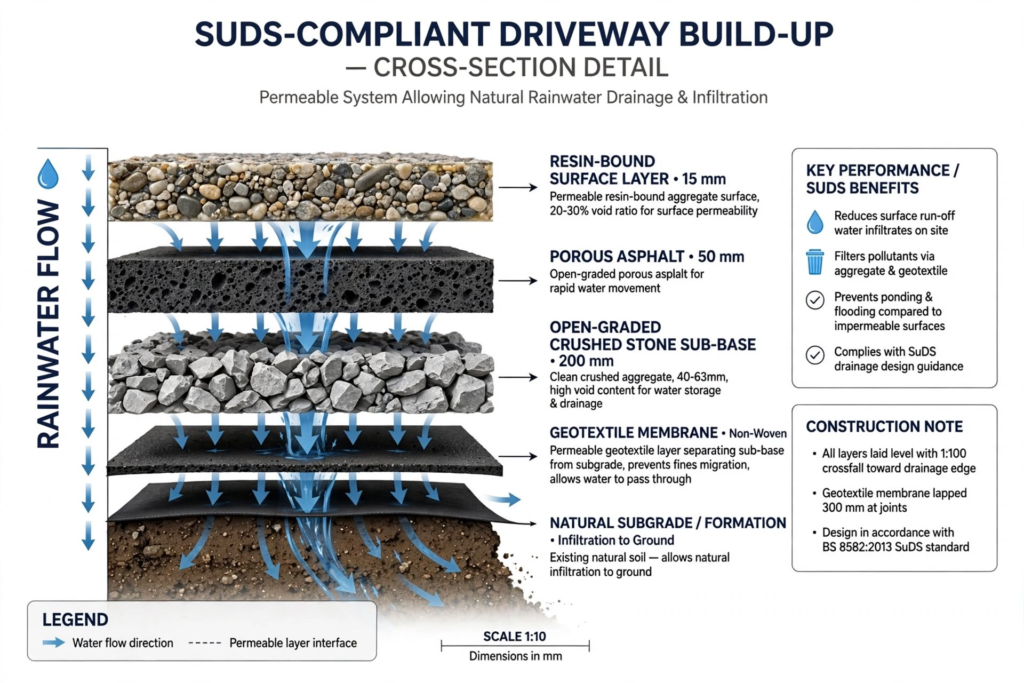
Resin bound passes because the surface lets water through. But here’s the catch that sales pages tend to bury: the water has to go somewhere. If a resin bound surface is laid over solid concrete or a sealed tarmac base, rain will pass through the resin and then sit on top of the slab and run off the edge, exactly as it would on any other hard surface. A properly permeable build-up needs an open, free-draining base (porous macadam or a permeable stone sub-base) and a way for water to reach the ground.
A few practical points follow from that.
- Ask what’s underneath. A good installer will talk about the base before the stone colour.
- Don’t assume “resin” means “no permission needed”. The exemption depends on the whole build-up.
- Rules differ. I’ve described the English rule. Scotland, Wales, Northern Ireland and other countries have their own regimes, and in the US, India and elsewhere stormwater rules vary by city. Check with your local authority before you start.
- There’s more than the surface. If you need a dropped kerb to cross the pavement, that’s a separate consent from the council in the UK.
If your site doesn’t drain well, a clay soil or a high water table for example, talk to a designer or drainage engineer about soakaways or attenuation. Our architectural designs guide explains how site, drainage and building are planned together.
What Resin Driveways Cost per Square Metre
I wish I could give you one number. The honest picture is that published prices disagree, and the reason is almost always the base.
If your existing drive is sound, flat and suitable, resin bound laid over it is often quoted around £40 to £70 per m² in the UK. If the old surface has to come out and a new permeable sub-base goes in, prices commonly jump to around £70 to £90 or more per m². Some installers and guides quote £85 to £140 at the premium end, and others sit around £60 to £100 for a typical job. Resin bonded usually lands lower, at roughly £30 to £60 per m², though it’s a different product.
Here’s what drives your own quote:
| Cost driver | Why it matters |
|---|---|
| Existing base | A sound one can be reused, a failed one can’t |
| Excavation and disposal | Digging out and taking away old material adds a lot |
| Area and shape | Small or awkward drives cost more per m² |
| Aggregate | Natural stone blends vary in price |
| Edging | Kerbs, steel or brick edging are extra, often a few pounds to £25 per metre |
| Access | Narrow gates or no vehicle access slow the work |
| Drainage | Channels, soakaways or crossing the pavement are extra |
As rough totals, published guides put a 20 m² drive for one car around £1,300 to £2,000, a 40 m² two-car drive around £2,600 to £5,600, and a large 100 m² drive from around £6,500 upward. Treat those as a sense of scale, not a promise.
Ask every installer to quote the surface and the base separately, so you can see where the money goes. And get at least three quotes. If the cheapest is half the others, find out why.
You can look at how finished exteriors and drives sit with the architecture at https://archtra.com/our-portfolio/ before you decide anything.
How Long Do Resin Driveways Last?
Properly installed on a sound base, resin bound typically lasts about 15 to 25 years, and many installers say 20 plus. Resin bonded is usually quoted at around 10 to 15. Those figures come with a lot of “ifs”.
What shortens a drive’s life is almost always the build, not the resin. A weak or poorly drained base that moves, resin that’s been mixed or laid in the wrong weather, cheap resin that yellows in the sun, and tree roots that heave the surface. What helps: a solid base with correct falls, UV-stable resin (ask which type), a competent crew, laying in dry weather above about 5°C, and not driving on it before it has cured. Ask the installer how long before you can walk on it and how long before you can park, because it varies by product and weather.
Day to day, maintenance is light. Sweep it, hose it, use a soft brush, and tackle moss in shady spots. Keep oil off, tackle spills fast, and avoid tight, power-steering turns on the same spot, since that can scuff the surface. Weeds that appear usually point to a problem with the base or edges, not the resin itself.
Choosing Colour and Aggregate
This is the bit people enjoy, and it deserves care, because a resin surface is large and hard to change.
The stones set the colour. Natural quartz, granite, flint, basalt, marble and similar aggregates come in dozens of blends, usually sized around 6 to 8 mm, and you can mix two or three to get a speckled effect. Look at physical samples outdoors, in daylight, wet and dry. A colour that looks warm in a showroom can look flat or grey on a dull day.
A few rules I’d stick to:
- Take your cue from the house. Pick up the tone of the brick, render, roof tiles or window frames. A warm buff or gold suits red brick and honey stone. A mid grey or silver sits well with white render, slate and dark frames.
- Avoid a perfect match. A drive that’s exactly the colour of the walls looks flat. One that’s a step lighter or darker feels designed.
- Choose blends over solids. Mixed stones hide dust, leaf stains and tyre marks far better than a uniform colour.
- Be careful with very dark or very light. Dark surfaces get hot in strong sun and show pale dust. Very pale ones show tyre marks and can reflect glare into windows.
- Think about the neighbourhood. A bold copper drive might be wonderful on a modern house and odd on a row of Victorian terraces.
Designing the Drive Into the Front Elevation
A good driveway doesn’t try to be the star. It leads you to the door.
Think of the front of the house as a composition: house, entrance, drive, boundary, planting. Start with where people arrive. The drive should point, gently, toward the front door, not just toward the garage. Then consider proportion: a huge sheet of resin in front of a small house makes it feel like a car park. Leave room for planting, a lawn strip or a border, and the house breathes.
Some details that make a surprising difference:
- Edging. Brick, stone setts or steel edging gives the drive a clean outline and holds the resin in place. A contrasting border or banding in a second colour can frame the drive without shouting.
- Shape. A gentle curve feels welcoming. A hard straight line suits a modern house. Don’t force a curve onto a narrow plot.
- Width. One car generally needs around 3 m, and two side by side more like 5 to 5.5 m. Leave turning room if you don’t want to reverse onto the road.
- Boundaries. Walls, hedges and gates should relate to the same material palette.
- Planting. Soft planting along the edges softens a large hard surface. Pick plants that won’t drop berries or sap onto the resin.
- Lighting. Low path lights, step lights and a wash on the front wall make the whole entrance feel finished after dark.
- Bins and cars. Plan somewhere to hide them, because they undo a lot of good work.
The entrance itself matters just as much. If you’re planning something dramatic on the front, our guide to the pivot door covers scale, weather and lighting, and the drive in front of it should be designed alongside.
To see how a drive, a façade and a landscape can work together before anything is poured, our 3D visualization and walkthroughs let you test colour and layout against your actual house.
When Resin Isn’t the Right Choice
I’d rather tell you now. Resin driveways are not the best answer everywhere.
If your base is poor and the budget is tight, spending money on a new sub-base first may cost more than the surface itself. On very steep slopes, resin bound can be slippery when wet, and a bonded or textured surface may grip better. If heavy lorries will turn on the drive regularly, you’ll want a stronger specification. Large trees close to the drive can lift the surface. In very hot climates, check how the surface behaves in strong sun and choose lighter, UV-stable materials. And if the house is a period property where block paving, gravel or setts suit the architecture, resin can feel out of place.
If any of that applies, consider permeable block paving, gravel with a grid, or a hybrid such as setts at the entrance and resin elsewhere.
Mistakes I’d Help You Avoid
Laying resin over a base that doesn’t drain, then assuming it’s SuDS-compliant. Choosing the cheapest quote without asking about the base. Picking a colour from a small chip indoors. Skipping the edging. Laying in cold, damp or rainy conditions. Using a resin that isn’t UV-stable, so it yellows. Forgetting the falls, so puddles sit by the door. Driving on it too soon. And designing the drive in isolation, so it fights the house.
If you’re managing the work from a distance, for example on a home you’re buying or moving to, get the specification, base build-up and colour sample in writing before anyone starts. Our relocation guide is a useful companion if the driveway is part of a bigger move.
Working With a Designer
For a straightforward drive over a sound base, a good local installer can handle it. If the front of your house is being redesigned, if the site has levels or drainage problems, or if you’re planning a gate, wall and entrance together, a designer will save you from expensive rework. You can contact the Archtra team, read about the studio, explore our services and projects, check the FAQ page or browse the blog. We also coordinate the interior and exterior sides of a home through our interior architecture work.
Final Thoughts on Resin Driveways
Start with the base, then the rules, then the colour. A resin drive that’s built on a free-draining base, laid in good weather and edged properly will look sharp for years and ease the pressure on local drains. Choose the colour to flatter the house, keep some green in front of it, and let it lead the eye to the door.
Frequently Asked Questions About Resin Driveways
1. What are resin driveways?
They’re driveways surfaced with stone aggregate held together by resin. In a resin bound system, the stone and resin are mixed and trowelled to a smooth, permeable finish. In a resin bonded system, resin is spread first and loose stone is scattered on top, giving a rougher, non-permeable surface.
2. Are resin driveways SuDS compliant?
Resin bound driveways can be, because water drains through the surface. The compliance also depends on the base: it must be permeable and free-draining so water can reach the ground. Resin bonded driveways aren’t permeable, so they need drainage or may need planning permission.
3. Do I need planning permission for a resin driveway?
In England, a front drive larger than 5 m² generally needs planning permission if it’s non-permeable and drains onto the road. A properly built permeable resin bound drive normally falls under permitted development. Rules differ in other nations and countries, so check with your local authority.
4. How much do resin driveways cost per square metre?
Published UK prices vary. Resin bound over a sound base is often quoted around £40 to £70 per m², while a new permeable sub-base pushes it to roughly £70 to £90 or more, and some quotes reach £100 or beyond. Resin bonded is usually cheaper. Always ask for the base priced separately.
5. How long do resin driveways last?
A well-installed resin bound driveway on a sound base typically lasts 15 to 25 years. Resin bonded is usually quoted at 10 to 15. Lifespan depends heavily on the base, the quality of the resin, the weather during installation and how the drive is used.
6. Is resin bound or resin bonded better?
For most front driveways, resin bound, because it’s smooth, permeable and longer-lasting. Resin bonded can suit steep slopes needing extra grip or tighter budgets, but it isn’t permeable and can shed loose stones. Treat them as different products, not versions of the same thing.
7. Can you lay a resin driveway over an existing drive?
Sometimes. A sound, flat and stable concrete or tarmac base can be reused, which saves money. However, if the base is cracked, uneven or not permeable, you may need to dig it out and lay a new sub-base. A good installer will inspect it before quoting.
8. What colour resin driveway looks best?
It depends on the house. Warm buffs and golds suit red brick and honey stone, and mid greys and silvers suit render, slate and dark frames. Choose blends over flat colours, look at samples outdoors in different light, and avoid an exact match to the walls.
9. How do I maintain a resin driveway?
Sweep regularly, rinse with a hose or gentle pressure wash, and treat moss in shade. Clean up oil and chemicals quickly, avoid tight power-steering turns in one spot, and keep trees and weeds in check. If weeds keep appearing, check the base and edges.
10. Do resin driveways add kerb appeal and value?
They can, particularly when the colour suits the house, the edging is crisp and the planting is considered. A tidy, seamless drive makes a home look cared for, but value depends on the whole front elevation, the neighbourhood and buyer preferences, so don’t treat it as a guaranteed return.