Last Updated: August 2026
Quick Answer
The 2 BHK vs 3 BHK decision usually comes down to three things: your current and near-future family size, how you actually use space day to day, and your budget across both purchase price and long-term maintenance. As a general guideline, a 2 BHK comfortably suits a couple or a small family of three, while a 3 BHK gives breathing room for a growing family, a home office, or regular guests. But the “right” answer depends far more on your lifestyle than on a generic rule, which is exactly what I want to walk you through here.
Why This Decision Deserves More Thought Than It Usually Gets
I’ve sat across the table from enough families weighing 2 BHK vs 3 BHK to notice a pattern: most people default to whichever option fits their current budget, then spend the next several years either wishing they’d bought more space or paying for space they never use. Both outcomes are avoidable with a bit more upfront thinking, and that’s really what this guide is for — not a generic pros-and-cons list, but the actual questions I ask clients before they commit to one layout over the other.
What “BHK” Actually Means (Quick Refresher)
BHK stands for Bedroom, Hall, and Kitchen. A 2 BHK has two bedrooms, a living/hall area, and a kitchen; a 3 BHK adds a third bedroom to that same structure. It sounds simple, but the practical difference between a 2 BHK vs 3 BHK apartment or house goes well beyond just one extra room — it affects total carpet area, monthly maintenance, resale value, and how flexible the home is as your life changes.
The Real Factors Behind the 2 BHK vs 3 BHK Decision
1. Family Size — Current and Planned
This is the obvious starting point, but people often only account for who lives in the home today, not who might in five years. A couple planning to have children, a family expecting aging parents to move in, or anyone anticipating a live-in caregiver should weigh a 3 BHK more seriously, even if a 2 BHK technically fits everyone right now. Moving is expensive and disruptive — buying slightly ahead of your actual need is often cheaper long-term than upgrading in a few years.
If you’re at the stage of comparing specific configurations, our detailed breakdown of 3 BHK house plans covers 15 layout options across different budgets, which is genuinely useful even if you’re still deciding between 2 BHK and 3 BHK, since it shows what the extra room actually buys you in practice.
2. How You Actually Use Extra Space
This is the question I push hardest on, because the answer isn’t always obvious. A third bedroom in a 3 BHK doesn’t have to be a bedroom — for many families, it becomes a home office, a guest room, a study space for kids, or a hobby room. If you work from home even part-time, “2 BHK vs 3 BHK for remote work” is really a question about whether you can genuinely focus in a shared living space, or whether a dedicated room changes your daily quality of life meaningfully enough to justify the cost.
On the other hand, if that third room would realistically sit empty most of the year, a well-designed 2 BHK with smarter storage and layout can serve a small family just as well, often better, than an underused 3 BHK.
3. Budget — Beyond Just the Purchase Price
The upfront cost difference between 2 BHK vs 3 BHK is the number everyone focuses on, but it’s not the full picture. A 3 BHK typically comes with higher monthly maintenance charges, higher property tax, higher utility bills (more space to heat, cool, and light), and often a larger furnishing budget to fill it properly. I always ask clients to run the numbers on total cost of ownership over five to ten years, not just the down payment, before deciding.
4. Resale and Rental Value in Your Specific Market
This varies significantly by city and even by neighborhood, so it’s worth researching locally rather than assuming. In some markets, 2 BHKs are in higher demand among renters and first-time buyers, making them easier to sell or rent out later. In others, particularly areas popular with growing families, 3 BHKs hold value better and sell faster. If resale flexibility matters to you, a quick conversation with a local real estate agent about demand trends in your specific area is worth the time before you commit either way.
5. Layout Efficiency Matters More Than Room Count Alone
Here’s something I tell every client: a poorly designed 3 BHK can feel more cramped than a well-designed 2 BHK. Room count is a blunt measure — what actually determines livability is how efficiently the space is used, natural light and ventilation, and whether the layout matches how you actually move through your day. Before deciding purely on bedroom count, it’s worth looking at actual floor plans rather than just the BHK label. Our guide on house front elevation design touches on how exterior design and interior layout should work together, which is a good next read once you’ve settled on a general size.
2 BHK vs 3 BHK for Different Family Situations
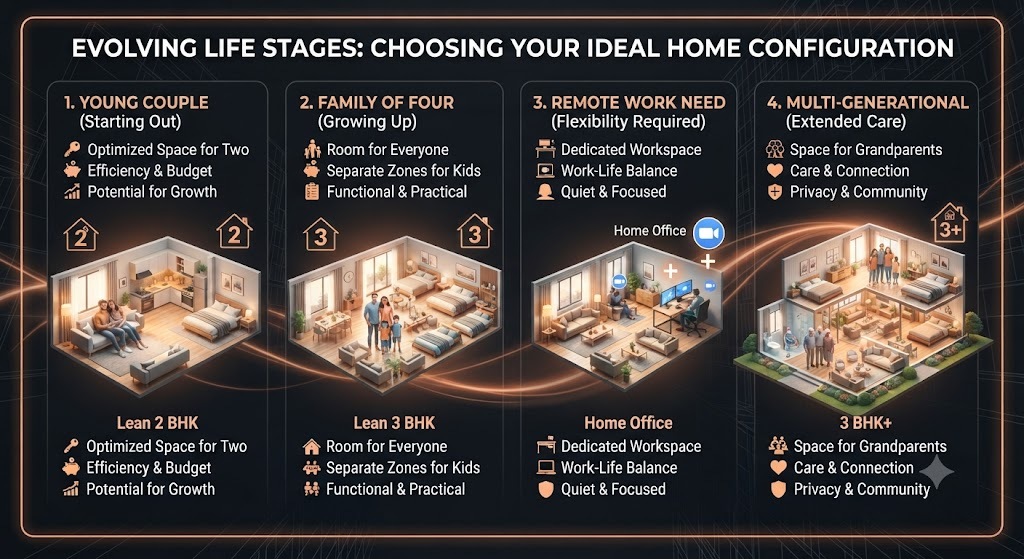
A young couple with no children yet: A 2 BHK is often the more sensible choice, with the second room used flexibly as a study, guest room, or storage until family plans firm up. If children are on the near-term horizon, though, weigh the cost of moving later against buying slightly bigger now.
A family of four with school-age children: A 3 BHK typically makes more sense here, giving children separate rooms as they grow and reducing daily friction over shared space. This is one of the more common scenarios where “2 BHK vs 3 BHK for family of 4” comes up, and in most cases, the extra room earns its cost through years of reduced daily stress.
A single professional or a couple prioritizing location over size: A 2 BHK, or even a well-designed 1 BHK, in a more central or well-connected location often serves better than a larger home further from work and amenities. Extra square footage matters less if it comes at the cost of a long daily commute.
Multi-generational households: A 3 BHK — or larger — is usually necessary here, and layout becomes especially important for balancing privacy with shared family space. This is a case where I’d strongly recommend working through a proper design consultation rather than assuming any standard floor plan will work, since the needs of multi-generational living are genuinely specific to each family.
A Practical Checklist Before You Decide
- List who’s living in the home today, and who realistically might be in the next 5 years.
- Be honest about how a third room would actually get used — not how you imagine it might be used.
- Calculate total monthly cost, not just the purchase price difference — maintenance, taxes, utilities, and furnishing all add up.
- Research resale and rental demand in your specific area, not general trends.
- Look at actual floor plans, not just the BHK label — layout efficiency can outweigh raw room count.
When It’s Worth Bringing in an Architect Before Deciding
If you’re building rather than buying an existing unit, this decision opens up more possibilities than choosing between two fixed configurations — you can design a layout that genuinely fits how your family lives, rather than picking the closest standard option. Our Interior Architecture team regularly works through exactly this kind of space-planning exercise with clients who are torn between 2 BHK vs 3 BHK, mapping out how a family actually uses their home before finalizing room count and layout.
Final Thoughts
There’s no universally correct answer in the 2 BHK vs 3 BHK debate — it depends on your family size today and in the near future, how you’d genuinely use extra space, your full budget picture, and your local market. What I’d caution against is deciding purely on price per square foot without thinking through the other factors, since the cheaper option upfront isn’t always cheaper over the years you’ll actually live there.
If you’re weighing this decision for a custom-built home rather than a resale unit, it’s worth talking through your specific family situation with an architect before finalizing a layout — the right answer is genuinely different for every household.
Frequently Asked Questions
Is a 2 BHK or 3 BHK better for a family of 4? For most families of four, especially with school-age children, a 3 BHK is generally better since it allows children separate rooms and reduces daily friction over shared space, though a well-designed 2 BHK can still work if the family prioritizes location or budget over extra space.
How much more expensive is a 3 BHK compared to a 2 BHK? The difference varies significantly by city and builder, but beyond the purchase price, expect higher ongoing costs too — maintenance charges, property tax, utility bills, and furnishing costs are all typically higher for a 3 BHK.
Is a 2 BHK enough for a couple planning to have children? It can work initially, but many couples choose to buy a 3 BHK ahead of time to avoid the cost and disruption of moving again once children arrive, especially if they plan to stay long-term.
Does a 3 BHK always have better resale value than a 2 BHK? Not always — this depends heavily on local market demand. In some areas 2 BHKs are easier to sell or rent due to higher demand from smaller households, while in family-oriented neighborhoods, 3 BHKs often hold value better.
Can a well-designed 2 BHK feel as spacious as a poorly designed 3 BHK? Yes. Layout efficiency, natural light, ventilation, and smart storage often matter more for livability than raw room count, so it’s worth comparing actual floor plans rather than deciding purely on the BHK label.