Biophilic design gets reduced to “add some plants” more often than any other architectural concept we work with — and that’s genuinely a shame, because it undersells what’s actually one of the more evidence-backed design movements in residential architecture right now. Biophilic design 101 starts with a simple idea: humans have an innate need to connect with nature, and buildings that ignore this connection measurably cost us in stress, focus, and wellbeing. Buildings that honor it, done right, can add real financial value too — homes with documented biophilic features are currently fetching an 8% premium over standard listings in major metro markets.
Here’s what biophilic design actually means, the research behind it, and how to bring it into a home properly — well beyond a few succulents on a windowsill.
Table of Contents
- What Biophilic Design Actually Is
- The Evidence Behind Biophilic Design
- The 14 Patterns of Biophilic Design
- Biophilic Design 101: Real Costs and ROI
- How to Bring Biophilic Design Into Your Home
- Common Biophilic Design Mistakes
- Frequently Asked Questions
What Biophilic Design Actually Is
Biophilic design is the intentional integration of natural elements — light, greenery, water, natural materials, and organic forms — into the built environment, grounded in the idea that humans have an evolved, innate affinity for nature that modern buildings have largely severed. The dominant architectural approach of the last century — sealed facades, mechanical climate control, and artificial lighting — achieved real efficiencies, but a growing body of research links that disconnection to increased stress, reduced cognitive performance, and worse physical health outcomes for occupants.
Biophilic design isn’t a stylistic add-on to correct that — it’s a structural design philosophy, addressing how a building is oriented, lit, and ventilated as much as what’s decorating it.
The Evidence Behind Biophilic Design
Unlike many design trends, biophilic design has a genuinely substantial research base behind it:
Stress and wellbeing. Multiple studies across different building types report consistent associations between biophilic environments and reduced stress, improved mood, and greater mental resilience — some research points to stress reductions of up to 15% from biophilic elements specifically.
Cognitive performance. Research reviewed by sustainability consultancy Terrapin Bright Green links biophilic design to better health outcomes, increased property values, and improved occupant satisfaction across the studies examined.
Energy efficiency. This is where biophilic design earns its place as more than a wellness feature — buildings incorporating biophilic elements like strategic daylighting and natural ventilation can improve energy efficiency by 8% to 20%, with daylighting specifically shown to reduce artificial lighting needs and associated energy use.
A note of honest context: a meaningful share of this evidence relies on self-reported outcomes and single-setting studies, so it’s fair to say the underlying direction is well-supported while the precise magnitude of benefit varies across the research. That said, the consistency of the pattern — across stress, cognition, and energy metrics, studied independently — is what’s moved biophilic design from “nice idea” to a baseline expectation in contemporary architecture rather than a fringe theory.
The 14 Patterns of Biophilic Design
Much of contemporary biophilic design practice is grounded in a framework developed by environmental psychologist Stephen Kellert and colleagues, organizing biophilic strategies into patterns architects can apply deliberately rather than intuitively. Broadly, these fall into three categories:
- Direct experience of nature — natural light, air, water, plants, and views of the outdoors
- Indirect experience of nature — natural materials, colors, and forms; images or representations of nature; natural analogs like organic shapes and textures
- Experience of space and place — spatial variety, refuge, and a sense of prospect (open views) balanced with enclosure
Understanding the framework, rather than just a checklist of “add plants, add wood,” matters because it lets a designer substitute strategies when the obvious option isn’t available — if a room can’t have a direct view of nature, natural materials or organic forms can still create a similar restorative effect.
Biophilic Design 101: Real Costs and ROI
Biophilic design spans an enormous cost range depending on ambition:
- Living/green walls: professionally installed, plumbed-in systems typically run $150–$250 per square foot, though the payoff in visual impact and air quality can be substantial for a well-placed accent wall
- Expanded windows and skylights: cost varies enormously by scope, but daylighting improvements are frequently cited as one of the highest-return biophilic investments due to both energy savings and wellbeing benefit
- Natural material upgrades (wood, stone, natural textiles): cost premium varies by material choice, and overlaps significantly with the material philosophy we cover in our warm minimalism guide
- Green roofs: higher upfront cost, but function as natural insulation, reducing heat-island effect and adding thermal resistance that can offset costs over time
On the value side, the 8% premium currently observed in major metro markets for homes with documented biophilic features, combined with the 8–20% energy efficiency gains, gives biophilic design one of the more concrete financial cases among current design trends — a genuine strategic equity play, not just an aesthetic one.
How to Bring Biophilic Design Into Your Home
A few high-impact starting points, roughly in order of architectural significance:
- Prioritize natural light at the design stage. Window placement, orientation, and skylight opportunities are architectural decisions best made early, not retrofitted later — directly connecting to the layout thinking we cover in our guide on is open concept still popular in 2026, where light flow between spaces is central to the whole conversation.
- Choose real natural materials over synthetic imitations. Genuine wood, stone, and natural textiles carry both the sensory and psychological benefit that biophilic research points to; a laminate “wood-look” surface doesn’t deliver the same effect.
- Design for cross-ventilation where possible. Natural airflow reduces reliance on mechanical cooling while reinforcing the direct-nature-experience principle central to biophilic theory.
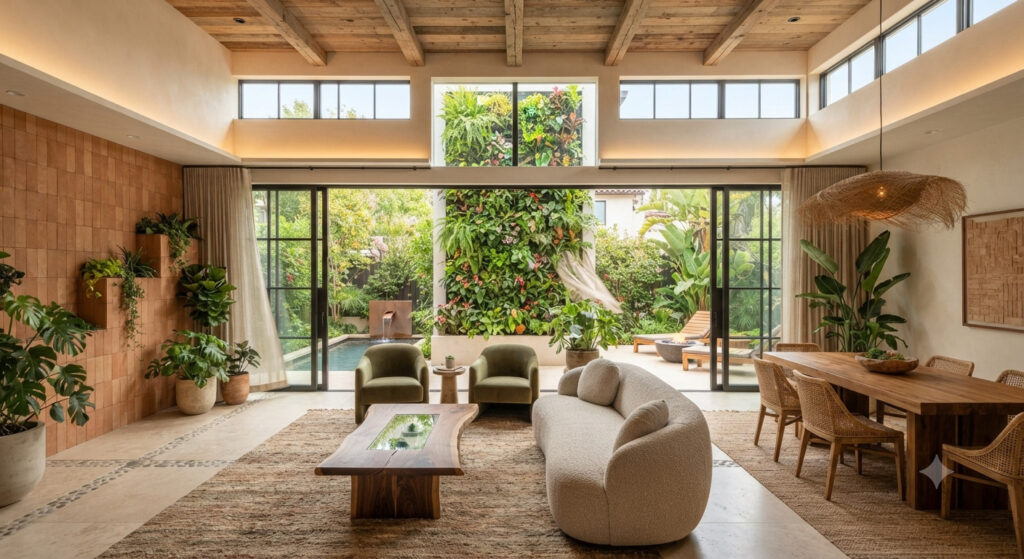
- Add a genuine living element, not just a decorative one. A well-placed living wall or a real, well-maintained indoor garden does more than a shelf of artificial greenery — though it requires a genuine maintenance commitment, which is worth being honest about upfront.
- Create spatial variety. A mix of open, expansive areas and smaller, enclosed “refuge” spaces mirrors the prospect-and-refuge pattern found in Kellert’s framework, and tends to feel more genuinely restorative than uniform openness throughout.
Common Biophilic Design Mistakes
A few pitfalls are worth avoiding as biophilic design becomes more mainstream:
- Treating it as purely decorative. A few potted plants without addressing light, material, or spatial structure captures very little of the actual research-backed benefit.
- Ignoring maintenance realities. Living walls and larger indoor plantings require genuine ongoing care; a poorly maintained green feature undermines the calming effect it’s meant to provide.
- Overlooking energy and structural planning. The efficiency gains from daylighting and natural ventilation depend on proper design integration, not just adding windows without considering orientation, shading, or ventilation pathways.
This is exactly the kind of integrated planning we bring to our residential architecture work — biophilic design done as genuine architecture, not surface decoration. See how it comes together in our recent projects.
Frequently Asked Questions
What is biophilic design in simple terms? Biophilic design is the intentional integration of natural elements — light, greenery, natural materials, and organic forms — into architecture and interior spaces, based on research showing humans have an innate need for connection to nature that benefits stress, mood, and cognitive performance.
Does biophilic design actually increase home value? Current data from major metro real estate markets shows homes with documented biophilic features fetching an 8% premium over standard listings, alongside 8–20% potential energy efficiency gains from strategies like daylighting and natural ventilation.
Is biophilic design just adding houseplants? No. While plants are one element, genuine biophilic design also addresses natural light, material choice, spatial layout, ventilation, and views of nature — a structural design approach rather than a decorating choice.
How much does biophilic design typically cost? Costs vary enormously by scope — a professionally installed living wall runs roughly $150–$250 per square foot, while other strategies like natural material selection or improved window placement vary based on the specific project and existing structure.
Considering Biophilic Elements for Your Home?
Biophilic design 101 comes down to this: nature-integrated architecture isn’t a passing aesthetic trend, it’s a genuinely evidence-backed approach to how a home affects the people living in it. At Archtra, we help homeowners bring these principles into a design in a way that’s structural and intentional, not just decorative.
Explore our residential architecture work, browse recent projects, or start the conversation with our team about your space.eam about your space.