Every homeowner planning a renovation eventually asks the same question, usually somewhere between the first design meeting and the first invoice: “Will I actually get this money back?” It’s a fair question, and it’s one that doesn’t get answered honestly nearly often enough. Contractors have an incentive to say yes to everything. Design blogs love to show the after-photos without mentioning the numbers.
As architects, we sit in a slightly different position. We’re not selling the renovation itself — we’re helping clients make decisions that need to hold up financially as well as aesthetically. So this is less of a trend piece and more of a straight answer to a question we get asked constantly: in 2026, what actually pays off, and what doesn’t?
How Renovation ROI Actually Works
Before getting into specific upgrades, it’s worth clearing up what “ROI” even means in a renovation context, because it’s frequently misunderstood.
Renovation ROI is typically expressed as the percentage of a project’s cost that gets recovered in added home value at resale. A renovation with 80% ROI that costs $50,000 adds roughly $40,000 to your home’s value. Very few renovations return 100% or more of their cost — that’s the exception, not the rule, and any contractor promising otherwise across the board should be questioned.
It’s also worth separating two different goals that often get conflated: renovating to sell soon versus renovating to live in the home long-term and enjoy the upgrade yourself. A renovation with mediocre resale ROI can still be an excellent decision if you’re planning to stay in the home for another decade and the upgrade genuinely improves your daily life. This article focuses primarily on resale value, but that distinction matters and is worth keeping in mind throughout.
Upgrades That Consistently Pay Off
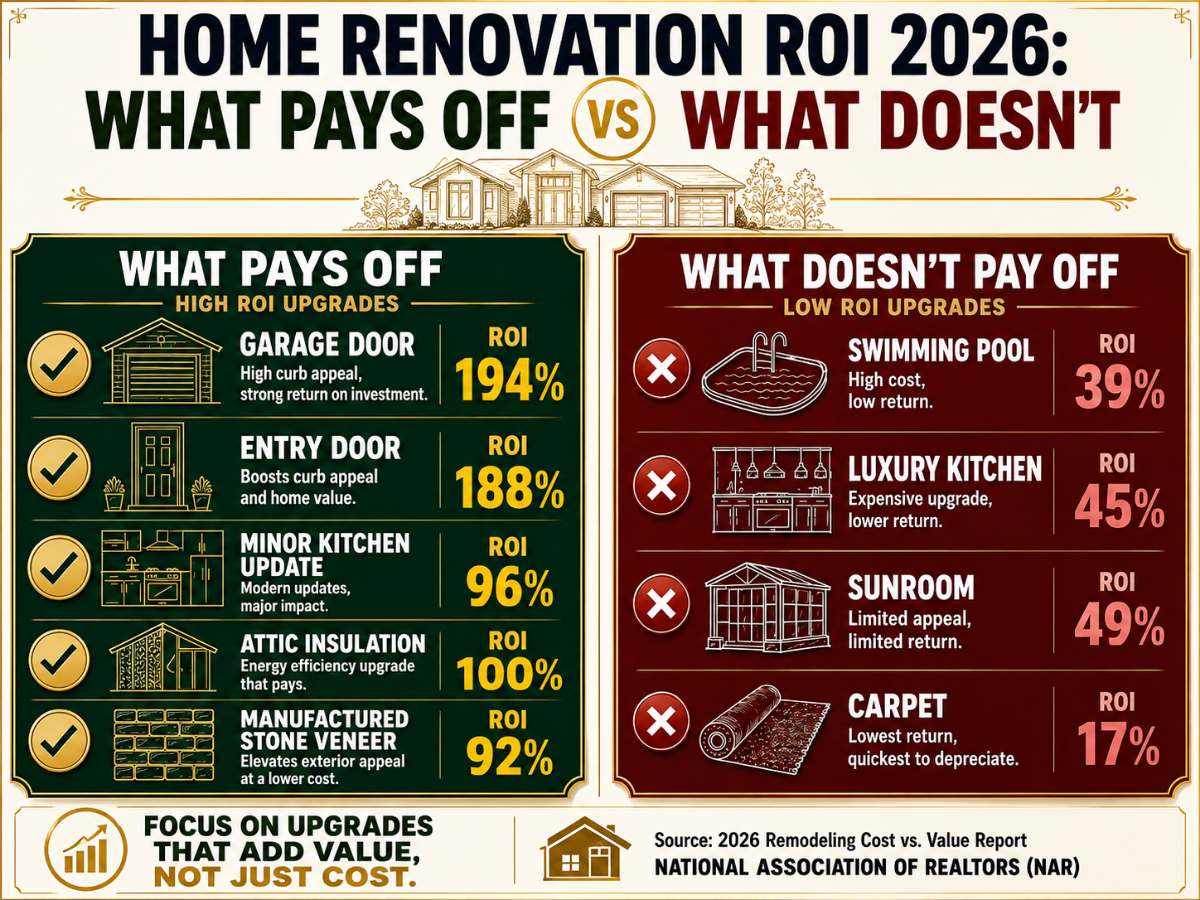
Minor kitchen updates. Full gut renovations of a kitchen tend to have surprisingly average ROI, largely because they’re expensive. Minor kitchen refreshes — new cabinet fronts, updated countertops, modern hardware, a fresh backsplash — consistently perform better on a cost-to-value basis because the investment is smaller relative to the visual and functional impact.
Garage door replacement. This one surprises almost everyone. A new garage door is one of the most reliably high-ROI projects available, largely because it’s one of the first things a buyer sees and one of the cheaper big-ticket exterior updates available.
Entry door replacement. Similar logic to the garage door — it’s a small investment with an outsized effect on curb appeal and first impressions, which matter more to resale value than most interior work.
Manufactured stone veneer / exterior refresh. Updating a home’s exterior material, even partially, tends to outperform most interior renovations on a pure ROI basis. Buyers form an opinion about a home before they walk through the front door, and exterior work directly targets that first impression.
Attic insulation upgrades. Not glamorous, rarely photographed, consistently one of the better-performing renovations available. Energy efficiency upgrades are increasingly factored into buyer decision-making as utility costs rise, and insulation is one of the cheapest ways to meaningfully improve a home’s efficiency.
Bathroom remodels — moderate scope. Like kitchens, bathroom ROI tends to favor moderate updates over full luxury remodels. A well-executed mid-range bathroom renovation — new fixtures, updated tile, improved lighting — consistently outperforms a high-end spa-style overhaul in terms of dollar-for-dollar return.
Upgrades With Weaker or More Situational ROI
Swimming pools. In most climates and most markets, pools don’t return their installation cost at resale, and in some cases they can actually narrow your buyer pool, since not everyone wants the maintenance and liability that comes with one. There are exceptions in consistently warm climates where a pool is a genuine market expectation, but as a general renovation, it’s one of the weaker financial bets.
High-end luxury kitchen remodels. There’s a ceiling effect here that catches a lot of homeowners off guard. Once a kitchen renovation exceeds what’s typical for the neighborhood, additional spending tends to stop translating into additional resale value, because the home is now priced above what comparable buyers in that area expect to pay.
Sunrooms and home additions built purely for personal use. Additions can absolutely add value, but purpose-built spaces like sunrooms, home theaters, or highly specific hobby rooms tend to have narrower buyer appeal, which limits how much of the cost gets recovered.
Over-customized primary suites. Similar issue to the luxury kitchen problem — a lavish primary suite renovation can outperform its neighborhood, at which point the home effectively becomes harder to sell at a price that reflects the investment.
Wall-to-wall carpet in high-traffic areas. In most markets, buyers currently favor hard flooring, and carpet installation over what could otherwise be refinished hardwood or another hard surface tends to underperform, sometimes actively reducing perceived value.
What This Means When You’re Planning a Project
A few practical takeaways worth applying before signing off on any renovation budget:
Moderate, well-executed upgrades usually beat luxury overhauls on ROI. This shows up again and again across kitchens, bathrooms, and additions. The instinct to go bigger and more expensive to maximize value is often backwards — it’s frequently the mid-range, tastefully done project that returns the highest percentage of its cost.
Curb appeal punches above its weight. Garage doors, entry doors, and exterior finishes consistently outperform flashier interior projects. If budget is limited and the goal is resale value, exterior-facing work deserves serious consideration before interior luxury upgrades.
Trend-driven upgrades need a longer view. A renovation that leans into a specific current design movement — for example, the arched doorways and curved architectural details trending through 2026 — can genuinely boost buyer interest and perceived value, especially if it’s a detail-level change rather than a structural overhaul. The key is scope: a single well-placed arch tends to age and resell better than an entire home rebuilt around a single aesthetic moment.
Sustainability upgrades are shifting from “nice to have” to expected. Energy efficiency, natural materials, and better air quality — the kind of thinking behind biophilic design principles gaining ground in 2026 — are increasingly factored into how buyers and appraisers view a home, not just how it looks in photos.
Know the ceiling for your neighborhood before you spend. This is the single most common mistake we see. A renovation budget should be evaluated against comparable homes in the immediate area, not against what feels reasonable in isolation. Spending beyond what the neighborhood supports rarely gets fully recovered, regardless of how well the work is executed.

When ROI Shouldn’t Be the Only Factor
It’s worth saying plainly: not every renovation decision should be made purely on projected resale return. If you’re planning to live in a home for many more years, the value of daily enjoyment, comfort, and function is real, even if it doesn’t show up cleanly on a resale spreadsheet. A kitchen you love using every day has a return that isn’t captured by ROI percentages.
That said, if a renovation is significant in scope — a structural change, an addition, or anything touching load-bearing elements — it’s worth having the conversation with a professional before committing to a budget. Knowing how to choose an architect early in the process tends to save homeowners money later, since a well-planned project avoids the costly mid-renovation changes that erode ROI faster than almost anything else.
Final Thought
The renovations that consistently pay off in 2026 aren’t usually the flashiest ones. They’re the moderate, well-executed, curb-facing, efficiency-minded projects that match what buyers in a given neighborhood actually expect. Luxury has its place, but as a financial decision, restraint tends to outperform excess more often than most homeowners expect going in.
Frequently Asked Questions
1. What renovation typically has the highest ROI in 2026? Garage door replacement and minor kitchen updates consistently rank among the highest-ROI projects, largely because they combine relatively low cost with a significant impact on buyer impression. Full luxury renovations rarely match this ratio.
2. Do kitchen renovations always pay off? Not always, and not proportionally. Minor to moderate kitchen updates tend to perform well, but high-end luxury renovations often exceed what a neighborhood’s resale market supports, which caps how much of the investment gets recovered.
3. Is it worth renovating before selling a home? It depends on the project. Curb appeal upgrades, minor kitchen and bathroom refreshes, and energy efficiency improvements tend to be worth it before a sale. Large structural projects or highly personalized additions are riskier to complete purely for resale purposes, since buyer preferences vary widely.
4. Do sustainable or energy-efficient upgrades actually increase home value? Increasingly, yes. As utility costs and buyer awareness around efficiency rise, upgrades like insulation, efficient windows, and better ventilation are being factored more heavily into appraisals and buyer decisions than they were even a few years ago.
5. Should I renovate based on ROI or based on what I actually want? If you’re planning to sell soon, ROI should weigh heavily in the decision. If you’re staying in the home long-term, personal enjoyment and daily function are legitimate priorities even when the projected resale return is lower — the “return” in that case is simply measured differently.
- House Orientation and Daylighting: How to Point a Home at the Sun, Shade It, and Keep Your Privacy

- Courtyard House Design: How an Open Square in the Middle of a Home Cools It, Shades It and Changes How You Live

- Fire-Resistant Home Design: Materials, Shape, Space and Glass That Give a House a Fighting Chance

- Home Soundproofing: How to Stop Noise Getting In (or Out) Without Wasting Money

- Office Amenities in Demand: What Tenants and Staff Actually Look For, and How to Prioritise It in a Fit-Out

Disclaimer:-
This article is for general informational purposes only and isn’t professional architectural, financial, or real estate advice. Renovation costs and resale value vary significantly by location and market conditions. Always consult a licensed architect, contractor, or real estate professional before making renovation decisions.