The basement is having a genuine renaissance in 2026 — long treated as a catchall for storage and holiday decorations, it’s increasingly viewed as some of the most cost-effective square footage a home already has. Basement renovation ideas and value searches have climbed alongside this shift, and for good reason: finishing a basement typically costs a fraction of building a comparable above-ground addition, while adding real, usable living space.
Here’s what a basement renovation actually costs in 2026, what it returns, and one crucial valuation detail most homeowners don’t find out until it’s too late to plan around.
Table of Contents
- What a Finished Basement Actually Returns
- The Below-Grade Valuation Rule Nobody Tells You
- Real Cost by Finish Tier
- What Drives Basement Renovation Cost the Most
- Basement Renovation Ideas Worth Considering
- Designing for Resale vs. Designing for Yourself
- Frequently Asked Questions
What a Finished Basement Actually Returns
Figures vary somewhat by report and methodology, but the consensus across current 2026 data is remarkably tight: a finished basement typically recoups roughly 70% to 75% of its renovation cost at resale, based on the most current Cost vs. Value and NAR remodeling data. On a $50,000 basement renovation, that translates to approximately $35,000 to $37,500 in added home value.
It’s worth noting this figure has shifted over time — an older 2022 NAR/NARI benchmark cited recovery as high as 86%, but that number shouldn’t be treated as current; market conditions and renovation costs have both moved since then, and the 70–75% range better reflects 2025–2026 data. Return also varies significantly by local market, ranging from as low as 23% in some rural areas to as high as 86% in competitive suburban markets — underscoring that “average” ROI figures are a starting point, not a guarantee for your specific property.
The Below-Grade Valuation Rule Nobody Tells You
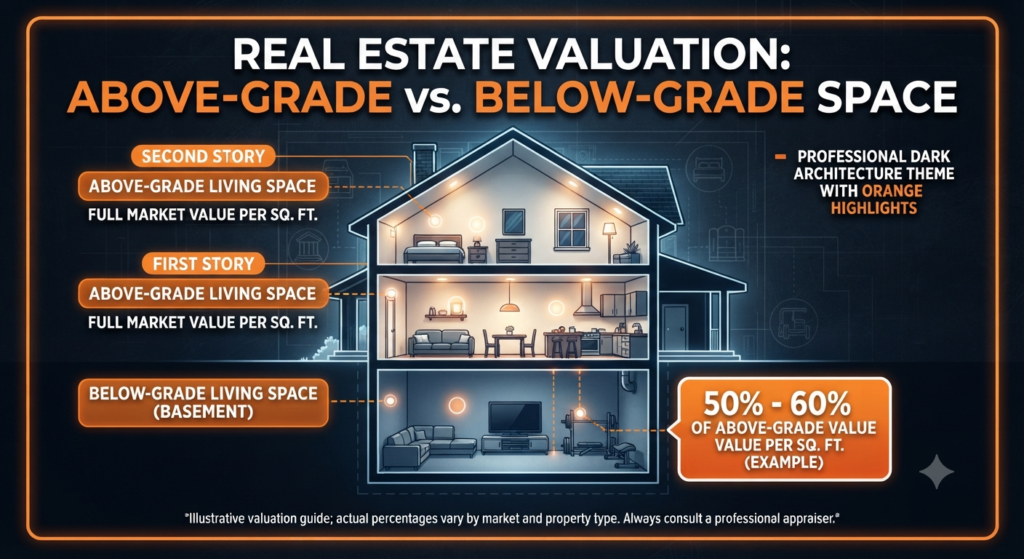
This is the single most important detail to understand before budgeting a basement project: finished basement square footage is not valued the same as above-grade living space. Appraisers typically assign below-grade space only 50% to 60% of the per-square-foot value of above-ground rooms, and — this is the part that surprises most homeowners — finished basement square footage generally cannot be counted toward a home’s official Gross Living Area (GLA) at all, regardless of how well it’s finished.
Walkout or grade-level basements can sometimes be treated as exceptions depending on local appraisal practice, so it’s worth confirming with a local real estate agent or appraiser how basements are actually valued in your specific market before assuming a national average applies directly to your home.
Real Cost by Finish Tier
Basement finishing costs in 2026 typically fall into three broad tiers, and the numbers vary noticeably depending on which source and market you’re looking at:
| Finish Tier | Cost per Sq Ft | What’s Included | Typical ROI |
|---|---|---|---|
| Basic | $25–$45 | Drywall, paint, laminate flooring, basic lighting — no bathroom or smart features | 50%–55% |
| Mid-range | $45–$80 | Quality flooring (LVP), one bathroom, zoned HVAC, water detection | 60%–70% |
| High-end / smart | $85–$130+ | Premium finishes, full bathroom, complete smart home integration, sustainable materials, ADU-ready infrastructure | 65%–75%+ |
For a standard 1,000 sq ft basement, most homeowners land somewhere between $30,000 and $75,000 total, with a national average project cost commonly cited around $22,000–$52,000 depending on scope and source. Adding a bathroom pushes projects toward the higher end of that range specifically because of the plumbing work involved — often requiring breaking through concrete to run new supply and drain lines.
What Drives Basement Renovation Cost the Most
A few factors move the final number more than anything else:
- Plumbing and electrical systems work. This is consistently cited as the most expensive part of a basement finish, especially once a bathroom or kitchenette enters the scope, since licensed plumbers and electricians command the highest hourly rates on the job.
- Structural repairs, waterproofing, and egress windows. If a basement starts out in rough condition, these items can dominate a budget before a single finish material gets chosen.
- Adding a bathroom or kitchenette. A wet bar for entertaining runs roughly $5,000–$15,000, while a full legal kitchen — requiring specialized ventilation, electrical, and appliances — can run $15,000–$35,000 or more.
- Permits and design. Architectural drawings and permits typically account for 10–15% of total project cost and are essential both for legal compliance and for the space to actually count toward resale value.
If you’re weighing a basement finish against building a full addition instead, our guide on adaptive reuse vs new construction covers similar reasoning — a basement finish is fundamentally a form of adaptive reuse, building on existing structure rather than new ground-up construction.
Basement Renovation Ideas Worth Considering
Beyond the numbers, the most successful basements in 2026 lean into flexibility rather than a single fixed use:
- Home gym or media room — consistently popular, comparatively low-complexity finishes
- Guest suite with a bathroom — one of the higher-value additions, since it adds genuine functional living space
- Home office or flex room — increasingly common as remote and hybrid work has become permanent for many households, echoing the same demand we cover in our guide on home office design 2026
- ADU-ready basement conversion — in jurisdictions where basement units qualify, this can unlock rental income potential; our guide on ADU cost and rules in 2026 covers the zoning considerations that apply here too
Designing for Resale vs. Designing for Yourself
If resale value is the priority, the data points toward restraint: open floor plans, neutral finishes, and genuinely multipurpose spaces appeal to the widest range of future buyers, while highly personalized choices — themed rooms, elaborate built-in gaming setups — can actually reduce ROI by narrowing who the space appeals to.
If you’re finishing a basement primarily to enjoy it yourself for years to come rather than to maximize resale, that calculus shifts — a basement built around your specific hobbies or needs may be worth more to your daily life than a slightly lower resale number reflects. This is exactly the kind of trade-off conversation we help homeowners think through in our residential architecture process. See how it comes together in our recent projects.
Frequently Asked Questions About Basement Renovation Ideas and Value
What is the ROI on a finished basement in 2026? Current data points to roughly 70–75% cost recovery at resale on average, though this varies significantly by local market — from as low as 23% in some rural areas to as high as 86% in competitive suburban markets.
Does a finished basement count toward my home’s square footage? Generally, no. Appraisers typically exclude below-grade space from a home’s official Gross Living Area (GLA) regardless of finish quality, and value it at only 50–60% of above-grade space per square foot. Walkout or grade-level basements can sometimes be treated differently, depending on local appraisal practice.
How much does it cost to finish a basement in 2026? Most standard 1,000 sq ft basement finishes run $30,000–$75,000, with cost per square foot ranging from $25 for a basic finish up to $130+ for a high-end, smart-home-integrated space. Adding a bathroom or kitchen pushes costs toward the higher end.
What adds the most value to a basement renovation? Adding a full bathroom is consistently cited as one of the highest-value additions, since it meaningfully increases the space’s functionality as genuine living area, though it also adds significant cost due to the plumbing work required.
Considering a Basement Renovation?
Basement renovation ideas and value ultimately come down to understanding both what the space can become and how it will actually be valued — two things that don’t always align the way homeowners expect. At Archtra, we help clients plan basement projects with both goals in view.
Explore our residential architecture work, browse recent projects, or start the conversation with our team about your space.