Every year, a national Cost vs. Value study compares what common home improvement projects actually cost against what they add back at resale — and every year, the results surprise homeowners who assumed a gorgeous new kitchen would outperform something as mundane as a garage door. Curb appeal and exterior renovation ROI data for 2026 confirms the same pattern that’s held for several years running: exterior projects dominate the top of the list, while big interior remodels — kitchens included — consistently deliver lower returns.
Here’s what the actual numbers show, why exterior work keeps winning, and how to think about your own renovation budget if resale value matters to you.
Table of Contents
- The 2026 Cost vs. Value Rankings
- Why Exterior Projects Outperform Interior Remodels
- Real Cost and ROI by Project
- The Psychology Behind Curb Appeal
- How to Budget for Curb Appeal Strategically
- When Interior Renovation Still Makes Sense
- Frequently Asked Questions
The 2026 Cost vs. Value Rankings
The headline finding is consistent across every source tracking this data: of the top 10 highest-ROI home improvement projects nationally, 8 to 9 are exterior replacements. Garage door replacement has topped the rankings for two consecutive years, with cited returns ranging from roughly 194% to 268% depending on the specific report and region — a wide range, but every version of the data agrees it’s at or near the very top.
Manufactured stone veneer consistently lands in the second tier, with ROI figures commonly cited between 153% and 208%. Steel entry door replacement and fiber cement siding round out the group of projects that regularly recoup well over 100% of their cost at resale — a genuinely unusual outcome in renovation, where most projects return less than what they cost.
Why Exterior Projects Outperform Interior Remodels
A few structural reasons explain why this pattern holds year after year, not just in 2026:
Labor cost ratio favors replacements. Exterior replacement projects (doors, siding, garage doors) typically require far less labor relative to material cost than large interior remodels, and labor is usually the largest line item in any renovation budget.
First impressions shape appraisal and offer behavior. Real estate agents and appraisers lean heavily on a home’s initial visual impression when pricing it, and research shows homes with strong curb appeal sell for 7% to 14% more than comparable properties with a tired exterior.
Curb appeal is a genuine dealbreaker for many buyers. A 2025 American Home Shield survey found 68% of homebuyers consider poor curb appeal a dealbreaker, with buyers willing to increase their offers by an average of over $9,000 for homes with strong exterior presentation.
Deferred maintenance signals matter. New siding or a new roof doesn’t just look better — it signals to buyers and appraisers that there’s no hidden maintenance debt behind the walls, which is one of the biggest discount factors in buyer negotiations.
Real Cost and ROI by Project
Figures vary somewhat by source and region, but the general pattern is remarkably consistent:
| Project | Typical Cost | Typical ROI |
|---|---|---|
| Garage door replacement | $1,800–$5,000 | 90%–268% (varies significantly by report) |
| Manufactured stone veneer | Varies by scope | 153%–208% |
| Steel entry door replacement | $2,500–$5,000 | 80%–216% |
| Fiber cement siding | Full-facade project | Over 114% |
| Exterior painting | $300–$1,000 (refresh) | 50%–152% |
| Landscaping | Varies widely | 100%–267% (highly variable) |
| Roofing | $8,000–$35,000+ | 60%–75% |
| Major upscale kitchen remodel | $80,000–$150,000+ | Roughly 40% |
| Minor midrange kitchen remodel | Lower cost tier | Roughly 96% |
The kitchen comparison is worth sitting with: even a large increase in resale value from an $80,000+ upscale kitchen remodel only translates to roughly 40% ROI, simply because the upfront cost is so much higher — while a $4,000 garage door swap can return double or triple its cost.
The Psychology Behind Curb Appeal
Beyond the raw numbers, curb appeal works because it’s the first data point a buyer or appraiser processes, before they’ve seen a single interior room. Door color specifically has measurable impact — some analyses tie black, deep navy, or charcoal entry doors to offers thousands of dollars above expected asking price, likely because these tones read as intentional and well-maintained rather than dated.
Well-maintained landscaping adds a further 5% to 12% to perceived home value in real estate and appraisal surveys, reinforcing that curb appeal isn’t a single fix but a cumulative impression built from several smaller, coordinated choices.
How to Budget for Curb Appeal Strategically
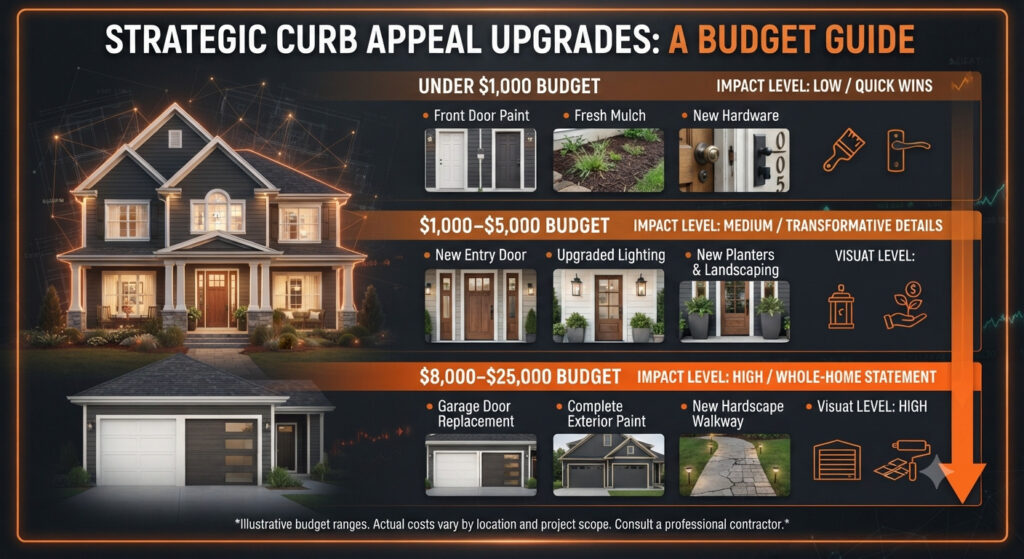
A useful rule of thumb: spending roughly 1% to 3% of a home’s value on strategic exterior improvements before listing tends to deliver the strongest overall return. For a $400,000 home, that’s $4,000 to $12,000 spread across two or three high-impact projects, rather than one large, expensive renovation.
If you’re budgeting in tiers:
- Under $1,000: Exterior cleaning, door paint, updated house numbers and hardware, fresh mulch and lawn care
- $1,000–$5,000: Landscape lighting, new shutters, lawn repair, a new entry door
- $8,000–$25,000: A full transformation combining a new garage door, exterior paint, and walkway or driveway repair
This tiered approach matters architecturally too — if you’re already planning a larger renovation or addition, coordinating exterior material choices (siding type, door placement, garage positioning) at the design stage avoids a mismatched, piecemeal look later. This overlaps with the material coordination we cover in our warm minimalism guide, where cohesive material choices matter as much on the exterior as inside.
When Interior Renovation Still Makes Sense
None of this means interior renovation is a bad investment — it means the reason for renovating matters. If you’re renovating to sell in the near term, the data is clear: let the cost vs. value numbers, not a showroom display, guide where your money goes. But if you’re renovating to live in and enjoy the home for the next decade or more, an interior remodel that genuinely improves your daily life — a kitchen you actually love cooking in, a primary suite that functions well — has value the resale-ROI framing doesn’t fully capture.
This is exactly the kind of prioritization conversation we have with clients in our residential architecture process — helping homeowners weigh resale value against quality of life, rather than assuming one always outweighs the other. See how it comes together in our recent projects.
Frequently Asked Questions About Curb Appeal and Exterior Renovation ROI
What is the highest-ROI home renovation in 2026? Garage door replacement has topped Cost vs. Value rankings for two consecutive years, with cited ROI ranging from roughly 194% to 268% depending on the specific report, making it consistently one of the highest-return projects tracked.
Is curb appeal really worth investing in before selling? Yes, according to multiple 2025–2026 studies. Homes with strong curb appeal sell for 7% to 14% more than comparable properties, and 68% of buyers surveyed consider poor curb appeal a dealbreaker.
Why does a kitchen remodel have lower ROI than a garage door? It comes down to cost relative to value added. A major upscale kitchen remodel can cost $80,000 to $150,000 or more, so even a substantial increase in home value only translates to roughly 40% ROI — while a garage door costs a fraction as much and can return double or more of its cost.
How much should I budget for curb appeal improvements before selling? A general guideline is 1% to 3% of your home’s value, spread across two or three high-impact exterior projects rather than one large renovation — for a $400,000 home, that’s roughly $4,000 to $12,000.
Planning an Exterior Renovation or Full Remodel?
Curb appeal and exterior renovation ROI data makes a clear financial case, but the strongest results come from coordinating exterior choices with your home’s overall architecture, not treating them as a last-minute add-on. At Archtra, we help homeowners think through both the resale numbers and the long-term design intent together.
Explore our residential architecture work, browse recent projects, or start the conversation with our team about your renovation.
The takeaway on curb appeal and exterior renovation ROI is simple: the outside of your home is doing more financial work than most homeowners give it credit for.