Quick answer: House Construction Cost Per Sq Ft 2026 typically ranges from $150 to $450+, depending on region, finish level, and whether you’re building a production home or a fully custom one. Standard and semi-custom builds generally fall between $175 and $320 per square foot, while custom homes in high-cost markets run $300 to $600+ per square foot. The national average construction cost for a typical single-family home is roughly $162 per square foot for the structure alone, before land, permits, and contractor overhead are added.
If you’ve gotten a few builder quotes and they don’t seem to agree with each other, you’re not imagining it. “Cost per square foot” gets used loosely across the industry, and depending on who’s quoting you, it might mean the raw structural shell, or it might mean a fully finished, move-in-ready home. This guide breaks down what the real 2026 numbers actually look like, what’s typically included, and how to budget without getting blindsided halfway through your build.
Table of Contents
- House Construction Cost Per Square Foot 2026: The Current Numbers
- Construction Cost by Region and State
- What’s Actually Included in a Per-Sq-Ft Quote (and What Isn’t)
- Production vs. Semi-Custom vs. Fully Custom Homes
- What’s Driving Costs in 2026 Specifically
- Real Example: Budgeting a 2,500 Sq Ft Home
- Hidden Costs Homeowners Consistently Underestimate
- How to Keep Costs Down Without Cutting Corners
- Frequently Asked Questions
House Construction Cost Per Square Foot 2026: The Current Numbers
Construction pricing is generally tiered by build type, and knowing which tier a quote reflects matters more than the headline number by itself.
| Build Type | Cost Per Sq Ft (2026) | What You Get |
|---|---|---|
| Production / Spec Home | $150 – $250 | Standardized floor plans, builder-grade finishes, efficient repeatable construction |
| Semi-Custom | $175 – $320 | More layout flexibility, mid-grade finishes, some personalization within a builder’s system |
| Fully Custom | $300 – $600+ | Architect-designed, unique floor plan, high-end finishes and materials, full personalization |
The most-cited national benchmark comes from the National Association of Home Builders’ Cost of Construction Survey, which found the average construction cost for a typical new single-family home was $428,215 for 2,647 square feet — about $162 per square foot for hard construction costs alone, excluding land and contractor overhead. Adding a general contractor’s standard fee (15–25% depending on market) brings that closer to $195 per square foot as a more realistic total.
Construction Cost by Region and State
Location is one of the biggest swing factors in construction cost, and the spread between the cheapest and most expensive states is substantial:
| Region | Typical Range | Example States |
|---|---|---|
| Lowest-cost | $130 – $200 | Mississippi, Arkansas, Oklahoma, Alabama |
| Midwest | $130 – $200 | Most Midwest states |
| National average | ~$162 (structure only) | — |
| Northeast / West Coast | $250 – $350+ | California, New York, Massachusetts |
| Highest-cost | $228 – $230 | Hawaii, Alaska |
That’s roughly a 49% swing between the least and most expensive states, driven by differences in labor markets, material supply chains, local regulatory environments, and land values. Regional and even city-level cost indexes can shift the real number well beyond a single national average, so a “national” figure is only ever a starting point for your own budget.
What’s Actually Included in a Per-Sq-Ft Quote (and What Isn’t)
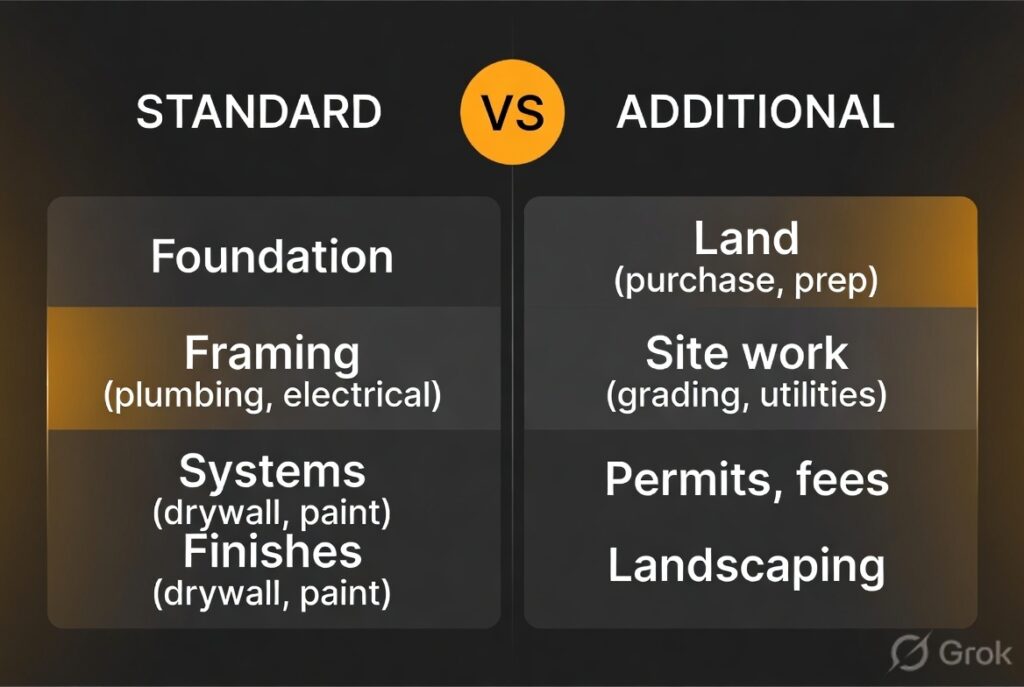
This is where most budget confusion starts. A typical construction-only quote generally covers:
- Foundation, framing, and structural work
- Roofing, exterior walls, windows, and doors
- Rough plumbing, electrical, and HVAC installation
- Interior drywall, standard flooring, and paint
- Basic fixtures and cabinetry
It generally does not include:
- Land purchase (a separate ~13.7% of a new home’s total price, per NAHB data)
- Site work — clearing, grading, excavation, retaining walls
- Permits, engineering, surveys, and inspection fees
- Well and septic installation, if not on municipal utilities
- Landscaping, driveways, and fencing
- Interior design, custom furniture, and premium finish upgrades
Construction costs now represent a record 64.4% of a new home’s total sales price, per NAHB’s most recent survey — the highest share since the organization began tracking this data, meaning the gap between “construction cost” and “total project cost” has never been more important to understand clearly before you budget.
Production vs. Semi-Custom vs. Fully Custom Homes
The build type you choose affects cost as much as location does:
Production/spec homes use standardized, repeatable floor plans a builder has constructed many times before, which keeps costs down through efficiency and bulk material purchasing. These typically complete in 7–9 months.
Semi-custom homes allow more layout flexibility and finish choices within a builder’s existing system — a middle ground between cost efficiency and personalization.
Fully custom homes, designed from scratch with an architect, offer complete design freedom but cost significantly more per square foot, both because of unique engineering requirements and because efficiencies of scale disappear. Custom builds typically average 12–18 months from permit to move-in. If you’re weighing this route, our guide on the cost to hire an architect covers how design fees typically factor into a custom project’s total budget.
Modular construction is worth mentioning separately: prefab/modular homes average around $240,000 nationally ($160,000–$320,000 for most projects), running $80–$175 per square foot — often meaningfully less than comparable site-built construction, since a large share of the work happens in a controlled factory setting.
What’s Driving Costs in 2026 Specifically
A few factors are pushing 2026 budgets higher than the NAHB’s underlying 2024 baseline:
- Tariffs on imported building materials, adding upward pressure on lumber, steel, and other key inputs
- Ongoing skilled labor shortages in the construction trades, pushing wages and project timelines up in many markets
- Financing costs — construction loan interest rates typically run 1–2 percentage points higher than a standard 30-year mortgage, adding $10,000–$30,000 in carrying costs over a 12-month build
- Regional cost index shifts, as demand continues to concentrate in already-expensive coastal and high-growth metro markets
Real Example: Budgeting a 2,500 Sq Ft Home
To make this concrete: at the national average of roughly $162–$195 per square foot (construction cost including standard contractor fees), a 2,500 sq ft home runs approximately $405,000–$487,500 for construction alone.
At the lower end of a semi-custom range (~$200/sq ft) in a moderate-cost state, that same home comes in closer to $500,000. In a high-cost custom market at $400+/sq ft, the same footprint could exceed $1,000,000. The difference is almost entirely driven by location and finish level — the underlying structural work scales more predictably than either of those two variables.
Add land, site work, permits, and financing costs on top of the construction number, and total project cost commonly climbs by another 13–25% beyond the structural quote alone.
Hidden Costs Homeowners Consistently Underestimate
Beyond the exclusions already mentioned, a few line items catch first-time builders off guard because they rarely appear in an initial per-square-foot quote:
- Off-site living expenses during construction (commonly $8,600–$11,900 over a 7-month build, if you need temporary housing)
- Soil testing and environmental/geotechnical surveys
- Utility connection fees (water, sewer, electric) if not already run to the lot
- Construction loan closing costs and carrying interest
- A genuine contingency reserve for unexpected site conditions or material price shifts
Budgeting a realistic 10–15% contingency on top of your estimated total is one of the most consistently repeated pieces of advice from builders and architects, precisely because per-square-foot estimates are a planning tool, not a guarantee.
How to Keep Costs Down Without Cutting Corners
A few genuinely effective strategies, rather than ones that just defer the expense:
- Get a detailed, itemized bid, not a single per-square-foot number. A real breakdown by structural work, systems, and finishes makes it far easier to see where your budget is actually going.
- Consider a production or semi-custom build if full customization isn’t essential. The efficiency gap between a repeated floor plan and a fully custom design is one of the largest cost levers available.
- Right-size the home to your actual needs. Every additional square foot carries its full share of structural, systems, and finish cost — a smaller, well-designed home consistently outperforms an oversized one on cost-per-dollar-of-livability. This connects directly to the reasoning we cover in our guide on small house plans in 2026.
- Compare production home costs against modular construction, particularly for straightforward layouts — the factory-controlled process can meaningfully undercut site-built pricing for a comparable finished result.
- Work with an architect from the design stage, not just a contractor at the build stage. Thoughtful early design decisions — efficient framing, standard material sizing, simplified rooflines — reduce waste and rework far more effectively than trying to value-engineer finishes after construction has already begun.
This is exactly the kind of budgeting conversation we have with clients from day one in our residential architecture process. See how it comes together in our recent projects.
Frequently Asked Questions About House Construction Cost Per Square Foot in 2026
What is the average cost per square foot to build a house in 2026? The national average is roughly $175 to $320 per square foot for production and semi-custom builds, and $300 to $600+ per square foot for fully custom homes, according to NAHB and RSMeans 2026 data. The underlying NAHB construction-only baseline is about $162 per square foot.
How much does it cost to build a 2,500 sq ft house in 2026? At the national average construction cost (roughly $162–$195/sq ft including standard contractor fees), a 2,500 sq ft home runs approximately $405,000–$487,500. Costs can range considerably higher in expensive coastal markets or with fully custom design.
Does the per-square-foot cost include land and permits? No. Per-square-foot construction quotes typically cover the structure only — foundation, framing, systems, and standard finishes. Land, site work, permits, and financing costs are separate and can add 13–25% or more to the total project cost.
Which states have the cheapest and most expensive construction costs? Mississippi, Arkansas, Oklahoma, and Alabama are consistently among the lowest-cost states (around $154–$200/sq ft), while Hawaii and Alaska are the most expensive (roughly $228–$230/sq ft), a difference driven by labor markets, material logistics, and regulatory environment.
Is modular construction cheaper than a traditional site-built home? Generally, yes. Modular homes typically run $80–$175 per square foot, often below comparable site-built construction, since a significant portion of the build happens in a controlled factory setting rather than on-site.
Planning a New Construction Project?
House construction cost per square foot in 2026 isn’t a single, fixed number — it’s a range shaped by region, build type, and how much of the real project scope actually made it into your initial quote. Getting a realistic, itemized budget from the start is the best way to avoid the surprises that derail so many self-managed builds.
If you’re planning a residential project and want professional guidance from the design stage onward, start the conversation with our team at Archtra, or explore our residential architecture work to see how thoughtful design decisions early on can meaningfully affect your final construction budget.