Mahjong room design ideas are in unusually high demand right now, and it’s not hard to see why. The game has moved well past its reputation as something only grandparents played on a folding table — a new generation of players has picked it back up, social mahjong clubs have opened in cities across the country, and Houzz’s 2026 Emerging Summer Trends Report even clocked “mahjong room” as the single fastest-growing search term it tracked all year, up nearly twentyfold year over year. Whatever first drew you to the idea of building one, the question quickly becomes practical: how big does the room need to be, what table should you buy, how do you light it properly, and how do you make it feel like a real room rather than a card table shoved in a spare corner?
This guide answers all of that in one place, covering space planning, layout, furniture, lighting, storage, acoustics, decor themes, comfort, technology, materials, and size-specific inspiration — everything you need to go from “we should really get a mahjong table” to a finished room you’re genuinely proud to host friends in. If you’d like help turning any of this into an actual build, our team handles exactly this kind of project through our interior design and renovation services at Archtra.
Table of Contents
- Space Requirements and Planning
- Layout and Space Planning
- Furniture Selection
- Lighting Design
- Storage Solutions
- Acoustics and Sound Control
- Decor and Theme Ideas
- Comfort and Amenities
- Technology Integration
- Multi-Functional Design
- Color and Material Guide
- Mahjong Room Design Ideas by Room Size
- Final Tips
- Frequently Asked Questions
Space Requirements and Planning
Before picking a single piece of furniture, it’s worth nailing down the basics of how much room you actually have to work with, since this decides almost everything that follows.
Minimum room size. For a fully dedicated mahjong room, treat 10 by 10 feet as a practical minimum and 12 by 12 feet as the ideal — enough to seat four comfortably with room left over for a sideboard or spectator seating. If a dedicated room isn’t realistic, a multi-purpose setup using an existing dining or living area works too, and most of the furniture and design ideas below translate directly into that kind of flexible space.
Table dimensions. A standard manual mahjong table runs 32 to 36 inches square, while automatic tables tend to run slightly larger to accommodate the internal shuffling mechanism.
Seating clearance. Allow 24 to 30 inches of personal space per player, and aim for roughly 36 inches of open clearance all the way around the table so chairs can push back fully without hitting a wall or another piece of furniture.
Traffic flow. Keep the table and any spectator seating clear of doorways, and make sure there’s genuine walking space behind every chair — not just enough to squeeze by, but enough that someone can get up mid-game without disturbing the table.
Layout and Space Planning
Getting the layout right is what separates a mahjong room that feels considered from one that just happens to have a table in it.
- Center the table in the room rather than pushing it to one side, so every player has equal access and the room reads as balanced rather than lopsided.
- Avoid placing the table directly against a wall. Even in a smaller room, leaving a gap — even a narrow one — makes the space feel intentional rather than cramped, and gives at least one player room to get up without everyone else having to move.
- Small room solutions. A corner setup, where the table sits diagonally or tucked into an underused corner, combined with vertical storage (wall shelves rather than floor cabinets), can make a modestly sized room work well.
- Dedicated rooms benefit from a bit of lounge seating along one wall for spectators or players waiting their turn — a small bench or two armchairs is usually enough.
- Multi-purpose rooms do best with room dividers or folding screens, or furniture specifically chosen to fold away (more on this in the Multi-Functional Design section below), so the space can shift cleanly between uses.
Furniture Selection
Mahjong Tables
- Automatic tables are the most convenient option, shuffling and racking tiles mechanically, but they’re bulkier and more expensive than manual alternatives, and they need a nearby power source.
- Manual tables are the traditional choice — more affordable, often foldable for easy storage, and simpler to maintain, though gameplay naturally moves a bit slower without the automatic shuffle.
- Convertible tables include a hard cover insert that turns the mahjong surface into a standard dining or work table, a smart option if the room needs to earn its keep outside of game nights.
Chairs
Chairs matter more than most people expect for a game that regularly runs an hour or longer:
- Ergonomic design with genuine lumbar support — comfort here isn’t a luxury, it’s what keeps a long game enjoyable rather than something people start angling to end early.
- Armless styling gives players full freedom to reach across the table for tiles without bumping into armrests.
- Cushioned seats in an easy-to-clean fabric hold up to spilled tea, snacks, and regular use.
- Seat height in the 18 to 20 inch range, which pairs correctly with standard mahjong table height.
Side Tables
Small nesting tables placed near the main table give players a spot for drinks, snacks, and a scorepad — just be careful to size and place them so they don’t crowd the actual playing area or block the clearance space discussed earlier.
Lighting Design
Lighting in a mahjong room has to do real functional work, not just look good in photos — players need to clearly read small tile details without glare bouncing off the table.
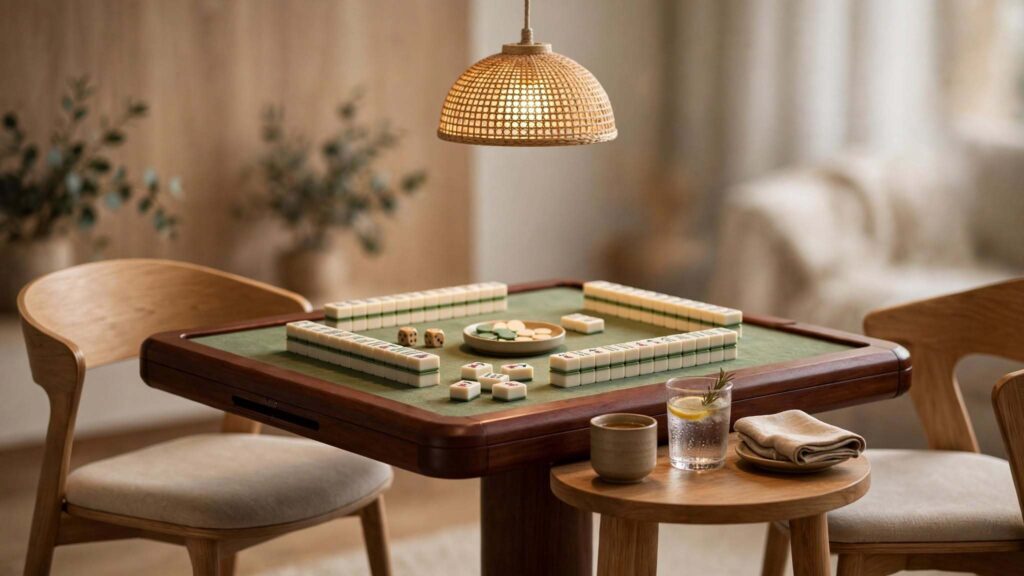
- Overhead lighting. A pendant or chandelier centered directly above the table provides even, shadow-free illumination across the whole playing surface.
- Adjustable brightness. Dimmable fixtures let the room shift from bright and functional during active play to warmer and more social during breaks — a detail worth planning for from the start rather than retrofitting later.
- Glare control. Frosted bulbs or fabric shades help prevent harsh reflections off a polished or lacquered table surface, which can otherwise make tiles genuinely harder to read.
- Ambient lighting. Floor lamps and wall sconces around the room’s perimeter round out the overhead fixture, giving the space depth rather than one flat pool of light in the center.
- Natural light. If the room has windows, sheer curtains diffuse daylight into something soft and even, rather than a harsh, directional glare during daytime games.
Storage Solutions
A mahjong set comes with a genuine amount of small, easy-to-lose pieces — tiles, dice, racks, scoring sticks — which makes dedicated storage one of the more practically important parts of the whole room.
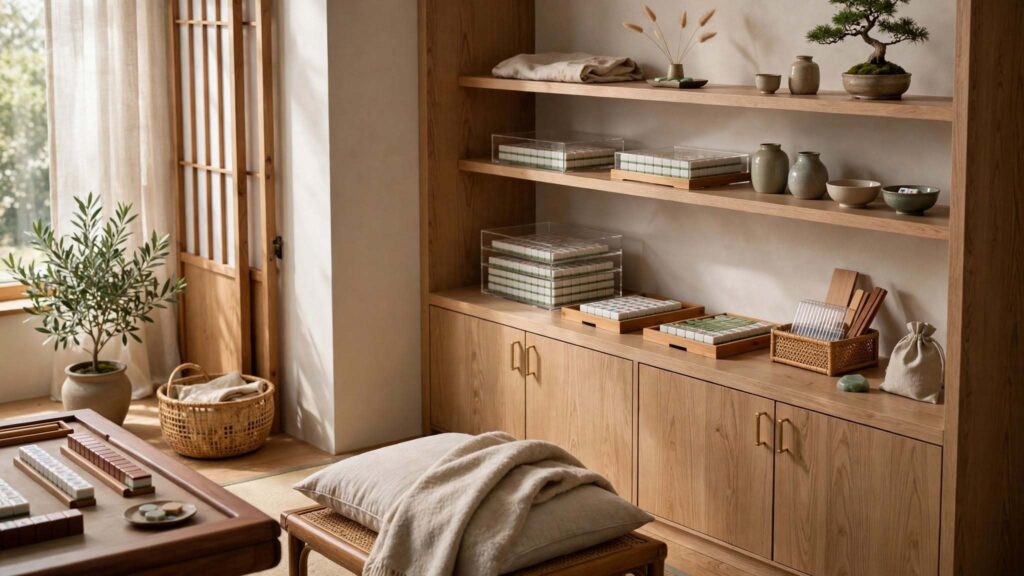
- A dedicated cabinet sized specifically for the mahjong set keeps everything in one place rather than scattered across drawers around the house.
- Drawer organizers for small accessories prevent dice and scoring sticks from sliding around loose.
- Wall-mounted racks for extra folding chairs or a spare folding table save floor space in smaller rooms.
- Built-in storage under a window seat or bench makes good use of space that would otherwise go unused.
- Vertical shelving is especially useful in smaller rooms, where floor-standing cabinets would eat too much of the clearance space discussed earlier.
Acoustics and Sound Control
This is a detail most mahjong room design content skips entirely, despite genuinely mattering to serious players: the sound of tiles being shuffled and placed is part of the traditional experience, and many players actively want that sound preserved rather than eliminated. The goal with acoustics, then, isn’t to silence the room — it’s to keep that sound satisfying rather than harsh.
- An area rug under the table absorbs some of the sharper edges of the sound without muting it entirely.
- Acoustic panels or heavy curtains help if the room has a lot of hard, reflective surfaces that would otherwise make the sound echo.
- A felt table cover is a simple, low-cost way to soften tile noise directly at the source.
- Cork or carpet flooring absorbs sound more effectively than hardwood or tile, worth considering if acoustics are a bigger priority than flooring’s visual style.
- The option to embrace the sound. Plenty of regular players consider the clack of tiles part of the ritual and deliberately keep the room’s acoustics lively rather than deadened — there’s no single “correct” answer here, just a decision worth making intentionally.
Decor and Theme Ideas
Current mahjong room design ideas tend to cluster around four distinct themes, each suited to a different kind of homeowner and a different way of using the room.
Traditional Chinese/Japanese. Built around red, gold, black, and jade green, this theme leans into calligraphy, ink paintings, or woodblock prints on the walls, alongside porcelain vases, bamboo accents, paper lanterns, and the occasional lucky cat figurine. Dark lacquered wood furniture and silk cushions complete a space that honors the game’s cultural roots directly.
Modern Minimalist. A neutral base palette with a single accent color, sleek low-profile furniture, and one sculptural pendant light overhead keep this version calm and uncluttered. Abstract art, a bold geometric pattern, and a single statement plant add personality without visual noise — an approach that pairs well with a modern or contemporary interior design style elsewhere in the home.
Luxury Lounge. Jewel tones — sapphire, emerald, ruby — paired with velvet chairs, a marble-topped table, gold accents, a crystal chandelier, and strategically placed mirrors create a genuinely glamorous, evening-ready atmosphere. A bar cart or small wine fridge rounds out a room built explicitly for hosting.
Cozy Game Room. Warm woods, soft greens, and terracotta tones, paired with upholstered chairs and a slightly rustic table, create a relaxed, family-friendly feel. Family photos, a shelf of other board games, and throw blankets make the space feel lived-in, with warm ambient lighting reinforcing the inviting mood — a theme that overlaps nicely with the character-driven approach in our guide to modern heritage design.
Comfort and Amenities
- Climate control. Good ventilation or dedicated air conditioning matters for a room where several people sit in close quarters for an hour or more at a time.
- A refreshment station. A kettle, a small tea set, a tray of snacks, or a compact mini-fridge nearby keeps a long game going without constant trips to the kitchen.
- Charging points. USB outlets or a wireless charging pad near the table keep phones handy without them cluttering the playing surface.
- Bathroom access nearby. A small, easily overlooked detail that genuinely affects how comfortable guests feel staying for a multi-hour session.
- Avoid direct heat or AC drafts aimed straight at the table or seating area — a surprisingly common and easily avoidable annoyance.
Technology Integration
- Automatic mahjong tables, covered above, remain the single biggest technology investment most homeowners make in the room.
- Digital scoring apps, run from a tablet or phone propped nearby, have replaced paper scorepads for a lot of regular players.
- Smart lighting with voice control makes it simple to shift between bright task lighting and a dimmer social mood without anyone leaving the table.
- A sound system for background music adds atmosphere without requiring someone to manage a playlist mid-game.
- Wireless charging pads built into a side table are a small but genuinely useful addition.
Multi-Functional Design
For anyone without the luxury of a fully dedicated room, a few design choices let a mahjong room design coexist comfortably with everyday life:
- A Murphy-style fold-down table tucks away against the wall when not in use, freeing the floor for other purposes between games.
- A reversible tabletop, as covered in the furniture section, lets a single table serve as both a dining surface and a mahjong table depending on which side faces up.
- Stackable chairs clear floor space quickly once a game wraps up.
- Room dividers visually and acoustically separate a mahjong corner from the rest of an open-plan living or dining area without the cost of a full renovation — useful if you’re not ready for a dedicated addition. For a bigger structural project, our guide to home addition ideas covers how to plan a new dedicated space from the ground up.
Color and Material Guide
A quick reference for the material decisions that come up across every part of a mahjong room design:
- Table: solid wood, laminate, or a felt-topped surface (felt specifically helps soften tile sound, as covered in the acoustics section).
- Chairs: leather, faux leather, fabric, or wood, chosen based on how easy the finish is to clean and how it holds up to extended sitting.
- Flooring: hardwood, tile, cork, or carpet — cork and carpet absorb sound more effectively, while hardwood and tile are easier to clean.
- Walls: paint, wallpaper, wood paneling, or dedicated acoustic panels, depending on how much of the acoustics section’s guidance you want to lean into.
- Rug: a low-pile, easy-to-clean, non-slip option works best underfoot near a table with moving chairs.
- Lighting: pendant or chandelier for the overhead fixture, supplemented by track lighting or floor lamps for ambient fill.
- Storage: wood cabinets, open shelving, or built-ins, chosen based on how much the room needs to double as display space versus pure function.
Mahjong Room Design Ideas by Room Size
Small (around 8×8 ft). A folding table and stackable chairs keep the room flexible, paired with wall shelves instead of floor cabinets, light wall colors to avoid a cramped feel, and a mirror to visually expand the space.
Medium (around 10×10 ft). This is the comfortable baseline for a dedicated room — a standard-size table, genuinely comfortable chairs, a small side table, a statement pendant light, and a corner cabinet for storage all fit without feeling tight.
Large (12×12 ft or more). Enough space for a true dedicated game area plus a separate lounge corner for spectators, a bar cart or small wine fridge, open shelving or a bookshelf, and in some layouts, a window seat with built-in storage underneath.
Final Tips
- Test the layout with painter’s tape on the floor before committing to a specific table size — a quick, free way to catch clearance problems before they become expensive mistakes.
- Invest in quality chairs. As covered above, this is one of the most commonly underestimated parts of the whole room.
- Personalize the space with art, photos, or small trophies from regular games — the detail that turns a well-designed room into a genuinely meaningful one.
- Keep the space tidy. A dedicated storage plan (covered earlier) makes this dramatically easier to maintain long-term.
- Prioritize good lighting above almost every other design decision — it’s the one element that affects both how the room looks and how comfortably the game is actually played.
Frequently Asked Questions
1. What’s the minimum room size for a dedicated mahjong room? Treat 10 by 10 feet as a practical minimum, with 12 by 12 feet considered ideal once you factor in a sideboard, spectator seating, or a small bar area. A multi-purpose setup using an existing dining or living space can work in a smaller footprint.
2. What size mahjong table should I buy? Standard manual tables run 32 to 36 inches square. Automatic tables tend to run slightly larger to accommodate the internal shuffling mechanism, so measure your available space carefully before choosing one.
3. Do I need an automatic mahjong table? Not necessarily — automatic tables are more convenient and speed up gameplay, but they’re bulkier, more expensive, and need a nearby power source. A manual table is a perfectly good choice, especially for a smaller or multi-purpose room.
4. What chair height works best with a mahjong table? A seat height of 18 to 20 inches pairs correctly with standard mahjong table height, keeping elbows and tile-reach at a comfortable working level over a long game.
5. How do I keep a mahjong room from feeling too noisy? A rug under the table, a felt table cover, acoustic panels or heavy curtains, and cork or carpet flooring all help soften tile sound without eliminating it entirely. Many regular players prefer to keep some of that sound, since it’s part of the traditional experience.
6. What’s the best decor theme for a mahjong room? There’s no single right answer — Traditional Chinese/Japanese suits homeowners who want to honor the game’s cultural roots, Modern Minimalist suits a flexible multi-use space, Luxury Lounge suits a room built for evening hosting, and Cozy Game Room suits a relaxed, family-friendly space.
7. Can I fit a mahjong room into a small space? Yes — an 8×8 ft room can work well with a folding table, stackable chairs, wall-mounted shelving instead of floor cabinets, and light wall colors to keep the space feeling open rather than cramped.
8. What storage do I need for a mahjong set? A dedicated cabinet sized for the full set, drawer organizers for small accessories like dice and scoring sticks, and either wall-mounted racks or vertical shelving in smaller rooms all help keep the many small pieces organized.
9. How do I make a mahjong table double as a dining table? Look for a convertible table with a hard cover insert, which transforms the playing surface into a standard dining or work table — a practical choice if the room needs to serve more than one purpose.
10. What lighting is best for playing mahjong? A pendant or chandelier centered directly above the table for even, shadow-free illumination, ideally dimmable, with ambient lighting (floor lamps or wall sconces) around the room to round out the space and avoid harsh glare on the tiles.
Conclusion
A great mahjong room comes down to a handful of fundamentals done well: the right table and clearance for your space, genuinely comfortable seating, lighting that actually supports gameplay, and a decor direction that reflects how you’ll use the room. Whether you’re working with an 8-by-8 foot nook or a fully dedicated 12-by-12 room, the same principles scale up and down — plan the layout first, then let the furniture, lighting, and decor follow.
If you’re ready to turn these mahjong room design ideas into a real, finished space, our team at Archtra can help design a room that works beautifully for mahjong and for everyday life. Browse our project portfolio for examples of our interior design approach, or reach out to our design team to start planning your space.