Avocado green kitchens have a reputation problem. Say the phrase to anyone who grew up in the 1970s and you’ll probably hear about a matching fridge, stove and dishwasher in a shade that now looks like a bruise on the past. And yet here we are, with designers putting creamy avocado on custom cabinetry in Paris and trend data suggesting people are searching for the colour again. The trick, as with most comebacks, is that the new version isn’t the old version.
This guide to avocado green kitchens is for anyone tempted by the idea and a little afraid of it. We’ll sort out what avocado green actually is (and how it differs from sage, olive and pistachio), what the trend numbers really say, how today’s avocado green kitchens differ from the originals, what to pair it with, how finish and light change it, and how to try it without a regretful repaint. If you’d like help testing it in your own home, our team does exactly this through Archtra’s interior design services.
Table of Contents
- What Is Avocado Green, Exactly?
- Why Avocado Green Kitchens Are Back (and What the Numbers Really Say)
- 1970s Avocado vs Today’s Avocado
- Will It Work in Your Kitchen? Light, Size and Style
- What to Pair It With
- Avocado Green Kitchens by Style
- How to Use It: From Safe to Brave
- Finish and Durability
- How to Test the Colour Properly
- Resale and Risk
- A Practical Note for Humid and Indian Kitchens
- Mistakes to Avoid
- Step-by-Step Plan
- Frequently Asked Questions
What Is Avocado Green, Exactly?
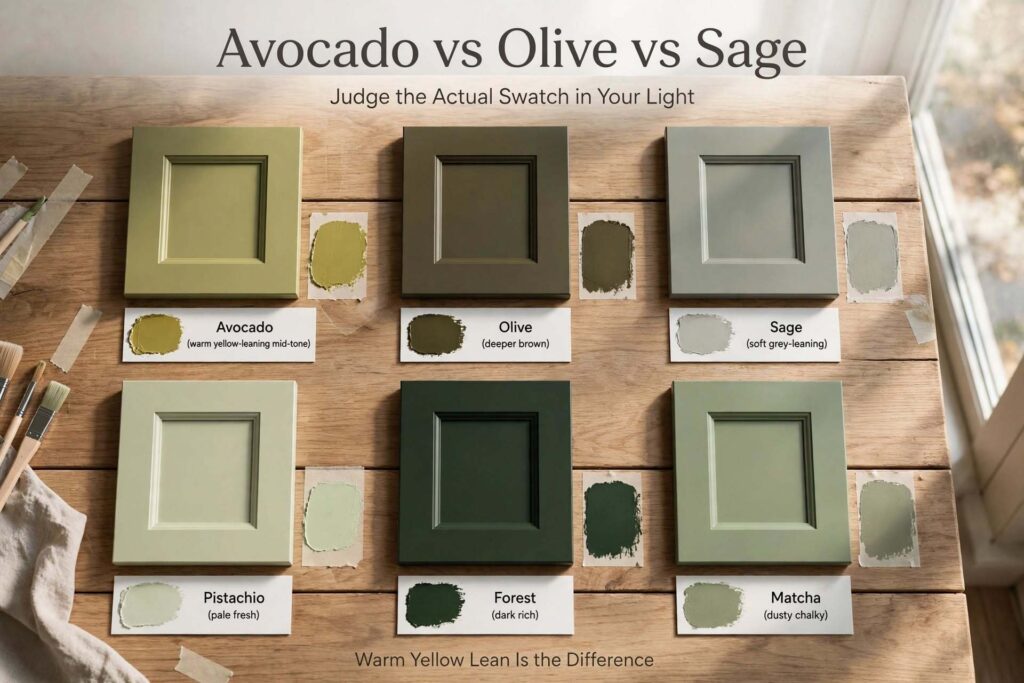
Avocado green, the colour at the heart of avocado green kitchens, is a mid-tone green with a yellow lean, closer to the flesh of a ripe avocado than to the skin. It sits in the olive family but is usually a touch brighter and warmer than classic olive. That “touch warmer” is the whole story: it’s why the shade can feel cheerful and earthy in one room and a bit muddy in another.
The names get used loosely online, so here’s a quick way to tell the neighbours apart.
| Shade | Character | Undertone | Typical mood |
|---|---|---|---|
| Avocado green | Mid-tone, earthy, slightly sunny | Warm, yellow | Retro, cosy, friendly |
| Olive green | Deeper, browner | Warm, brown | Grounded, traditional |
| Sage green | Soft, grey-leaning | Neutral to cool | Calm, spa-like |
| Pistachio | Light, pale, fresh | Warm, yellow | Playful, light |
| Forest green | Dark, rich | Cool to neutral | Moody, historic |
| Matcha | Dusty, slightly chalky | Warm | Soft, contemporary |
Designers themselves slide between these. One Paris project used a creamy avocado on cabinetry, and some trend coverage lumps avocado in with sage and forest green as “earthy greens.” Treat the labels as a family, and judge the actual swatch for your avocado green kitchen in your own light.
Why Avocado Green Kitchens Are Back (and What the Numbers Really Say)
Several data points have been circulating in 2026. They’re interesting, but they measure different things, so it’s worth reading them carefully.
- CopperSmith’s search analysis. The kitchen manufacturer analysed Google search data and reported that avocado green kitchens grew more than 4,000% year on year, with over 1,000 monthly searches. Two honest caveats: that’s a big percentage off a small base (1,000 searches a month isn’t huge), and the same coverage notes that black kitchens still take the top spot in the colour category overall. So avocado is a fast riser, not the market leader.
- Green kitchens in general. Realtor-association coverage citing Magnet trend data says searches for “green kitchens” rose about 50% over the past year, with blue kitchens up roughly 24 to 25%.
- Designers’ expectations. The NKBA’s 2026 Kitchen Trends Report found that 86% of designers expect earthy shades such as greens to dominate kitchens this year.
- The shift away from white. In Houzz’s 2026 US Kitchen Trends Study of 1,780 renovating homeowners, wood finishes (29%) edged out white (28%) for new cabinets for the first time. Among homeowners choosing contrasting lower cabinets in a two-tone kitchen, wood led at 37%, followed by blue (19%) and green (14%).
- The names behind it. Designer Pierre Yovanovitch used a creamy avocado for custom cabinetry in a Paris project, and CopperSmith’s founder credits designers like Joanna Gaines for making nature-inspired palettes fashionable again.
My honest read on avocado green kitchens: there’s a real, broad move toward warm, earthy colour and away from sterile white. Avocado is the boldest, most nostalgic point on that spectrum. Houzz also found most homeowners still lean neutral, and that white remains the favourite for upper cabinets in two-tone kitchens. So the safest way to join the trend is to use green where it can be changed or balanced, which we’ll get to.
1970s Avocado vs Today’s Avocado
If you remember the original, forget it. The modern version differs in five ways:
- The shade. Today’s avocado tends to be softer, creamier and closer to olive or sage, rather than the saturated yellow-green of vintage appliances. CopperSmith’s CEO describes today’s versions as softer olive and sage-inspired greens.
- The materials. The 70s version came with laminate, vinyl and harvest-gold accessories. The modern version sits beside natural stone, brushed brass, copper and wood.
- The finish. Today’s kitchens often use matte or satin finishes instead of high-gloss enamel.
- The context. It’s now one colour in a considered palette, not a whole matching suite.
- The mix. Designers talk about “dressing” green in different ways, from warm and rustic to sleek and contemporary.
In other words, avocado green kitchens work today because they’re edited. One or two green elements surrounded by calm, natural materials read as intentional. A full 70s throwback reads as a themed room.
Will It Work in Your Kitchen? Light, Size and Style
Colour behaves differently in every room, and avocado green kitchens are fussier than most because of its yellow undertone. Check three things before you commit.
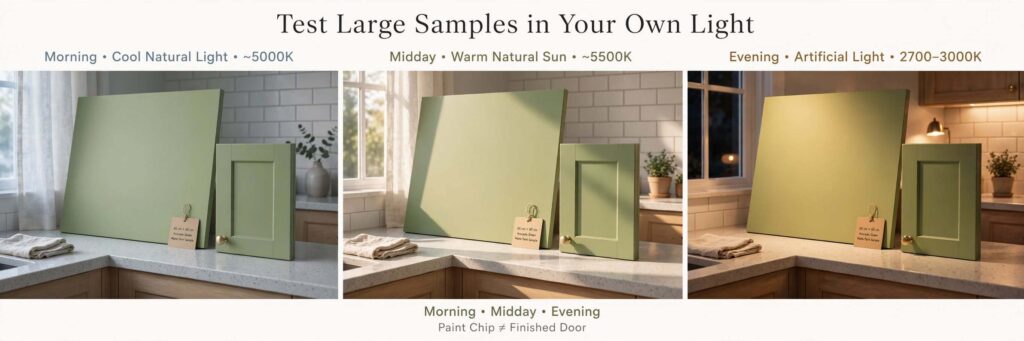
Light direction. North-facing kitchens get cooler, flatter light, which can make a warm green look dull or slightly murky. South-facing rooms bring warmer light that makes avocado glow. East light is warm in the morning and cool later, west light the reverse. Always look at a swatch at several times of day.
Artificial light. Warm bulbs (around 2700K to 3000K) flatter avocado and brass together. Very cool, bluish bulbs can push it toward grey and make it feel harsh. If you’re redoing the lighting at the same time, this matters.
Size and surroundings. In a small, dim kitchen, green on every surface can feel heavy. Using it on lower cabinets or an island and keeping the walls light keeps things airy. Large, bright kitchens can carry a fuller expression.
Style. Designers suggest using brighter greens in classic spaces and darker greens in moodier, historic-inspired kitchens. Avocado, being mid-tone, is a natural fit for mid-century, farmhouse, eclectic and relaxed transitional kitchens. If you’re still deciding on an overall look, our guide to interior design styles is a useful starting point.
What to Pair It With
This is where avocado green kitchens succeed or fail. Warm, natural partners make it look grown-up.
| Element | Good partners | Why it works | Watch out for |
|---|---|---|---|
| Countertops | Butcher block, light wood, soapstone-look quartz, warm white or cream stone, honed marble-look | Natural, warm, plays down the yellow | Cold bright-white quartz can feel stark |
| Backsplash | Handmade or zellige-style tile in cream or off-white, plaster, simple ceramic | Adds texture without competing | Strong patterns plus strong colour |
| Hardware and taps | Brass or aged brass, copper, warm bronze | Warm metals echo the undertone | Cold chrome can clash with a warm shade |
| Flooring | Natural oak, warm stone, terracotta, patterned encaustic tile | Grounds the colour | Grey floors can look flat beside it |
| Walls | Soft neutral, warm white, cream, pale plaster | Lets the cabinets lead | Pure stark white can feel clinical |
| Appliances | Stainless, panel-ready, or a deliberate vintage-style set | Keeps it modern, or leans into the story | A matching coloured set can tip into costume |
Mixed metals are also still popular, so a brass tap with a black light fitting isn’t a problem if the tones are balanced. If you love tactile finishes, our piece on tactile textures explains how plaster, wood and handmade tile add depth without clutter.
Avocado Green Kitchens by Style
- Mid-century modern. Avocado with walnut or teak, tapered legs and simple brass pulls. It’s the most natural home for the colour.
- Modern farmhouse. Avocado or sage lower cabinets, a wooden island, cream walls and a deep apron sink. This is where the Joanna Gaines connection shows.
- Japandi. A quieter, greyer version of avocado with pale oak and minimal hardware. See our Japandi style guide for how restraint and warmth balance.
- Modern heritage. Avocado millwork with aged brass, paneling and antique pieces. It sits comfortably with the character-led approach in our guide to modern heritage design.
- Transitional. Slim shaker doors in avocado, white uppers, neutral stone and soft metal accents. The most resale-friendly version.
- Contemporary minimal. Flat-front cabinets in a muted avocado with concealed handles and a pale stone top.
How to Use It: From Safe to Brave
Not everyone wants a fully green kitchen, and with avocado green kitchens you don’t need one. Here’s a ladder from low-commitment to full-on.
| Level | What you do | Risk | Rough effort |
|---|---|---|---|
| 1. Accessories | Ceramics, textiles, a pendant, a bowl of actual avocados | Very low | Minimal |
| 2. Paint a wall or the ceiling | A single surface in a softened avocado | Low | Weekend |
| 3. Island only | The island in avocado, everything else neutral | Low to medium | Moderate |
| 4. Lower cabinets | Two-tone: avocado below, white or wood above | Medium | Significant |
| 5. Full cabinetry | Avocado on all cabinets | Higher | Large |
| 6. Appliances too | A coloured or vintage-style set | Highest | Largest |
Level 3 and 4 are where most designers land, and it matches the data: two-tone kitchens with coloured lowers are growing, and white remains the choice for uppers. If you’re drawn to the island idea, our article on moveable kitchen islands and appliance garages shows how an island can carry colour without committing the whole room.
Finish and Durability
Colour is half the story; the finish decides how avocado green kitchens age.
- Matte and satin. Houzz guidance notes that matte dark blue or green cabinet finishes can hide minor scuffs better than bright white, but they may show dust and fingerprints more clearly, especially in bright kitchens. That’s useful to know before you choose.
- Gloss. High gloss reflects light and can look lively with avocado, but it highlights every flaw in the surface and can look dated if it echoes the original.
- Paint vs other surfaces. Painted timber cabinets can be refreshed later. Laminates, acrylics and polyurethane finishes (common in modular kitchens) are more durable and wipeable but harder to change. Ask your supplier for a real sample of the exact finish, not just a colour chip.
- Sun fade. Strong direct sun can fade some finishes over the years, so check the product’s UV resistance, particularly for west-facing windows.
- Cleaning. Use cleaners the manufacturer approves, and wipe splashes promptly, especially near the hob.
How to Test the Colour Properly
The same discipline that works for exterior colour works indoors, and it matters even more for avocado green kitchens. Paint a large sample board (at least 60 cm square), put it next to your actual countertop, floor and splashback, and look at it in morning light, midday and evening, with the lights on and off. Look again with the door open and closed if the kitchen borrows light from another room. Our guide to exterior paint color combinations explains the testing method in more detail, and the same logic applies here.
Order a real door or drawer sample in the final finish if you can. A flat paint chip and a finished cabinet door can look surprisingly different.
Resale and Risk
Colour is personal, and kitchens are expensive. Weigh these points honestly before choosing avocado green kitchens:
- Houzz found most homeowners still lean toward neutrals, so a bold green may narrow your buyer pool if you plan to sell soon.
- A softened, olive-leaning avocado is safer than a bright, saturated one.
- Painted cabinets are reversible. Full replacement is not.
- Keep the big-ticket items neutral. Stone, flooring and appliances in timeless tones let you change the cabinet colour later.
- If you’re staying for years, choose what you love. If you’re selling within two or three years, use colour on removable or easily repainted elements.
For a wider look at budgeting a kitchen alongside the rest of the house, see our guide to interior design cost per sq ft.
A Practical Note for Humid and Indian Kitchens
Many readers are planning modular kitchens in humid climates, so here’s what I’d keep in mind for avocado green kitchens. Green laminates and PU finishes in olive and avocado tones are generally easier to keep clean than painted timber in a kitchen with heavy oil and steam. Choose finishes rated for moisture, ask about edge-sealing, and test the colour under your kitchen’s actual lighting, since many apartments have limited natural light. A softer avocado with warm lighting tends to look better in smaller kitchens than a very saturated one. If kitchen orientation and Vastu matter to your family, raise it with your designer early, before the cabinets are ordered. Our comparison of architect vs interior designer explains who to involve and when.
Mistakes to Avoid
- Choosing from a small chip. Always test a big sample in your own light.
- Ignoring undertones. Avocado’s yellow lean clashes with cold greys and chrome.
- Going full 1970s with avocado green kitchens. Matching appliances, harvest gold and green laminate together reads as costume.
- Stark white around it. Pure white can make avocado look dingy, so warm your whites.
- Cheap, thin finishes. A flat paint on poor surfaces will chip and look tired.
- Forgetting the lighting. The wrong bulb can ruin the colour.
- Overcommitting in a small, dark kitchen. Use it on the lower half or the island.
- Not planning the whole kitchen. Colour works best as part of a layout, lighting and storage plan. Our list of common interior design mistakes covers pitfalls worth avoiding.
Step-by-Step Plan
- Define your tolerance for avocado green kitchens. Decide which level of the commitment ladder suits you.
- Pick a family, not a name. Collect swatches across avocado, olive and sage.
- Test large samples next to your countertop, floor and tile, at different times of day.
- Choose the finish. Matte, satin or gloss, and paint versus laminate or PU.
- Warm the palette. Pick brass or copper, warm whites and natural wood.
- Check the lighting, including bulb temperature.
- Keep the permanent items neutral. Stone, floors and appliances.
- Order a finished sample door before committing to the full run.
- Budget a contingency for adjustments.
- Get a second opinion. A short consultation can save a costly repaint.
Frequently Asked Questions
1. Are avocado green kitchens really coming back? There are signs they are, though the data deserves a careful reading. CopperSmith’s analysis of Google search data reported over 4,000% year-on-year growth for avocado green kitchens, but off a small base of just over 1,000 monthly searches, and black kitchens still lead the colour category overall. Broader data is also supportive: “green kitchens” searches rose about 50% over the past year, and 86% of designers in the NKBA’s 2026 report expect earthy shades such as greens to dominate. It’s a genuine comeback in a warmer, softer form.
2. What is the difference between avocado green and olive or sage? Avocado is a warm, mid-tone, yellow-leaning green. Olive is deeper and browner, sage is softer and greyer, and pistachio is paler and fresher. Designers often blend these names, so judge the actual swatch.
3. What colours go with avocado green kitchens? Warm, natural partners work best: cream and warm white, light wood or butcher block, soft neutral walls, brass or copper hardware, and honed or soapstone-look stone. Avoid cold greys and bright chrome, which fight avocado’s yellow undertone.
4. Are avocado green kitchens too dated for a modern home? Not if you edit it. Today’s versions are softer, used on part of the kitchen, and paired with natural materials rather than a full 1970s suite. A restrained, olive-leaning avocado on lower cabinets or an island looks current.
5. Should I paint my whole kitchen avocado green? You don’t have to. The safest and most popular route is two-tone cabinets with coloured lowers or a coloured island, with white or wood above. Houzz found white still dominates uppers in two-tone kitchens, while green accounted for 14% of contrasting lowers.
6. Will avocado green kitchens hurt resale value? It can narrow your pool of buyers if you sell soon, since most homeowners still lean neutral. A softer shade, neutral big-ticket items and painted (reversible) cabinets reduce the risk. If you’ll stay for years, choose what you love.
7. What finish is best for avocado green kitchens? Matte or satin finishes are popular. Houzz guidance notes that matte dark green or blue can hide minor scuffs better than white but may show dust and fingerprints more clearly. Always check a real sample door in your own light.
8. What hardware looks best with avocado green cabinets? Brass, aged brass, copper and warm bronze are the most flattering because they echo the warm undertone. Black can look sharp and modern. Cold chrome tends to clash.
9. Do avocado green kitchens work in a small or dark space? It can, with care. In a small or dim kitchen, use it on lower cabinets or the island, keep walls light, and use warm lighting. A full green kitchen in a small, dark room can feel heavy.
10. How do I test avocado green before committing? Paint a large sample (about 60 cm square), place it beside your countertop, floor and tile, and view it in morning, midday and evening light with the lights on and off. Ask for a finished sample door in the actual finish, because paint chips and real cabinets can look quite different.
Final Thoughts
Avocado green kitchens work when they’re edited, warm and a little bit restrained. Think of the colour as one voice in a conversation with wood, stone and brass, not the whole conversation. Start with the island or the lower cabinets, test the shade in your own light, keep the permanent items neutral and choose a finish that will age well.
If you’d like help turning a green idea into a kitchen that works, from layout and lighting to materials and budget, our team at Archtra can guide you from the first sketch to the final fit. Browse our project portfolio and project gallery for ideas, or get in touch with our design team to start planning your kitchen.