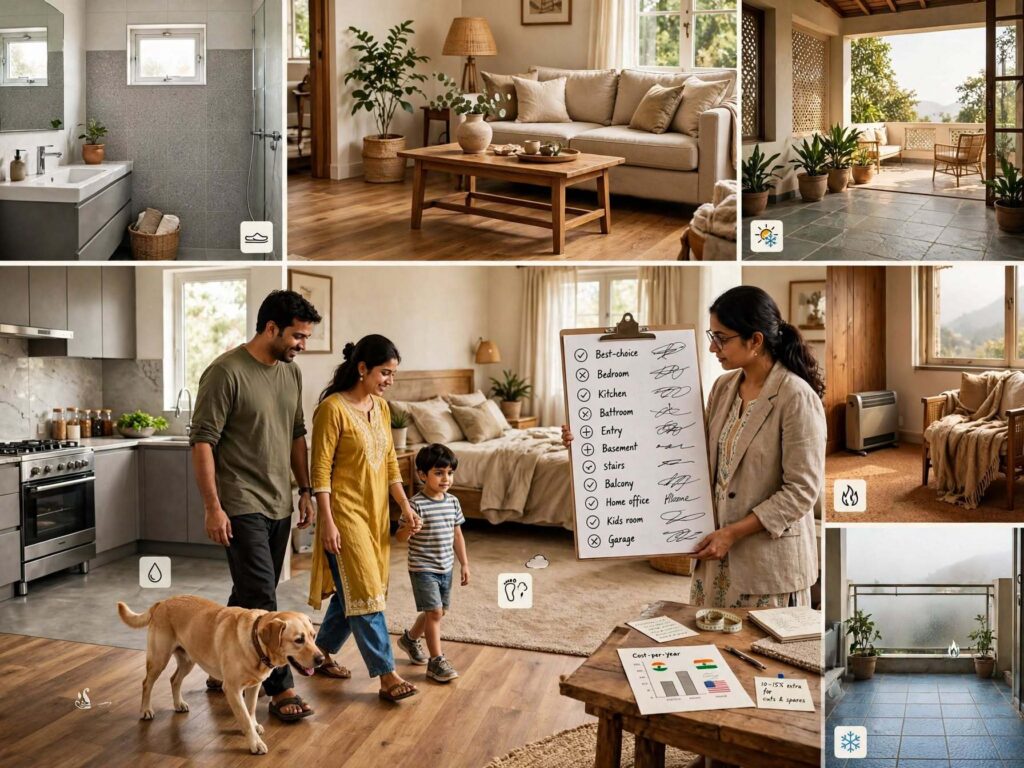
Types of flooring are easy to list and hard to choose between, because every guide shows the same samples and the same warm-wood photographs, then quotes a price per square foot that may or may not include the labour. The honest way to pick a floor is to ignore the photos at first. Start with the room’s moisture, the traffic, the shoes and the pets, what’s underneath, how warm you want it underfoot and how much maintenance you’ll really do. Then the right material mostly picks itself. Below I compare twelve floors on cost, lifespan, comfort, water resistance and the places they belong, with figures for the US and India, and I flag the technical details that decide whether a floor lasts: wear layers, slip ratings, subfloor flatness, underfloor heating and climate.
Before You Look at Samples: Eight Questions That Decide the Floor
Answer these on paper, because they eliminate half the options.
- How wet does the room get? Bathrooms, kitchens, entries, balconies and basements are very different from bedrooms.
- How much traffic? A hallway takes ten times the wear of a spare room.
- Who and what walks on it? Children, dogs with claws, outdoor shoes, high heels, wheeled chairs.
- What’s underneath? Concrete slab, timber joists, existing tile? Is it flat and dry?
- How much height can you spare? Floors add thickness, and doors, thresholds and neighbouring rooms have to match.
- Do you want to feel warm underfoot, or cool? A cold climate and a hot one want different things.
- Is there underfloor heating, or will there be? Some floors love it, some hate it.
- How loud can it be? Hard floors amplify footsteps, which matters in flats and for the neighbours below.
And one more: how long will you stay? A floor you’ll keep for 20 years justifies a different budget from one you’ll replace when you sell.
Types of Flooring Compared at a Glance
Prices are installed (materials plus labour) and vary widely by region, so treat the ranges as a guide. US figures are in dollars per square foot, and India figures are indicative installed rates in rupees per square foot. Lifespans are typical, with good care.
| Flooring | US installed ($/sq ft) | India installed (₹/sq ft) | Typical lifespan | Water | Comfort underfoot |
|---|---|---|---|---|---|
| Solid hardwood | About 8 to 25 | Varies, often higher | 30 to 100 years (refinishable) | Poor | Warm, slightly soft |
| Engineered wood | About 6 to 18 | Varies | 20 to 40 years | Fair | Warm |
| Laminate | About 3 to 8 | About 100 to 220 (with vinyl) | 10 to 20 years | Poor to fair | Medium |
| Vinyl plank / tile (LVP, SPC) | About 4 to 12 | About 100 to 220 | 10 to 25 years | Excellent | Slightly soft, quiet |
| Ceramic / porcelain / vitrified tile | About 5 to 15 | About 55 to 130 (ceramic), 90 to 220 (vitrified) | 20 to 50+ years | Excellent | Hard, cool |
| Natural stone (marble, granite, Kota, slate) | Often 10 to 30+ | Kota about 70 to 150; granite and marble well above 200 | 50+ years | Good to fair (depends, needs sealing) | Hard, cool |
| Polished concrete | About 5 to 16 | Varies | 40+ years | Good | Hard, cool |
| Carpet | About 3 to 8 | Varies | 5 to 15 years | Poor | Soft, warm |
| Cork | Mid-range | Varies | 20+ years (sealed) | Fair | Soft, warm, quiet |
| Bamboo | Mid-range | Varies | 10 to 25 years | Fair | Hard |
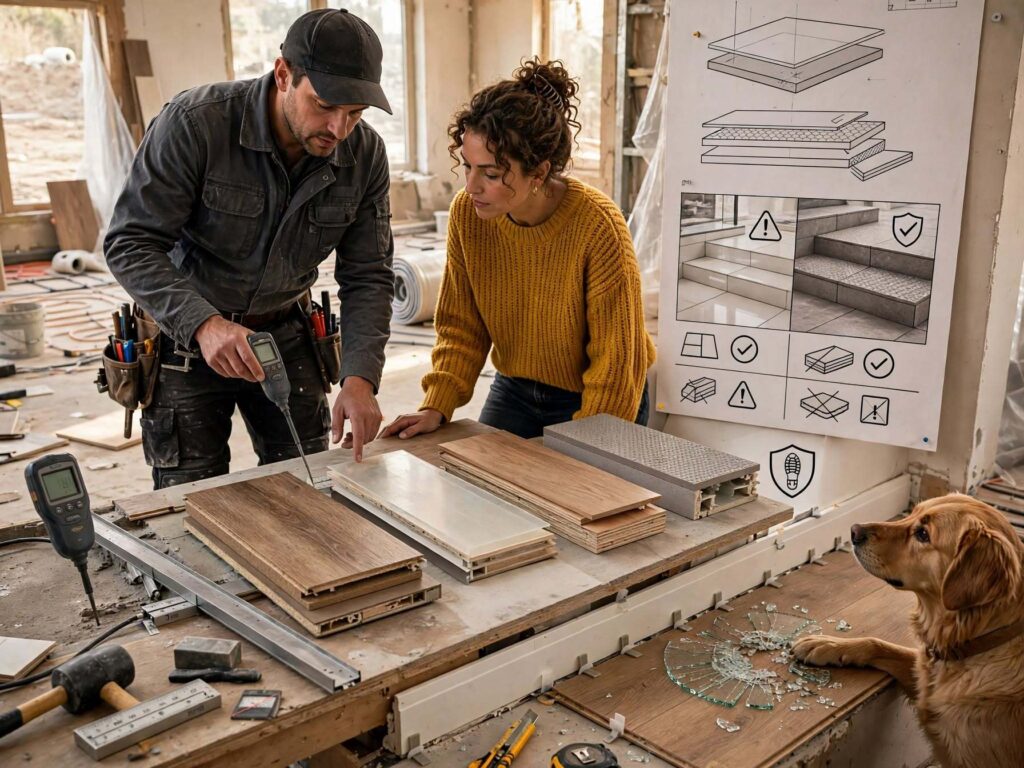
Two warnings. First, “installed cost” in the US often includes only basic prep, and demolition of old flooring (typically $1 to $3.50 per square foot) and subfloor repair are extra. Second, in India, quoted rates may exclude 18 percent GST, skirting, polishing and adhesive, so always ask what a rate includes.
Solid Hardwood
The classic. Planks cut from a single piece of timber, usually oak, maple, teak or walnut, nailed or glued to the subfloor.
Why people love it. It looks and feels like nothing else, it adds warmth and character, and it can be sanded and refinished several times, so a well-kept floor can last decades, even a century. It’s repairable, and it tends to be well regarded by buyers.
What goes wrong. It hates moisture and big humidity swings, because timber swells and shrinks. It can dent and scratch, and it’s among the most expensive floors, around $8 to $25 per square foot installed in the US. In humid or termite-prone regions, you need properly seasoned and treated timber and good ventilation under the floor. It’s also generally not suited to damp slabs or bathrooms.
Use it in: living rooms, bedrooms, dining rooms and studies where the climate is stable. Avoid it in: bathrooms, laundry rooms, basements, and kitchens with a lot of splashing.
A hardness note. Timbers are ranked on the Janka scale (oak around 1,200, maple around 1,450, some tropical hardwoods much higher). A harder wood dents less, but hardness isn’t everything: moisture stability matters just as much.
Engineered Wood
A real hardwood veneer glued onto a plywood or fibreboard core. It’s the more stable cousin of solid wood and the type most people should consider first.
Pros. It looks like solid wood because the top layer is real timber, it moves less with humidity, it can be laid over concrete and used with most underfloor heating, and it comes in wide planks that would be unstable in solid wood. It’s also usually cheaper than solid, around $6 to $18 per square foot installed in the US.
Cons. The veneer’s thickness decides how many times you can sand it. A 2 to 6 mm wear layer allows maybe one to three refinishes, while a thin 0.6 mm veneer can’t be sanded at all. Water damage still ruins it, and cheap ones with thin veneers look and wear like a photo.
Use it in: living areas, bedrooms, hallways and rooms over underfloor heating. Be careful in: kitchens and entries, unless it’s rated for them and you wipe spills promptly.
Tip. Ask for the veneer thickness in millimetres, not just “engineered”. It’s the number that tells you how long the floor will last.
Laminate
A photographic layer of wood, stone or tile printed onto a fibreboard core, sealed under a hard, clear wear surface.
Pros. It’s cheap (roughly $3 to $8 per square foot installed in the US, and similar in India’s lower tier), scratch-resistant, quick to fit with click-lock planks, and it comes in a huge range of looks. For a rental or a budget refresh it’s hard to beat.
Cons. It isn’t truly waterproof, because swelling at the edges is the usual failure. It can sound hollow underfoot, and it can’t be refinished. Cheaper ranges can emit more formaldehyde, so choose products certified to a low-emission standard (look for E1 in Europe or CARB P2 in the US).
Check the AC rating. European abrasion classes run from AC1 to AC5, with AC3 suitable for general home use and AC4 to AC5 for heavy traffic. For a busy hallway, choose AC4 or above.
Use it in: bedrooms, living rooms, offices and dry areas. Avoid it in: bathrooms, laundry rooms, and damp basements.
Vinyl Plank and Tile (LVP, LVT, SPC)
Modern vinyl is a different thing from the sheet vinyl of old kitchens. Luxury vinyl plank or tile prints a realistic design under a clear wear layer, and rigid-core versions (SPC, WPC) add a stable, dense core.
Pros. It’s waterproof, quiet and a bit soft underfoot, easy to install, durable and comes in convincing wood and stone looks. It’s the fastest-growing flooring type in several markets, often at roughly half the installed cost of hardwood, about $4 to $12 per square foot in the US and around ₹100 to ₹220 in India.
Cons. It’s plastic (PVC), with the environmental questions that raises, and cheap versions can dent, fade or look artificial. It can’t be refinished. Some products can discolour in strong sun or from rubber mats, and you need a flat subfloor, since vinyl telegraphs bumps.
What to check. The wear layer is the clear top coat that takes the abuse. Common home products run around 12 to 20 mil (roughly 0.3 to 0.5 mm), with 20 mil or more for heavy traffic. Rigid-core SPC resists dents better than soft flexible vinyl.
Use it in: kitchens, bathrooms, basements, entries, kids’ rooms. Be careful with: direct strong sun, very hot climates in unshaded glazing, and underfloor heating beyond the maker’s limit.
Ceramic, Porcelain and Vitrified Tile
The workhorses of wet rooms and hot climates, and the dominant floor in much of India and the Middle East.
Pros. Tile is waterproof, hard-wearing, easy to clean, stays cool in summer and works well with underfloor heating. It can last decades. In India, vitrified tiles have largely replaced natural stone for floors in houses and offices, because they’re cheaper, more consistent and easier to maintain. Prices are roughly $5 to $15 per square foot installed in the US, and about ₹55 to ₹130 for ceramic and ₹90 to ₹220 for vitrified in India.
Cons. It’s hard, cold in winter and noisy underfoot, and a dropped glass will shatter. Grout lines stain and need sealing. Installation is skilled work, so labour is a big part of the price, and a poorly levelled floor shows lippage (uneven edges) and cracks.
The vocabulary. Ceramic is a clay body that’s more porous, and better for walls and light-duty floors. Porcelain is denser and less absorbent. In India, vitrified floor tiles are made to a standard (IS 15622) with water absorption under 0.5 percent, and ceramic floor tiles can stain, so for floors choose vitrified. Double-charge tiles have a thicker wear layer and suit foyers and hallways. GVT (glazed vitrified) has a printed glaze layer that offers wide design range, though the pattern can wear in heavy traffic after eight to ten years. PGVT is polished and glossy, and slippery when wet.
Slip resistance matters. In wet areas, choose a textured or anti-slip finish. Slip ratings vary by region: Europe commonly uses R ratings (R10 to R11 for wet barefoot areas), and the UK uses a pendulum test value of 36 or more for low slip risk. Our accessible bathrooms guide explains slip-resistance and drainage in more detail.
Use it in: bathrooms, kitchens, entries, balconies (frost-rated for cold climates), utility rooms and hot, humid regions. Be careful with: bedrooms in cold climates, and glossy tiles on steps and ramps.
Natural Stone: Marble, Granite, Kota, Slate and Limestone
Beautiful, heavy, individual, and a lot more particular than a tile.
- Marble. Elegant, cool and luxurious, but soft, porous and stain-prone. Turmeric, acids, oil and red wine mark it, and it scratches. It needs sealing and polishing. Imported Italian marble costs several times more than domestic Indian marble, with Italian slabs often quoted at hundreds of rupees per square foot for the material alone.
- Granite. Hard, durable and heat- and scratch-resistant, so it’s good in busy areas.
- Kota stone. A fine-grained limestone from Rajasthan, much used in India for its low cost (often ₹70 to ₹150 installed), durability and cool, matte surface.
- Slate. Natural, textured and good for slip resistance, but can flake.
- Limestone and sandstone. Soft, warm tones, but porous.
Pros. Natural stone is extremely durable, lasts for generations, stays cool in hot weather, and each slab is unique. Cons. It’s heavy (check the structure), cold in winter, needs sealing and regular care, can be slippery when polished and wet, and costs a lot, since laying and polishing on site adds a few tens of rupees per square foot even before the material. Installed stone often runs past ₹200 to ₹400 per square foot in India and $10 to $30 or more per square foot in the US.
Use it in: hallways, living areas in hot climates, verandas, courtyards. For a courtyard or shaded veranda, our courtyard house design guide explains how pale stone floors help cooling. Avoid it in: kitchens, if you can’t live with stains, unless you choose a dense, sealed granite.
Polished Concrete and Screed
The industrial look: the structural slab, or a thin topping, ground, densified and sealed to a sheen.
Pros. It’s hard-wearing, low-maintenance, works with underfloor heating and has a clean modern look. It uses what’s already there, so it can be cost-efficient, around $5 to $16 per square foot in some US guides.
Cons. It’s hard, cold and echoey, it can crack, it stains if poorly sealed, and it’s tough to repair invisibly. It’s also unforgiving if the slab wasn’t designed to be exposed. Plan joints and sealing early.
Use it in: open-plan living areas, studios, garages, workshops, cafés. Be careful with: bedrooms in cold climates, and noise in flats.
Terrazzo
Chips of marble or stone set in cement or resin and polished smooth. A long-lived floor with a distinctive look, and part of the traditional character of many older homes in India and Italy.
Pros. Very durable, repairable and easy to clean, with lots of design possibilities. Cons. It needs skilled labour, can crack, and is hard and cold. Modern resin versions are lighter and more flexible. It suits entry halls, living rooms and public spaces.
Carpet
Soft, warm and quiet. In cold climates and in bedrooms, nothing beats it for comfort.
Pros. It’s warm underfoot, absorbs sound (excellent in flats and for stairs), cushions falls and is relatively cheap, about $3 to $8 per square foot installed in the US. Cons. It traps dust, stains and allergens, can’t be used in wet areas, and wears out in 5 to 15 years. In hot, humid regions, it holds moisture and invites mould and mites, so it’s rarely a good idea there.
Fibres. Wool is resilient, naturally stain-resistant and expensive. Nylon is durable and good in traffic. Polyester is soft and colourful but crushes sooner. Choose a dense pile and a good underlay.
Use it in: bedrooms, home offices, stairs, media rooms in dry climates. Avoid it in: kitchens, bathrooms, entries and humid regions.
Cork
Harvested from the bark of cork oak trees without cutting them down, and made into tiles or click-lock planks.
Pros. It’s warm, soft, quiet, naturally resistant to mould and insects, a decent insulator and renewable. Quality, sealed cork can last 20 years or more. Cons. It dents under heavy furniture, can fade in strong sun, needs resealing, and isn’t suited to very wet areas. It works well in bedrooms, studies, playrooms and kitchens that are sealed carefully.
Bamboo
Technically a grass, bamboo is turned into strips and pressed into planks.
Pros. It grows fast, can be hard, and it comes in many looks. Cons. Quality varies enormously, cheap products can warp, dent or release glue emissions, and it doesn’t like moisture. Choose a reputable maker, check the emissions rating, and treat it like engineered wood. It suits living rooms, bedrooms and studies.
Linoleum, Sheet Vinyl and Others
Linoleum is made from linseed oil, cork dust and jute, and it’s durable, biodegradable and naturally antibacterial, though it needs sealing and can be fussy to lay. Sheet vinyl is the cheapest waterproof floor, around $2 to $5 per square foot, and works for utility rooms, but can look dated and dents. Epoxy and resin floors suit garages and modern interiors, though they need expert installation, and a poorly prepared base will fail.
Which Floor for Which Room
| Room | Best choices | Avoid | Why |
|---|---|---|---|
| Living room | Engineered wood, hardwood, tile, stone (hot climate), LVP | Thin laminate if heavy use | Looks, comfort, long wear |
| Bedroom | Carpet (dry climate), engineered wood, cork, LVP | Cold, hard stone in cold climates | Warmth and quiet. See our small bedroom design ideas for layouts and rugs |
| Kitchen | Porcelain tile, LVP, sealed concrete, dense stone | Solid wood, laminate, marble | Spills, grease, heat |
| Bathroom | Anti-slip porcelain, vitrified, LVP | Wood, laminate, carpet, polished marble | Constant water, slip risk |
| Entry / mudroom | Porcelain, slate, stone, heavy-duty vinyl | Carpet, thin laminate | Dirt, water, grit. See our mudroom design guide |
| Basement / ground floor on a damp slab | LVP, tile, sealed concrete | Solid wood, laminate | Moisture from below |
| Stairs | Carpet, hardwood, vinyl with nosing | Slick polished tile | Grip and noise |
| Balcony / terrace | Frost-rated or anti-slip tile, stone, deck tiles | Indoor tile, wood without treatment | Weather, drainage |
| Home office | Carpet tile, engineered wood, cork | Hard floors with a rolling chair, unless protected | Noise, comfort |
| Kids’ room | Cork, LVP, carpet, rubber | Slippery polish | Soft landings, cleaning |
| Garage | Epoxy, sealed concrete | Wood, carpet | Oil, tyres |
The Hidden Part: What Goes Under the Floor
Most floor failures have nothing to do with the material.
- Check moisture. On a concrete slab, test for moisture before laying wood, laminate or vinyl, and use a damp-proof membrane where needed. Moisture from below warps wood and lifts glue.
- Check flatness. Click-lock floors typically want the base flat to within about 3 mm over 2 metres, and tile needs a well-prepared, level bed. A floor laid on a wavy base will creak, gap or crack.
- Use the right underlay. It adds comfort, takes up minor irregularities and cuts sound, and it matters in flats. Many leases require acoustic underlay. Our home soundproofing guide explains impact noise and what works.
- Leave expansion gaps. Wood, laminate and bamboo expand and contract, so leave a gap (often 10 to 15 mm) at walls, covered by skirting.
- Plan the height. A new floor raises the level, so check door clearances, thresholds, stairs and the transition to the next room. Matching heights between rooms avoids trip hazards and awkward ramps.
- Underfloor heating. Tile, stone, concrete and engineered wood suit it well. Solid wood, thick carpet and cork can restrict it. Check the manufacturer’s temperature limit.
- Skirting and edges. Budget for them separately, since they’re often not included in a flooring quote.
Climate Changes the Answer
The same floor behaves differently in different weather.
- Hot and humid (coastal, tropical, monsoon). Tile, vitrified, stone and good vinyl cope well. Solid wood and carpet are risky, and termites love untreated timber.
- Hot and dry. Stone, tile and terrazzo stay cool underfoot, and engineered wood works with good ventilation.
- Cold. Wood, cork and carpet feel warm, and tile or stone work well with underfloor heating.
- Big seasonal swings. Choose stable engineered products, leave expansion gaps and control humidity.
- Strong sun. Some floors fade. Check glazing and direction, and see our house orientation guide for how light moves through a room.
What Flooring Really Costs
Most price guides give a single figure per square foot. Real quotes are built from parts: material, adhesive or underlay, labour, preparation, skirting, removal of old flooring, delivery, wastage and tax.
In the US, the installed ranges I found are roughly $3 to $8 for laminate and carpet, $4 to $12 for luxury vinyl, $5 to $15 for tile, $6 to $18 for engineered wood and $8 to $25 or more for solid hardwood, with prices varying 20 to 40 percent by region. Removing old flooring typically adds $1 to $3.50 per square foot. A typical 500 square foot project runs from about $1,500 to well over $7,000 depending on material.
In India, indicative installed rates run around ₹55 to ₹130 per square foot for ceramic, ₹70 to ₹150 for Kota or Tandur stone, ₹90 to ₹220 for vitrified tile, ₹100 to ₹220 for laminate or vinyl, and well above ₹200 to ₹400 for granite and marble, before you add polishing (around ₹20 to ₹60 per square foot on site), skirting and 18 percent GST. Imported Italian marble can cost several hundred rupees per square foot for the slab alone.
Order extra. Buy about 10 percent more material for straight layouts, and 15 percent for diagonal patterns or awkward rooms, so you have spares and can cover cuts.
Think in cost per year, not per square foot. A $12 per square foot hardwood that lasts 30 years and can be refinished costs less per year than a $5 floor you replace in ten. That isn’t always the right comparison, since you might sell in five years, but it’s worth doing.
You can see how Archtra plans and details finished homes through the project pages, and our guide to architectural designs and what they cost explains how a brief becomes a plan and a budget.
For ideas on how different floors look in finished rooms, there’s a wide selection at https://archtra.com/our-portfolio/ to browse whenever you like.
Add 10 to 15 percent for surprises, especially if the old floor comes up to reveal damp, an uneven slab or rotten boards.
Choosing by Household
- Families with young children. Soft or forgiving surfaces (cork, LVP, carpet in bedrooms), and easy-to-clean floors in eating areas.
- Pets. Scratch-resistant and waterproof: porcelain tile, LVP with a thick wear layer, sealed concrete. Avoid soft wood and thin laminate.
- Allergies. Hard, smooth floors are easier to clean, though evidence on carpet and allergies is mixed, so ask your doctor if it matters.
- Older people or limited mobility. Choose non-slip, glare-free, level floors with no thresholds, and avoid thick rugs that catch feet. Our accessible bathrooms guide covers slip resistance and level access.
- Rentals and short stays. Laminate or LVP keeps costs low and installation quick.
- Long-term homes. Invest in the floors that are hardest to change, such as tile, stone and engineered wood.
Mixing Floors Without Making a Mess
Most homes use two or three types. A few rules help it look intentional.
- Keep a consistent flow in open-plan areas. Use one floor through living, dining and kitchen, or change at a natural boundary.
- Change at doorways, not in the middle of a room.
- Match heights at transitions so you don’t need ugly thresholds.
- Keep the tones related. Different materials in similar colours blend, while wildly different ones clash.
- Limit to three. Wood or LVP in living areas and bedrooms, tile in wet rooms, and a durable floor at the entry is plenty.
If you’re thinking about how floors work with furniture and rugs, our living room layout ideas and kitchen layouts guides explain how to plan around them.
Mistakes I’d Steer You Away From
Choosing a floor from a tiny sample under shop lighting. Skipping the moisture test. Laying a click floor on a wavy base. Using solid wood or laminate in a bathroom. Polished tile in a wet area. Forgetting the height change at doors. Ignoring acoustic rules in a flat. Choosing the cheapest quote without asking what it includes. Not ordering spare material. Forgetting skirting. Putting a glossy floor where children run in socks. And buying for the photograph instead of the Tuesday morning spill.
If you’re planning a floor for a home you can’t visit often, ask for large samples, a written specification (material, thickness, wear layer, underlay, preparation) and a 3D view before you order. Our 3D visualization and walkthroughs let you see how a floor looks with your furniture and light, and the relocation guide is useful if the floor is part of a bigger move.
Working With a Designer
For a simple floor swap in one room, a good fitter is often enough. If you’re renovating a whole home, dealing with damp, levelling, underfloor heating, stairs or changing levels, a designer will plan the floors, finishes and transitions as one system. You can contact the Archtra team, read about the studio, explore our services and interior architecture work, check the FAQ page or browse the blog.
Final Thoughts on Types of Flooring
Start with the room’s moisture, traffic and base, then pick the material that suits it: tile or vinyl in wet rooms, engineered wood or cork in living areas, carpet in cold-climate bedrooms, stone or vitrified tile in hot ones. Check the wear layer, the slip rating, the veneer thickness and the subfloor before you check the colour. Compare cost per year, not just per square foot, and ask what a quote includes. The best types of flooring aren’t the most expensive ones. They’re the ones that suit how you live and still look right in ten years.
Frequently Asked Questions About Types of Flooring
1. What are the main types of flooring?
The most common are solid hardwood, engineered wood, laminate, vinyl plank and tile, ceramic, porcelain and vitrified tile, natural stone, polished concrete, terrazzo, carpet, cork and bamboo. Each has different costs, water resistance, comfort and best-use rooms.
2. What is the cheapest type of flooring?
Laminate, carpet and sheet vinyl are usually the cheapest, often around $3 to $8 per square foot installed in the US, and ceramic and Kota stone are low-cost options in India. The cheapest floor isn’t always the lowest lifetime cost, so consider lifespan and repairs.
3. What is the most durable type of flooring?
Porcelain and vitrified tile, natural stone such as granite, polished concrete and terrazzo are among the most durable, often lasting decades. Solid hardwood can last a century because it can be refinished. Durability also depends on installation and moisture control.
4. What is the best flooring for a kitchen?
Porcelain tile, luxury vinyl plank, sealed concrete and dense stone such as granite handle spills, grease and traffic well. Avoid solid wood and laminate, and think twice about marble, which stains easily. Choose a slip-resistant finish.
5. What is the best flooring for a bathroom?
Anti-slip porcelain or vitrified tile and luxury vinyl are the safest choices, because they’re waterproof and durable. Avoid wood, laminate and carpet, and avoid polished marble or glossy tile, which become slippery when wet.
6. Is engineered wood better than solid hardwood?
Engineered wood is more stable in humidity, can be laid over concrete and suits most underfloor heating, while solid hardwood can be refinished more times and may last longer. Check the veneer thickness on engineered wood, since it decides how many times it can be sanded.
7. Is vinyl plank flooring waterproof?
Most luxury vinyl plank and rigid-core SPC products are waterproof, which is why they’re popular in kitchens, bathrooms and basements. The seams and edges still need to be sealed properly, and moisture from below can cause problems, so check the manufacturer’s guidance.
8. What is the best flooring for hot and humid climates?
Tile, vitrified tile, natural stone and good vinyl cope best. They stay cool and resist moisture. Solid wood, carpet and thin laminate can warp, mould or swell, and untreated timber attracts termites in some regions.
9. Which types of flooring work with underfloor heating?
Tile, stone, concrete and engineered wood work very well. Vinyl and laminate work if the maker approves and temperature limits are followed. Solid wood, thick carpet and cork can limit heat transfer or dry out, so check the manufacturer’s advice.
10. How much flooring should I buy?
Order about 10 percent extra for straight layouts and 15 percent for diagonal patterns or complicated rooms, to cover cuts and future repairs. Check what’s included in a quote, such as underlay, skirting, removal of old flooring, preparation and tax.